Day #2 on our Christmas Countdown is…
A Belemnite!






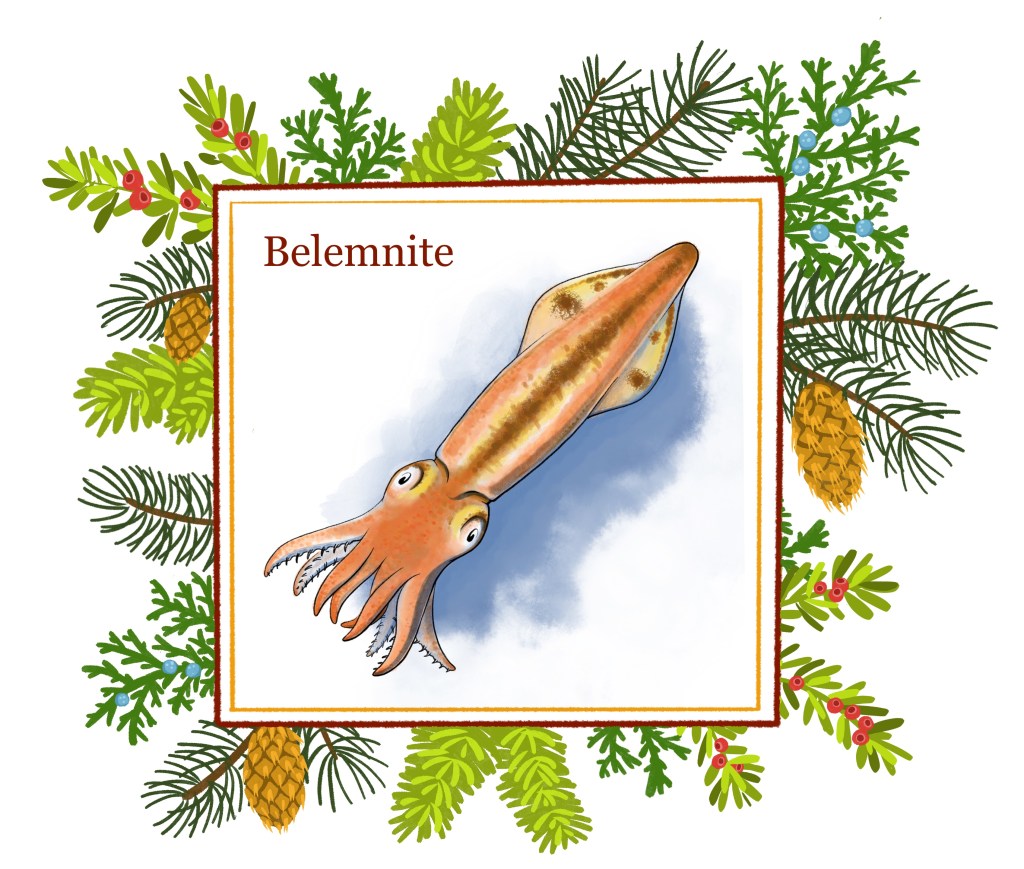
Belemnite: the “Dart”
Belemnites are extinct relatives of squid and octopus, and they look very similar to modern squid. Can you see what makes them different?
The hooks instead of suckers are easy to spot, but the other thing that makes them special is the cone-shaped skeleton inside the spear-shaped part of the body.
It is this skeleton that gave them their name, because humans have been stumbling on these things for almost as long as we’ve been around. They even inspired stories about lightning bolts fallen to Earth, because in some places it’s common to find them after a thunderstorm.
The ancient Greeks were the first to officially describe them, first as Lyngurium (basically lynx pee that had been buried and hardened like amber or petrified dino poop!), but then also as some other type of gemstone or amber. Pliny the Elder, a famous Roman naturalist, author, philosopher, and army commander, was the first to name the unusual “gemstone” a Belemnite. After the ancient Greek word belemnon, which means dart.
A German scientist of the Middle Ages (1546 to be exact) who specialized in studying rocks (or mineralogist), studied the cone-shaped stone and proposed that it was actually a fossil. I find this amazing, because they did not have any fossils of the creature’s soft body until 1844. So in all the time between it was speculated to be the fossil of some sort of sea snail, sea urchin spines, sea cucumber, coral, or the internal shell of something completely different!
In the year 1823, Belemnites (beh-lem-night-eez) was given an official name and description as an extinct cephalopod- the group that includes octopus and squid- after studying the internal shell of cuttlefish. About twenty years later, in 1844, Sir Richard Owen confirmed this by describing the first fossil that preserved the soft body of the squid-like animal.
I find it fascinating to discover the history of fossils and how humans have tried to explain them over time. It paints a wonderful and complex picture of human imagination and ingenuity. First with the creativity of trying to explain something completely unknown and strange, and then the leaps of insight that come when people carefully study the natural world.
What other amazing discoveries will we make in the future? And how do fossils inspire your imagination?
See you tomorrow for day 3 of the Critter Christmas Countdown!
 Pete's Paleo Petshop
Belemnites are interesting prehistoric cephalopods and it’s good that for today, you focused on the type genus, Belemnites.
For today, I will dedicate to a different prehistoric cephalopod that I hope you’re not covering: Tusoteuthis. Tusoteuthis is a prehistoric cephalopod from the Cretaceous. Often referred to as a squid, it is now considered to be more related to octopuses. As of now, only one specimen is truly recognized under this genus: a poorly preserved specimen from Kansas. As the specimen is fragmentary, it is hard to determine if other referred specimen belong to the genus. A number of specimens have been suggested to be instead classified under the separate genus Enchoteuthis
Tusoteuthis was thought to be an active predator, and fossils described as Tusoteuthis were found to be preyed on by other animals, particularly the many predatory fish of the West Interior Seaway.
Names I’d pick for each if I could decide:
Belemnites: Belen
Tusoteuthis: Tulio
LikeLike
Extra Note: Don’t forget to reply to my comment(s) from yesterday’s post whenever possible.
LikeLike
Thank you, I’m glad you like the little guy. The illustration itself is not Belemnites proper, since I I based it on a soft tissue fossil (no name attached), and I couldn’t find any soft tissue impressions for the type genus. But it was good to at least give it a shout out. 🙂
Squidy critters are fun and I always like to see how varied they are, so Tusoteuthis is pretty cool. 🙂
LikeLike