Day #6 on our Christmas Countdown is…
FRUITAFOSSOR!






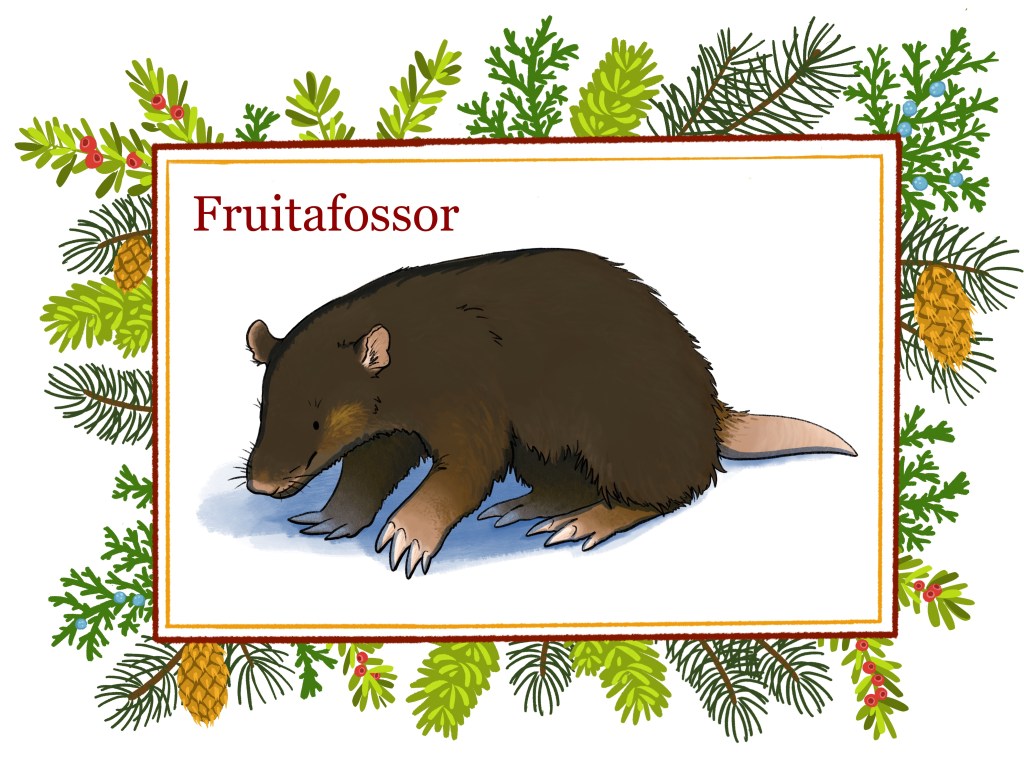
Fruitafossor: the “Digger from Fruita”
Fruitafossor was a highly specialized lover of insects that lived in Late Jurassic North America, and only grew to about the size of a chipmunk. Depending on what sort of screen you are browsing on, the illustration above is not too far off from life size!
This little critter is a great example of how varied and specially adapted mammals could be during the dinosaurs’ long reign. Large claws, strong arms, and a rather stiff backbone are seen in animals like armadillos today. The teeth are also very much like those of an armadillo or aardvark, so this critter was very good at digging for insects, and possibly specialized for finding insects that live in colonies.
Ants didn’t appear until the Cretaceous Period, so it’s possible that Fruitafossor’s primary source of food were termites, or something very much like a termite. It’s also very possible that Fruitafossor had to dig into hard mounds to reach them just like aardvarks and anteaters today, because some trace fossils found in the Morrison Formation suggest that termites may have already been building complex structures. These ichnofossils (fossils that leave traces of animal behavior, but not the animal itself, like footprints, burrows, or poop) show the same tiny, hard, pebbly structure of many modern termite mounds. These are made by chewing up mouthfuls of soil, leaves, wood (your house), and mixing this up with their saliva until it forms a substance that’s about as hard as concrete.
Animals like anteaters, armadillos, aardvarks, gophers, and Fruitafossor have incredible strength in their arms to tear apart hardened soil. They use a technique called scratch digging, which is when they use their shovel-like front paws to move soil, and then kick it out of the way with their back feet.
Imagine this little guy moving with short, fast, shuffling steps. Shuffle shuffle, pause, snuffle in the dirt and scratch at it for a few quick strokes, then shuffle, snuffle, repeat.
A few critters to watch out for are the legged snake Diablophis, the house cat-sized croc Fruitachampsa, and the small heterodontosaurid Fruitadens. That small dinosaur may enjoy munching on ferns, but little Fruitafossor won’t take any chances, just in case.
A few much bigger neighbors thundering overhead were Stegosaurus, Ceratosaurus, and Camarasaurus.
Learning more about the smaller, often-overlooked creatures like the mammals and insects that lived alongside the dinosaurs we know and love helps to bring their world to life. What sort of creatures flew overhead or crawled beneath their feet? What sort of plants may have been good to eat, or should be avoided?
What are some of your favorite overlooked critters and what dinosaurs did they live alongside? How do you think they would fit in their habitat?
See you tomorrow for day 7 of the Critter Christmas Countdown!
 Pete's Paleo Petshop
Real life Paradox Sandshrew , and a very floofy one at that.
LikeLike
Or at least I could you it as a basis for the Past Paradox of Sandshrew.
LikeLike
This is me replying to myself by the way
LikeLike
Good to see another non-Cretaceous animal get a CC entry (hoping for the Triassic to get spotlight soon enough). Fruitafossor is quite an interesting early mammal, and I had no idea about this scratch-digging behavior. I honestly feel like smaller non-dinosaurian organisms shouldn’t be completely overlooked.
My entry for today will focus on a different mammal, specifically a Cenozoic one from a now-extinct order that first evolved in the Mesozoic (specifically in the Middle Jurassic): Taeniolabis. Taeniolabis was a multituberculate mammal, and this group existed from the Middle Jurassic to the Late Eocene. The genus was coined during the Bone Wars, a large paleontological feud that occurred within the late nineteenth century. A later species would then described more than 100 years later. A notable thing about Taeniolabis is that the type species, T. taoensis, is the largest multituberculate mammal currently known and had a skull of up to six inches (15cm) in length.
And here would be my headcanon names:
Fruitafossor: Frumencio
Taeniolabis: Talulah
LikeLike
Thank you! Yes, I think we can learn a lot about our favorite dinosaurs by taking a look at the smaller critters under their feet. 🙂
Oh, and that is one big not-a-beaver! Of course, the Paleocene has all sorts of awesome giant mammals. 🙂
LikeLike
Hooray for the Morrison Formation!
LikeLiked by 1 person
Thank you! There are many amazing formations full of wonderful animals, but I must admit I’m a bit biased towards my favorite, and I’m glad you enjoy it too. 🙂
LikeLike