Day #10 on our Christmas Countdown is…
Jobaria!






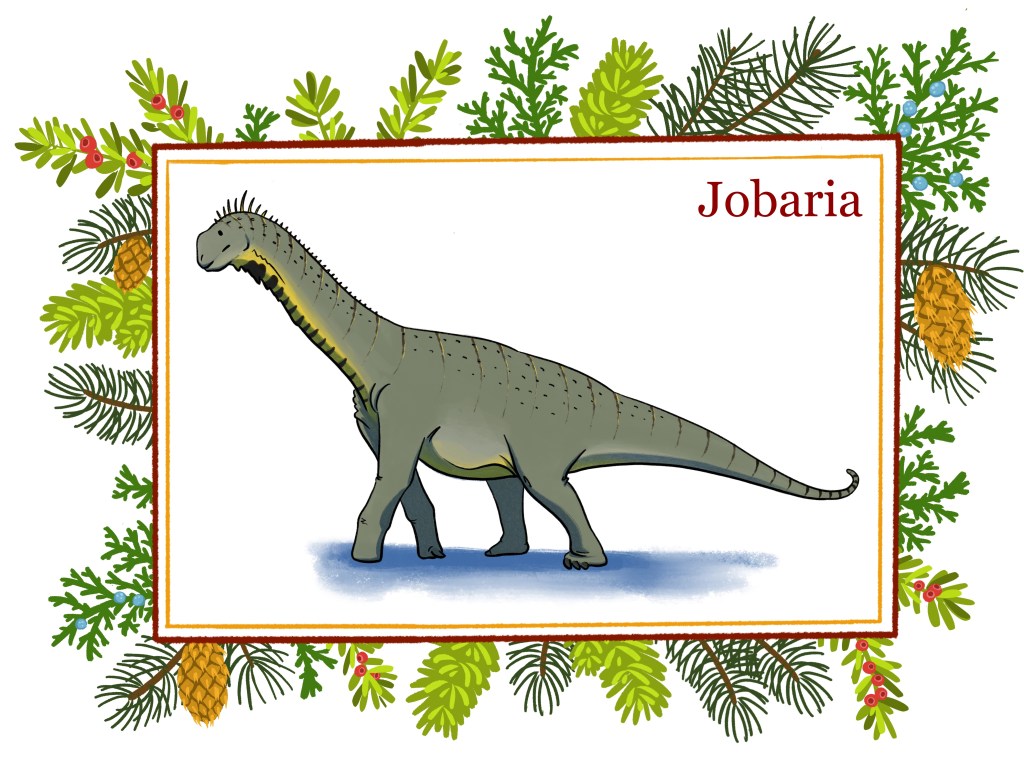
Jobaria: the “Jobar”
Jobaria was a large sauropod from what is now known as the African country of Niger (knee-j-AIR). The name Jobaria tiguidensis comes from both mythology and the area where it was discovered. Jobar is the name of a giant, mythical beast from the legends of the Tuareg, a nomadic people native to the region. While the species name refers to the cliff of Tiguidi, where the bones were discovered.
The amazing thing about this fossil was how beautifully complete it was. 95% of the first skeleton was found, which led to the discovery of even more adults and juveniles in what turned out to be a mass burial site. It’s unsure what led to their deaths, but their beautiful preservation suggest a very fast burial. Possibly a flash flood, since the area was marshy and crisscrossed by many rivers.
With so much of the skeleton complete, we can learn a lot about how it moved. For example, studies were done to compare it to modern elephants to see where it carried most of its weight. Modern elephants have large heads and small tails, so they are more front heavy and carry most of their weight on their front legs. Because of this, the bones of their front legs are thicker and stronger than the back legs.
The opposite is true for Jobaria, so it carried most of its weight on its back legs. With this study, it was proposed that Jobaria could stand on its hind legs even more easily than an elephant. It’s just a matter of rocking back a little and using the thick tail to balance.
Unfortunately, even with beautifully preserved, mostly complete skeletons there can be a few tricky questions.
The Tiouraren Formation in which these fossils were found has been a subject of some debate. Was it Early Cretaceous, or Middle-Late Jurassic?
Why the confusion?
Dating layers of rock and figuring our how old they are sometimes depends on finding fossils of particular plants, fish, shells, etc, that are commonly found only in specific layers of rock. These are known as index fossils. The fish being used as index fossils for this formation were considered to not be a good enough indicator of the formation’s age, especially since all the dinosaurs known from the area seemed to be evidence for a much older time period.
If you want to explore this further, I highly recommend a quick read-through of “Considerations on the Age of the Tiouaren Formation” (click the title for the link).
In short, it appears that dinosaurs like Jobaria and Afrovenator show traits far more typical of dinosaurs from the later part of the Middle Jurassic or the earlier portion of the Late Jurassic.
One question that comes to mind is, what if these dinosaurs are an unusual example of supposedly primitive traits still holding out far longer than in other areas of the world? For example, the “primitive” traits of marsupials and egg-laying mammals in an isolated area like Australia.
Of course one may quickly point out that the heart of Africa is far from isolated, and it is also much more likely that we simply have the age of the rock wrong rather than thinking a small population of dinosaurs would be so different from the norm. Plus the older, more basal traits of these dinosaurs seem to be pretty consistent and far better proof of age, especially compared to the doubtful status of the proposed index fossils.
Do you have any thoughts on this? I would love to hear what you think in the comments!
See you tomorrow for day 11 of the Critter Christmas Countdown!
 Pete's Paleo Petshop
Back of head full of spikes, belly full of leafs, mind full of worries.
LikeLiked by 1 person
I say this because of the look on His/Her face
LikeLiked by 1 person
Now that you mention it, he does look a bit worried. I think he lingered around a particularly tasty tree for a bit too long, and now he’s like, “Where did everybody go?”
He’ll find the rest of his herd soon though. They’re not far.
LikeLike
Remember when I first brought up this dinosaur back in 2018-19? Well, I’m glad it’s finally featured here.
(Also a reminder to at least talk about one thing from the Triassic; no specific genus you’ve covered as of now is from that period and I don’t want you to forget. And I’m also hoping that you don’t repeat any critters featured from last year’s lineup; this note may prevent you from recycling Kentrosaurus)
My owned featured creature will have its entry posted later. And yes, I’ve figured out the alphabetical order idea; specifically about a week ago.
LikeLike
Jobaria’s remarkableness can be divided into two different categories and you covered both; good for you.
The critter I will be discussing today will be Diamantinasaurus, a titanosaurian sauropod from the early Late Cretaceous of Australia. First described and named in 2009, Diamantinasaurus is known from a surprisingly decent amount of fossils. Its discovery was the first of a sauropod in Australia to be named in over 75 years. It was found alongside the remains of Australovenator and Wintonotitan, both of which were also named in 2009. Even more specimens have been described since the initial discovery. One specimen that was described as recently as this year even includes parts of the dinosaur’s skull!
Diamantinasaurus was medium-sized compared to other titanosaurs. Almost all of its right forelimb is known. An embryo discovered in Mongolia shared features of Diamantinasaurus and Rapetosaurus and was intermediate between these two genera. Diamantinasaurus can be distinguished from other sauropods by the overall robustness of its known fossils along with multiple specific features.
Names for each if I could decide:
Jobaria: Jodi
Diamantinasaurus: Matilda
(Also a friendly reminder to look at and reply to the my reply on the 3rd and 5th and the replies from the 6th onward. Part of me is still waiting for you to reply to them, but the other part understands how busy you are, so I get why you aren’t immediately responding, which I’m fine with)
LikeLike
Thank you, I’m glad you like him! 🙂 To be honest I completely forgot about that, I was just choosing from a list of dinosaurs that start with J. There aren’t very many of them that have enough remains to be able to draw them very well.
Lol, I think if I were to draw Diamantinasaurus I would also choose the name Matilda. 😀 Perhaps her pattern would be reminiscent of the patterns you see in aboriginal paintings. That would be cool. I need more Australian and Antarctic critters.
LikeLike