Day #18 on our Christmas Countdown is…
Repenomamus!






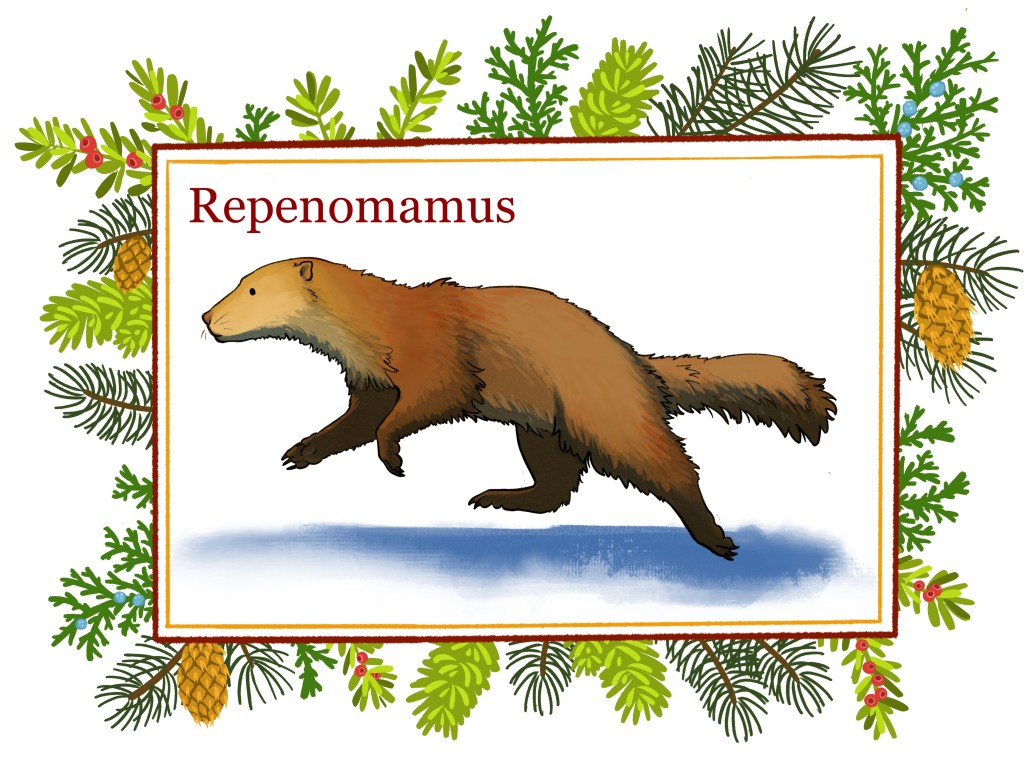
Repenomamus: the “Reptilian Mammal”
Repenomamus was a badger-sized mammal from Early Cretaceous China. The larger of the two species, R. giganticus, was the largest Mesozoic mammal ever found, and could grow to about 3 feet long and weigh a whopping 30 pounds! The adults of the second species, R. robustus, where about the size of a Virginia opossum.
These animals had strong bones and sharp teeth, and would definitely be opportunistic in their food sources. Scavenging was probably common, and small dinosaur remains in the stomachs of some are evidence that they raided the nests of their saurian overlords…but it goes even deeper than that.
A fossil of the smaller Repenomamus robustus was found locked in combat with a Psittacosaurus, an early relative of Triceratops that was about 6 feet long and weighed in at 40 pounds. So not only did Repenomamus kind of look like a badger or wolverine, but it seems to have the tenacity and attitude to match!
Ferocious when on the hunt (even if it only happened once and we just got a miraculously lucky fossil), they seem to be much like other mammals when it comes to raising their young. The shape of their hips suggests that they might have laid eggs like platypus, or had tiny, utterly helpless pups. Perhaps they carried these little ones in a pouch. Perhaps they dug burrows to watch over their young in the way mice care for their blind and deaf pups (also called pinkies, because they have no fur when they’re born).
Ultimately these are fascinating mammals, and hopefully we can continue to find more amazing fossils from the Yixian Formation. Maybe we’ll find some to show that Repenomamus was a marsupial? After all, it is from this amazing formation that we get amazing fossils like the feathered Yutyrannus, the beautifully preserved Psittacosaurus with its quills and skin pattern, and the fluffy Sinosauropteryx with its banded tail.
See you tomorrow for day 19 of the Critter Christmas Countdown!
 Pete's Paleo Petshop
Where is the post for the 19th? I hope you don’t forget it (thoughts on this post will come later; also I’m waiting for replies for my comments on the 3rd’s and 5th’s posts in addition to those from the 13th to the 17th; this is just a friendly reminder by the way).
LikeLike
(Sorry about me appearing a bit rude in the original comment. I’ve calmed down and it appears you’ll simply be doing later entries later each day)
Regarding this entry, it’s good to see Repenomamus get the spotlight. It was impressive for its relationship with the dinosaur Psittacosaurus, which I very much appreciate. Good to see your analysis and I love this post too.
For the 18th, I will bring up Glacialisaurus, a basal sauropodomorph (specifically a massospondylid) dinosaur from the Early Jurassic of Antarctica. Known from two specimens collected in the early 90s, Glacialisaurus is the third non-avian dinosaur from Antarctica to be named, after Cryolophosaurus and Antarctopelta. It was distinct from other related dinosaurs from these features: robust medial epicondylar ridge on the lower femur, a robust adductor ridge extending from the upper end of the femoral medial condyle, and a second metatarsal with a front border that is weakly convex in the upper end.
Its fossils, after being collected, were then sent to the Chicago Field Museum and were announced in 1994. Its discovery is important to the study of early dinosaur distribution; it showed that both primitive and advanced nasal sauropodomorphs coexisted in the same area in the Early Jurassic.
Glacialisaurus was part of a formation from Antarctica’s Transatlantic Mountains. The high altitude supports the Jurassic having forests with a diverse range of organisms. It would have lived alongside the large theropod Cryolophosaurus , a crow-sized pterosaur, a rat-sized tritylodont synapsid, two small unnamed sauropodomorphs, and several different plants, including conifers, horsetails, and ferns. Basal sauropodomorphs were the first truly big dinosaurs and the first high-browsing herbivores.
Names for each of I could decide:
Repenomamus: Remus
Glacialisaurus: Gladys
LikeLike
Fearsome momma, still cute but not one to be missed with
LikeLiked by 1 person
Danger Floof
LikeLiked by 1 person