It’s the little things that can make the biggest difference…
How has your year been? I hope things are running smoothly for you and that everything is falling into place for any goals you may have set. If so, then I’m super happy for you, and wish to share these cute little critters as a small celebration for you!
Life is never “easy” though, is it? It has moments of joy and peace, those times that you stepped outside to take out the garbage and paused to take in a breathtaking sunset. Or that quiet space between conversations with a loved one, when you simply embrace the presence of each other’s company.
It’s the accumulation of many of these moments that gather together into something beautiful. Much like it takes single words gathered together to create a wonderful story that moves us, or single brushstrokes to create a beautiful painting that touches our soul. A small thing alone is almost nothing, a moment that might be forgotten in the passage of time. But together, these moments create something great.
Right now I’m only making little things. Quick sketches and tiny cute critters. Each one brings a little smile, but together they bring a warmth and cute loveliness to my day that really makes a difference for me. It’s drawing little things like this that bring me joy when I’m exhausted, and I hope they bring a little smile to your day.
Many of these critters are also tiny in their own way. Some started out as the first in their family to be discovered, small beginnings for a great legacy. Others are known from only a single fossil, the only thing we have to even know they existed in time. And of course some are tiny in size, and could fit inside polished amber set on a ring…
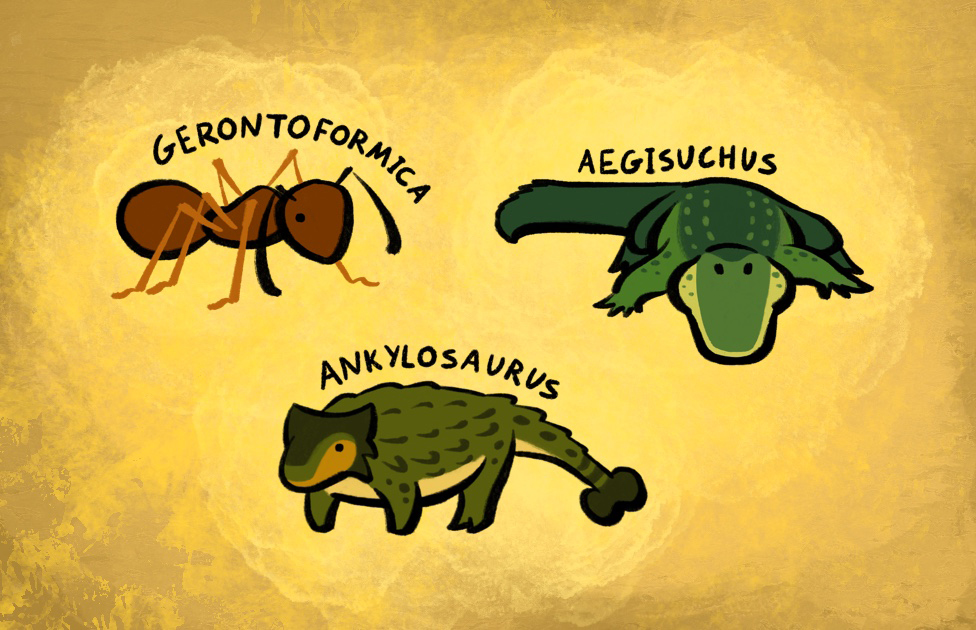
Gerontoformica was an ant from Late Cretaceous Asia and Europe. There are thirteen species known from many individuals beautifully preserved in their amber tombs. The cute critter above is G. occidentalis, from France.
Aegisuchus was a giant crocodilian known for its flat head. It lived in Late Cretaceous Morocco and may have looked like a very large alligator, though it’s a bit difficult to tell for sure since there’s only a partial skull.
Ankylosaurus was a large, heavily armored dinosaur from Late Cretaceous North America. It is the largest of the armored dinosaurs, and the first discovered in its family, the club-tailed Ankylosaurs.

Mellitosphex is known as the first bee, and was discovered in Early Cretaceous Burmese amber. Bees are thought to have separated from wasps sometime in the Jurassic, but this is the first proof of something that is much more bee than wasp.
Brontosaurus was a giant, long-necked dinosaur from Late Jurassic North America. The “thunder lizard” is famous for losing and then regaining its status as a dinosaur separate from Apatosaurus.
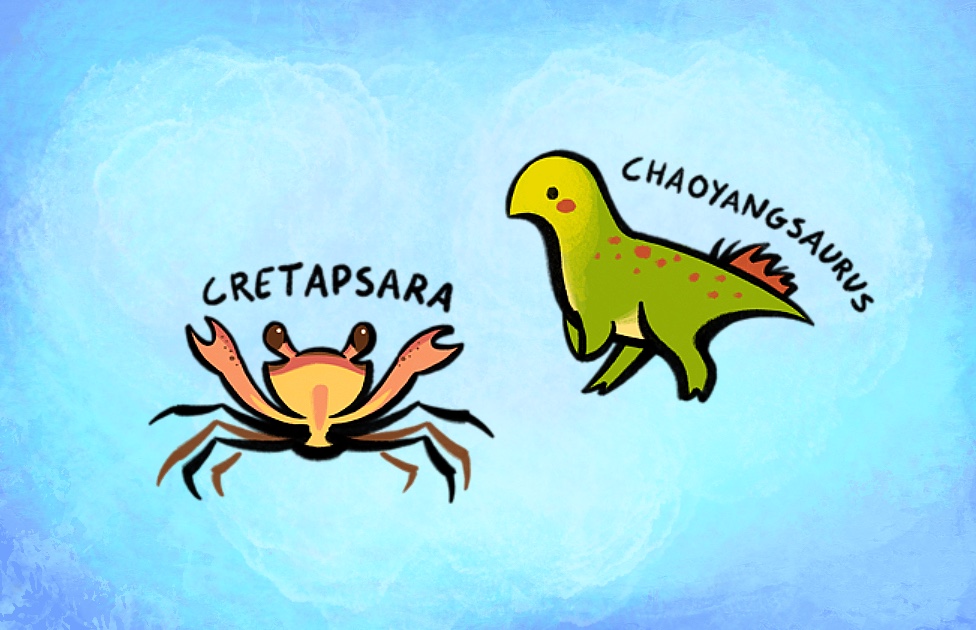
Cretapsara is known as the first crab, and was discovered in Early Cretaceous Burmese amber. It is only a few millimeters wide, and perfectly preserved in amber even with the gills that helped it breathe in water.
Chaoyangsaurus was a small dinosaur from Late Jurassic China. There are only a few bones from the head, neck, and shoulders, but even with so little we can tell that it was an ancient cousin of Triceratops that wasn’t much bigger than a turkey.
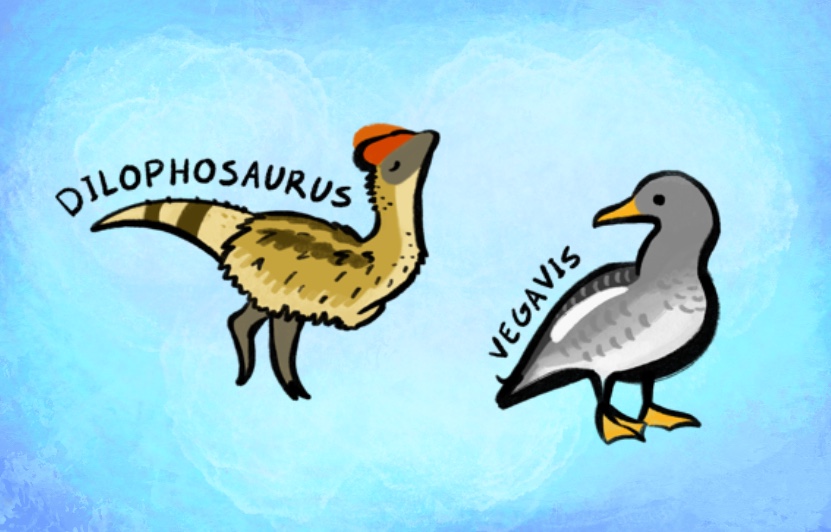
Vegavis was a bird that lived in Late Cretaceous Antarctica, and is often described as the world’s first duck. Fossils show that it may have honked like a goose, but dove after fish like a loon.
Dilophosaurus was the largest predator of its time in Early Jurassic North America. The two crests on its head are now considered to be the support for larger crests of keratin, very much like modern hornbill birds. This made for a very lightweight, and possibly very showy, headpiece.
I hope these cute critters bring a smile to your day as they have mine. I always love an excuse to stick these on things, and I have another idea in mind for them…maybe you can spot the pattern in the critters above?
Thank you for sharing a little of your time with me. Do you have any small moments you would like to share? I would love to hear from you in the comments! I always read them, even if I can’t answer right away.
And the Critter of the Month is…

It’s all about the little things today, and Yi Qi was a pigeon-sized dinosaur from Late Jurassic China. It’s known from only a single fossil, but what a find! It preserves perfect details like feathers of different lengths, and the interesting bone from the wrist that make people think of dragons and bats when we see reconstructions.
I chose to make a speculative reconstruction for mine. Flying squirrels are the only other animals that have the special wrist bone, which is used to support a membrane of skin as they glide.
Since most reconstructions of Yi show a membrane of bare skin, I thought it would be fun to experiment with a thin coating of fuzz. The cheek fluff is also speculative and not shown in fossils.
Chia is a cautious little dinosaur, but also very curious, and she is often quick to warm up to anyone who is friendly (especially if you have a treat). Her favorite sweet treat is maple syrup. Don’t give her honey, because bees won’t be around for millions of years yet and it might make her sick. Technically maple trees aren’t around either, but Pete tested both the raw sap and the maple syrup made from it and they are safe for Chia. She’ll also leap your way for a wriggly mealworm or cricket.
She uses her sharp claws to climb trees, pant legs, cabinets…anything to get higher. Once she has a nice perch, then she wil look around to see if she can find a better one, like your shoulder or head. A mobile perch is even better than one that stands still, because she can see more things that way.
Just before leaping to a new perch, she will bob from side to side and up and down, like a squirrel does before it jumps to a new branch. Don’t worry if she jumps your way! Her claws are only a little scratchy.
See you May 1st for the next Critter of the Month!
Speaking of little, the next dino has a reputation for being small, and possibly cuddly?
Share your guess in the comments! He’ll be one of the critters over on the critter page. 🙂
 Pete's Paleo Petshop