L is for a lazy lobster and a lovely Lambeosaurus…
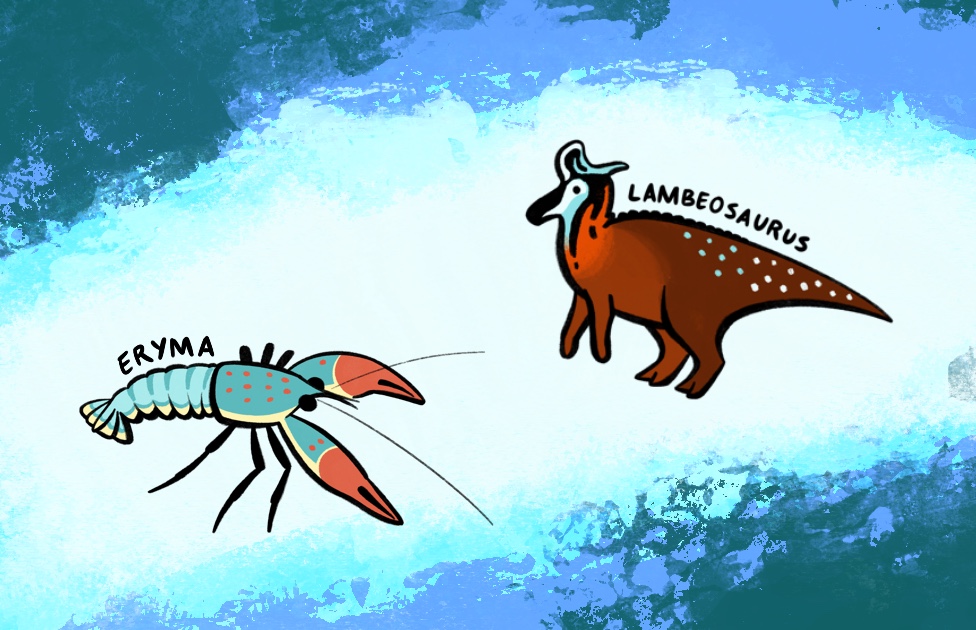
With school days and the busy days of Fall around the corner, let’s just take a moment to enjoy a few more lazy days of Summer with our lobster and lambeosaurus friends.
Lobster-ish critters have been around ever since the Permian, long before dinosaurs ever came. Eryma here is closer to a true lobster, and lived in Jurassic Germany. Maybe it was perfectly safe from island critters like Archaeopteryx and Compsognathus in the lagoons and coral reefs where it lived, but surely it had to watch out for our friend Chum down below!
Eryma is still not quite a “true” lobster yet, those show up in the Cretaceous period. So perhaps Lambeosaurus got to see one.
Lambeosaurus lived in Late Cretaceous North America, most commonly in Alberta, Canada. North America was divided in two by a shallow sea that stretched from Canada all the way down to Texas. Sadly, there doesn’t appear to be any lobsters in the coastal and marshy areas Lambeosaurus lived, but there was one of Chum’s relatives!
But who is Chum? If you’ve been here for a while, then you already know, but if you’re new here, let me introduce you to…
The Critter of the Month!
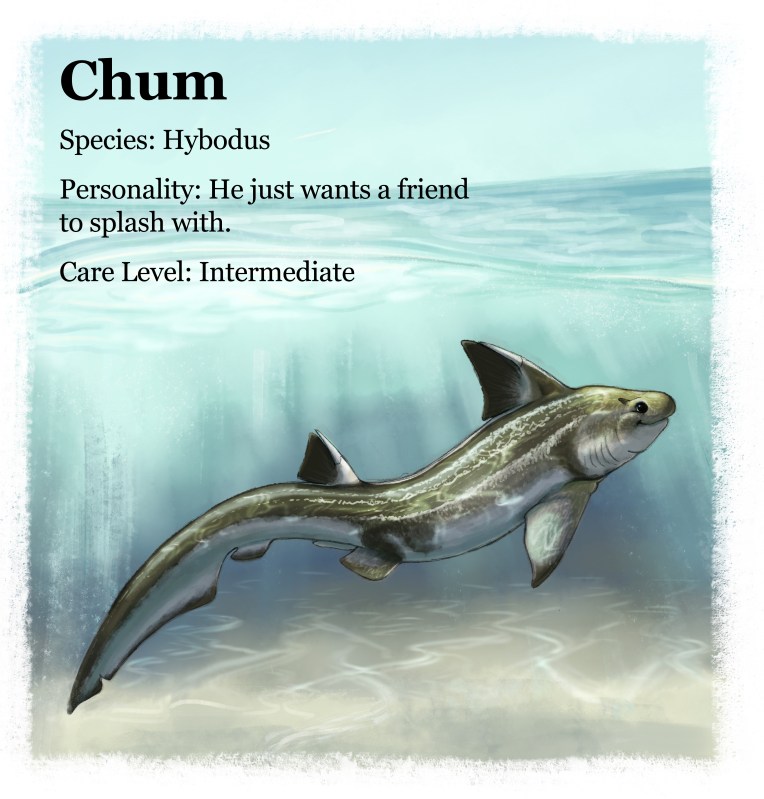
Hybodus was a sharkish critter that ranged far and wide, and was especially common in Jurassic seas. The little hornlets above the eyes and the spines on their fins make them easy to recognize from other sharkish and truly-shark critters at the time. Chum is Hybodus fraasi, the species that lived around the islands of Jurassic Germany.
Meristonoides used to be lumped in the same pile of critters as Hybodus, but was defined as a new critter (or genus) in 2010. It is still a hybodont though.
What does that mean?
Basically, Meristonoides is related to Hybodus in the same way that dogs and coyotes are related to wolves.
Domestic dogs, wolves, foxes, and coyotes are all within the family of Canidae, but each are within their own genera of wolf, fox, or coyote, which then can be broken down further into species. Like red fox, arctic fox, fennec fox, and bat-eared fox.
For our sharkish friend, the family is Hybodontidae, the genera are Hybodus itself and Meristonoides, and the species is Hybodus fraasi. Meristonoides used to be lumped into the genus Hybodus because there were too few fossils known (Hybodus montanensis). But once enough fossils were found that it could be studied more thoroughly, it was discovered to be different enough to be put it in its own genus- Meristonoides. Very much like coyotes are different enough from wolves to separated into their own genus.
Chum here really doesn’t know anything about that though. He just likes to cruise in the rippling sunlight beneath the waves…

See you September 1st for the next Critter of the Month!
This flashy gentleman likes to spend time with his special person. 🙂
Share your guess in the comments! He’ll be one of the critters over on the critter page. 🙂
 Pete's Paleo Petshop