

Author: Patricia Bujard
Critter of the Month: Stegosaurus
Meet Steggy. She might not have very much of a brain, but she makes up for that with the softness of her heart. There’s not a whole lot that’ll surprise her (thanks to Pete’s training), and she’ll let just about anybody clamber on her back. 🙂

I say “just about” anybody, because there was that one time some kids wanted her to be their fortress in a water balloon battle. That was a bit too much for Steggy. But that class of preschoolers who came to visit were adorable. Steggy just sat there and let them climb all over her (Pete stuck a few tennis balls on her spikes, so they wouldn’t be so sharp). The kids had a great time painting stars and hearts on her big plates.
Continue readingFossil Friday: Eopneumatosuchus

Species: Eopneumatosuchus colberti (Ee-noo-ma-toh-soo-kus kol-brr-tye)
What it means: Pneumatic passage crocodile
Other species: None
Where I live: Arizona in the U.S.A.- The Kayenta formation
When to find me: The Early Jurassic period, about 196 million years ago.
My favorite food: I like fish the best! I’m a pisciivore.

The Kayenta Formation lies along the southern border of a great desert every bit as hostile as today’s Sahara. The transition of habitat from desert to savanna creates an environment called the sahel, or sahelian climate. Only the hardiest of cycads and stunted conifers grow here. 
The floodplain is savanna for most of the year. Drought-hardy ferns and cycadophytes replace the grasses and wildflowers of today. Cycad groves and the occasional hardy conifer dot the wide expanse. In the distance, we see the green of tree ferns, conifers, and ginkgo trees that trace the banks of the rivers that crisscross the plains. In the hot, wet summer, the rivers flood and turn the plains to marshes choked by horsetails. In the winter, the northern desert blasts sand and cool, dry wind for months of no rain. 
Habitat alongside the many rivers that crisscross the otherwise arid landscape. Mud and silt accumulate from seasonal flooding and sands blowing down from the deserts to the north. Horsetails thrive in places where we might imagine grass and cattails. Ferns, cycadoids, and cycads are the “bushes” of the Jurassic. Ginkgo trees and tree ferns stay close to the water.
My neighborhood: The Kayenta formation used to be a tropical floodplain, a bit like African savannah today- but no grass or flowers. Ferns cover the open plains, dotted with islands of spiky cycad groves. Rivers crisscross the land with lush tree ferns, ginkgo trees, and conifers. Every year during the wet season the plains turn into a flooded marsh, but the hottest months bring no rain, and the rivers shrink until the plains are almost as dry as the great desert that lies to the north.
A few of my neighbors: I’m surrounded by big and scary dinosaurs like Dilophosaurus, Coelophysis, and Kayentavenator, so I stay out of their way. Sarahsaurus (an early sauropod) and Scelidosaurus (armored dinosaur) are plant eaters, but also pretty tough neighbors. Little Scutellosaurus (small armored dinosaur) is quite a bit more friendly, and if I’m lucky might even join me for lunch. Mostly I hang close to the river with the frogs, turtles, or fellow crocodile cousins. I’ll often see a long-tailed pterosaur flying overhead for insects like beetles, dragonflies, an ancient cousin of the moth, and something called a snakefly.
Fun Facts:
- I look a bit like a crocodile, but I’m not! You might say we’re distant cousins.
- Even though there are very few fossils, paleontologists still try to make a good guess at who my closest relatives are. At first they thought I was related to a crocodile-ish critter called Protosuchus. But the latest theory is that I’m from a family called Teleosaurs. They’re crocodile-ish critters that look a lot like the modern gharial (think croc, but with a super skinny and long snout), and they specialized in living out on the ocean. Some of them look a bit like crocs trying to play shark.
- My name basically describes the bones that the paleontologists found. Eo (Latin for passage/ “to move along” + pneumaticus (latin for “operated with air pressure”). Describing the part of the skull that was found. The tympanic synuses in a crocodilian are at the very back of the head, almost where the neck connects. Suchus is from the Greek souchos, which is Greek for crocodile, and is pretty common in the names of croc-ish things.
Fossil Finds: A few fragmentary fossils from the back of the skull.
References:
“Eopneumatosuchus.” Wikipedia, https://en.wikipedia.org/wiki/Eopneumatosuchus
Fossil Friday: Rhamphinion
Fossil Friday: Dinnebitodon

Fossil Friday: Calsoyasuchus
Fossil Friday: Kayentatherium

Critter of the Month: Castorocauda
Meet Cassie. All she wants in life is to get her feet wet, and perhaps a fish or two. Yes, she would really like fish. Do you have some?

Fossil Friday: Kayentavenator
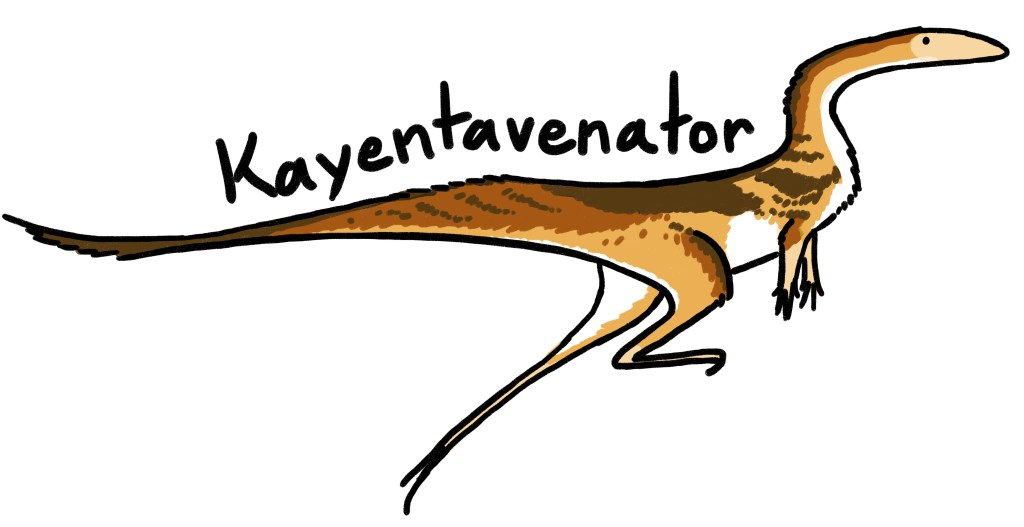
Species: Kayentavenator Elysiae (Kah-yen-tah-veh-nay-ter Eh-lee-see-eye)
What it means: Kayenta hunter
Other species: none
Where I live: Arizona in the U.S.A.- The Kayenta formation
When to find me: The Early Jurassic period, about 196 million years ago.
My favorite food: Meat! I’m a carnivore.


My neighborhood: The Kayenta formation used to be a tropical floodplain, a bit like African savannah today- but no grass or flowers. Ferns cover the open plains, dotted with islands of spiky cycad groves. Rivers crisscross the land with lush tree ferns, ginkgo trees, and conifers. Every year during the wet season the plains turn into a flooded marsh, but the hottest months bring no rain, and the rivers shrink until the plains are almost as dry as the great desert that lies to the north.
A few of my neighbors: Sarahsaurus (an early sauropod) is a tough neighbor. We don’t talk much. But if I’m lucky, little Scutellosaurus (small armored dinosaur) might join me for lunch. Dilophosaurus is the biggest carnivore around, but Coelophysis (smaller meat-eater) is happy to take a few leftovers or join me on a quick chase after frogs, turtles, or a crocodile cousin or two. They like to stay close to the rivers. A long-tailed pterosaur patrols the skies for insects like beetles, dragonflies, an ancient cousin of the moth, and something called a snakefly.
Fun Facts:
- Paleontologists don’t really know how big I could grow, because the only fossils found are of a juvenile, with a lot of growing left to do!
- There’s been a bit of discussion back and forth about what family I should be in. I was first described as a Tetanuran, which is a group that includes dinosaurs like Tyrannosaurus rex, Allosaurus, Ornithomimus, and even birds, just to name a few. Others suggested I was related to the local Coelophysis k. or possibly a young Dilophosaurus, but the Dilophosaurus idea was quickly ruled out since other fossils of young Dilophosaurus have been found, and mine don’t look exactly like them. All in all there are not very many bones to go on, and it can be difficult to figure out where the puzzle pieces go when they are broken and squashed with time!
- A lot of dinosaurs are named after the place they’re found, like me! Kayenta + venator (latin for hunter). Hunter of the Kayenta Formation.
Fossil Finds:
Only one partial, juvenile skeleton with part of the pelvis, some vertebrae, and pieces of hind legs.
Resources:
Gay, Robert. 2010. “Kayentavenator elysiae“, a new tetanuran from the early Jurassic of Arizona” In: Notes on Early Mesozoic Theropods. Lulu Press. p. 27-43. ISBN 978-0-557-46616-0
Mortimer, Mickey. “Kayentavenator is not a tetanurine.” The Theropod Database Blog, Blogger, 30 September 2010, https://theropoddatabase.blogspot.com/2010/09/kayentavenator-is-not-tetanurine.html
Mortimer, Mickey. “Is Kayentavenator a young ‘Megapnosaurus’ kayentakatae?” The Theropod Database Blog, Blogger, 1 October 2010, https://theropoddatabase.blogspot.com/2010/10/is-kayentavenator-young-megapnosaurus.html
These two websites were a huge help in knowing where to start when finding research material and basic information.
“Kayentavenator.” Prehistoric wildlife, http://www.prehistoric-wildlife.com/species/k/kayentavenator.html
“Kayentavenator.” Wikipedia, https://en.wikipedia.org/wiki/Kayentavenator
 Pete's Paleo Petshop