Dinosaurs are such a diverse group of animals that it can be a challenge to sort out who’s who. Theropoda, sauropodomorpha, ornischia…just what does it all mean? For now let’s talk about the group everyone knows and loves (but might not know it), the theropods.
For your convenience and entertainment, here are a couple of helpful Youtube videos I found. These two clips are part of a much longer course about dinosaurs, taught by paleontologist Benjamin Burger. Enjoy! 🙂
Who Were the Theropod Dinosaurs?
How Do We Group the Theropod Dinosaurs?
Warning: This one is much longer, about 30 minutes, so grab your popcorn (theropods are a ginormous group 🙂 ). If you don’t have time (because we’re all busy these days), then just scroll down for the Cliffnotes version.
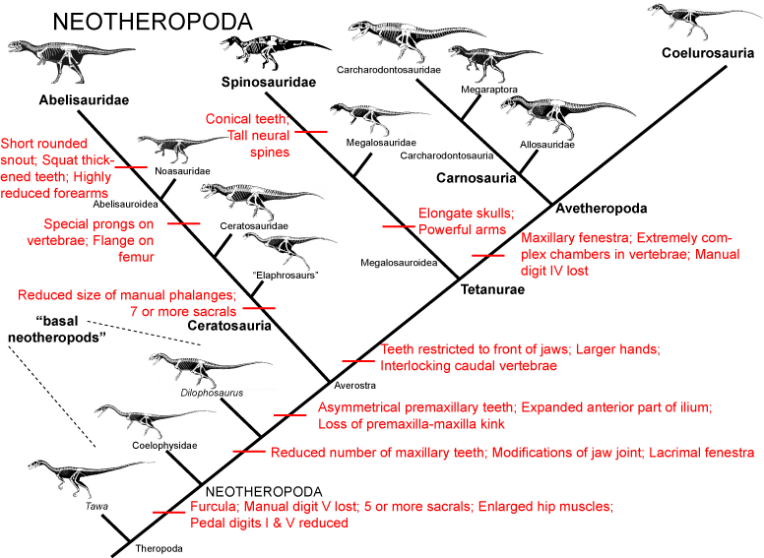
Here’s the Cliffnotes version. Start from the bottom of each picture and work your way to the top.
Fun Fact: the three earliest groups here- Tawa, Coelophysidae,& Dilophosaurus, are proposed to have some sort of fur-like feathers because they are so young in the family tree. Then you don’t see very many feathers at all until Coelurosauria at the top there. Notice how we have critters like Ceratosaurus & Allosaurus here.
Since a number of critters in the middle groups have scaly skin impressions, it’s more likely that these groups were generally scaly, with limited (if any) feathering. There are one or two exceptions, but for the most part there are only bones and a few scaly skin impressions.
Coelurosauria, anything defined as more closely related to birds than Allosaurus. Pretty much everything in this group is more likely to have some sort of feathered integument. Anything from quills, hairlike filaments, or full blown assymetrical flight feathers and “peacock tails”. Yes, even T-rex, those tiny Compsognathus, and Velociraptor. 🙂
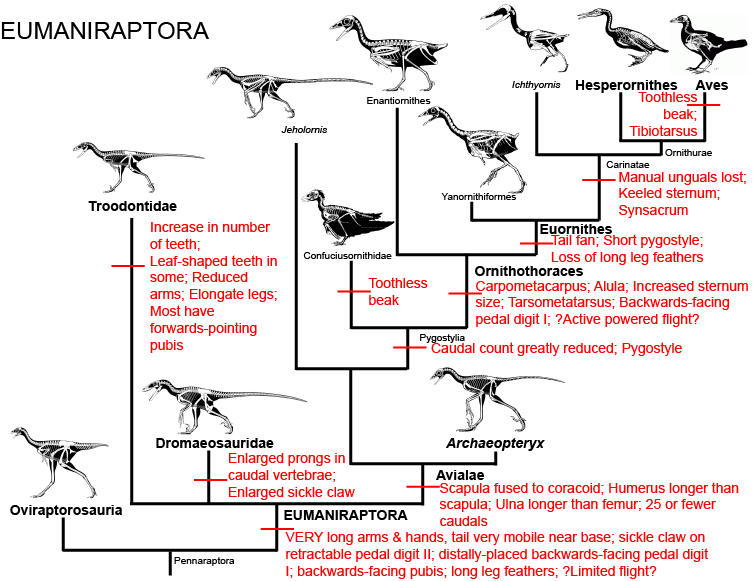
Eumaniraptora- if you saw these walking around, your first thoughts would be “bird” or “very strange bird”. Yes, Jurassic Park franchise, your “velociraptors” are supposed to be very, very birdy. We also get Archaeopteryx here, right at the base of the branch with “true birds” on it. Troodontidae are often considered a sister clade to birds. Think birds with longer tails, and teeth, and you’ve got a troodon. Possibly a bit like an owl, since they’re nocturnal, and have asymmetrical ears like owls do.
Bonus Question: Do you see any of your favorites here? What’s your take on the “enfluffening” of dinosaurs? I’d love to hear your answer in the comments!
PS.- I know the idea of feathered T-rex is quite the hot point for some people, but if that’s you, please remember to be kind.
I’d like to avoid the ALL CAPS AND EXCLAMATION POINTS PLEASE!!!!!1! Nobody likes to be yelled at.
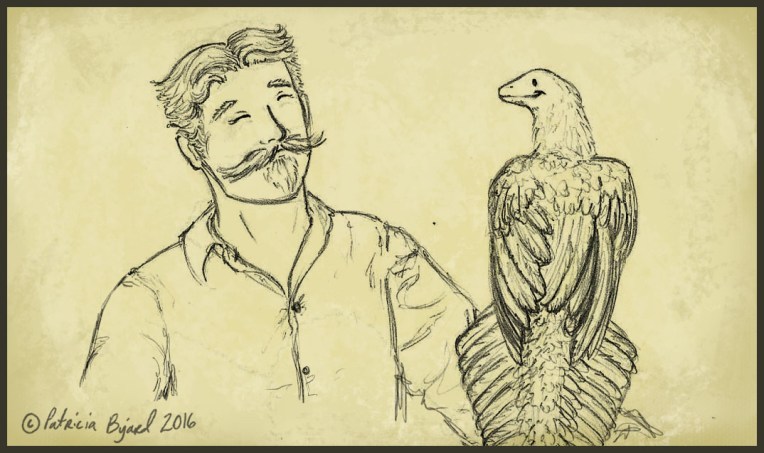
Tango is excited to see you! Say hello Tango (Weeooh! Chip-chip!). He gets pretty excited when he meets new people, so we’ll see if he’ll let us talk for a little while. (weep-weep!)
A rude (but necessary) disclaimer interrupts this post to say…
I do the best I can with research, but I’m a stay-at-home mom who’s always had a passion for all things prehistoric. I’m not a paleontologist, and I don’t have access to all the scientific papers available. But I try my best to keep up to date, and all my illustrations reflect this.
That said, all the drawings in the A&S post series are quick doodles to illustrate a point, with not as much reference as I usually use, so there are plenty of inaccuracies for you to point out for me. 😉
Thank you disclaimer, you can go bother someone else now.
Oh, and one more thing, before you start seeing the name Archaeopteryx everywhere (and trying to pronounce it in your head), here’s a quick pronunciation guide. I wasn’t sure myself, so I thought I’d share it!
1. Ok, So What is He Really?
You probably recognize Tango from just about every book on dinosaurs out there. They tend to announce him as the “first bird” a lot, and 8-year-old me would think, “then what’s a bird doing in a dinosaur book?”
So what is he, a dinosaur or a bird?
Well if you read last week’s post on birds, then of course you might say he’s a dinosaur, since all birds are dinosaurs anyway. But we’re being more specific this time. 🙂
So let’s get into something called cladistics.
To put it simply (partly for my own benefit because I’ve just started getting my hands dirty with this stuff)…
cladistics is how scientists determine where an animal goes on the family tree, and how we explore animal’s relationships with each other. Animals in any particular group are determined to have shared traits and characteristics, and must therefore have a common ancestor.
For example. All cats, wild and domestic, have a number of traits that are the same, so then they must have a single common ancestor that gave them all those traits. Very much how your great grandmother passed down her characteristics to her daughter, grand daughter, and great-granddaughter. 🙂
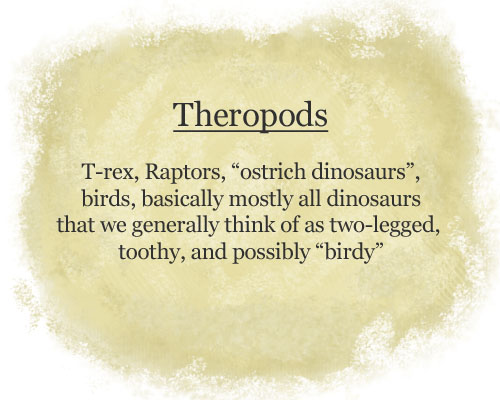
I’ll start off with a group of dinosaurs called Theropods. They’re the ones we typically think of as walking on two legs, and generally meat-eaters, like T-rex. 🙂
Nestled inside the Theropod box are many groups. You can think of them as smaller boxes inside the big box. The box that we’re taking out of the Theropod box will be a group called Coelurosaurs (seel-ooh-row-saurs).
Most of the critters in this group are possibly feathered, and include the “ostrich dinos”, “velociraptors”, T-rex, and mostly all the animals we would think are birds at first glance.
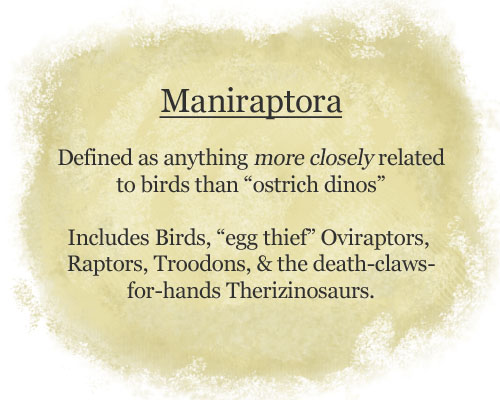
Inside the Coelurosaur box are other boxes, including the one with T-rex inside it. But as much as I like T-rex, we’ll be ignoring his box for now and looking at a box labeled “Maniraptora”.
This box has animals that are more obviously bird-like. If we were to see them in life (vs. the Jurassic Park version) we would think “bird” or “very strange bird”. Very strange (and giant) when it comes to Therizinosaurus, but that’s a subject for another day. 🙂
Inside the Maniraptora box there are more boxes. These boxes get reorganized about twice a year, because now things start getting a little difficult when it comes to separating true birds from non-avian dinosaurs.
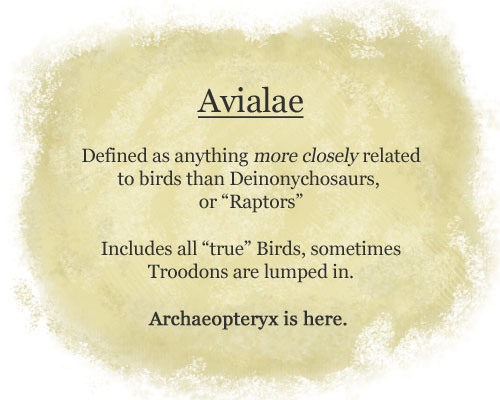
We’ll find Archaeopteryx in a box labeled Avialae.
This box includes all modern birds and their direct grandparents and great-great-grandparents. It also includes the toothy birds, and sometimes Troodontids (think mini raptors, but even more “birdy” and kinda like owls).
Whew! Thank you for sticking with me for all that. 🙂
The final verdict according to the family tree…
Archaeopteryx is a bird. 😀
And yes, it’s a dinosaur too, because birds fit in the “Dinosaur” box.
2. But is He the First?
Tango’s gotten a lot of press over the years as the “first bird”, but is he really the first? It depends on if there was another dinosaur as closely related to modern birds as possible, but earlier in the timeline.
And it turns out there’s another one that’s earlier in the timeline…
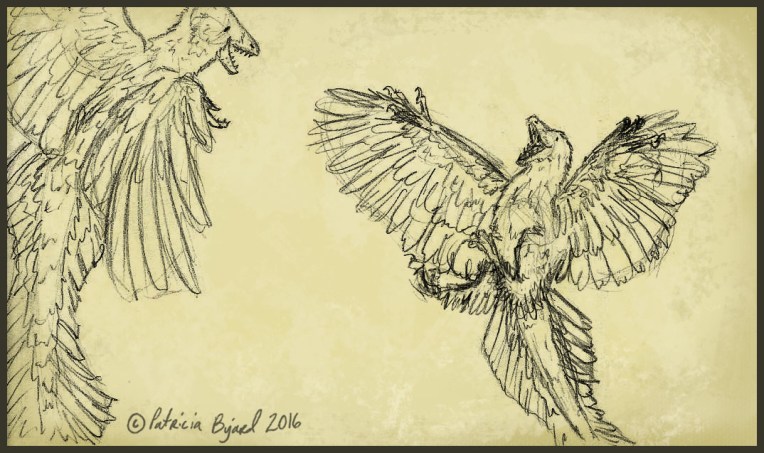
Most of us may look at Tango and see a birdy critter with big wings- of course he can fly! But wait, not so fast. Flight, as you know, is a very difficult skill to master, and just because an animal has wings doesn’t really mean it has all the other things it needs to fly.
So poor Tango’s been in the middle of an argument.
The wing feathers are asymmetrical, just like modern birds. This gives the wings a more aerodynamic shape, which is useful for flying.
Tango’s muscles are a bit weak, and his tail is not the best for flying, but in nature, whatever you’ve got is good enough to thrive where you’re at. Tango may’ve been just good enough a flyer to get across the river, from one branch to the next. Landings were probably not his strong point.
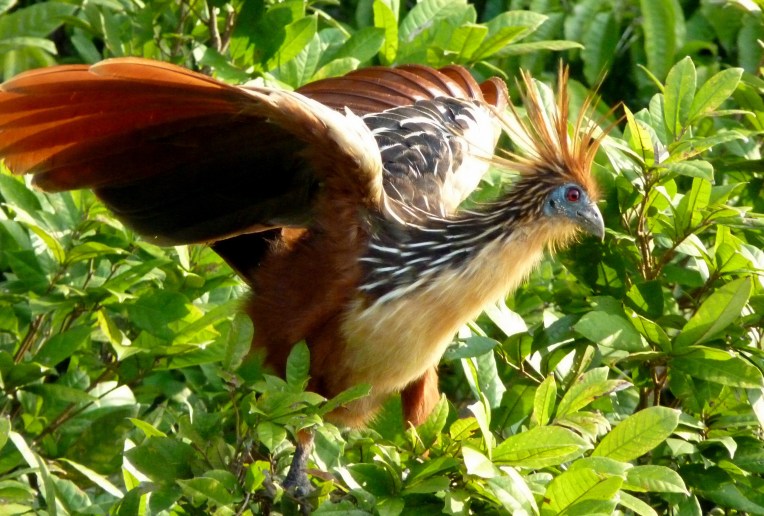
I’d be really curious to see what paleontologists would find if they compared Archaeopteryx flight muscles with those of a hoatzin. 🙂
Quick Question: Do you remember your first “encounter” with Archaeopteryx? How has the media, books, and maybe your own research affected your thoughts of birds as living dinosaurs? I’d love to hear from you in the comments!
If I asked you, “What is a bird?” What would you say? For most of us (at least for me) the first things that come to mind are feathers, a beak, and usually flight. Oh yes, and lays eggs. If you look out your window, go on a hike, or visit the zoo, it’s easy to recognize birds for what they are.
But what if we went back in time a few million years? It may be harder to pick out the bird from the…not bird, than you think.
Let’s say you’re picking your way through the thick undergrowth of a pine grove. You hear twittering from a branch above you, and you look up to see the tiny singer. It looks like a bird, it acts like a bird, but when it opens its beak to sing you notice tiny teeth.
Is it a bird?
Let’s try another one. Another place, another time.
You look up when you hear the sound of flapping wings above you. At first glance it looks like a bird, but then you notice those long tail feathers are not just feathers. Instead of a long train like a parrot or peacock, this fan is supported by a long tail. A closer look and you notice that this bird has claws on its wings, and a beakless snout with tiny teeth.
Is it a bird?
Let’s take a look at one more.
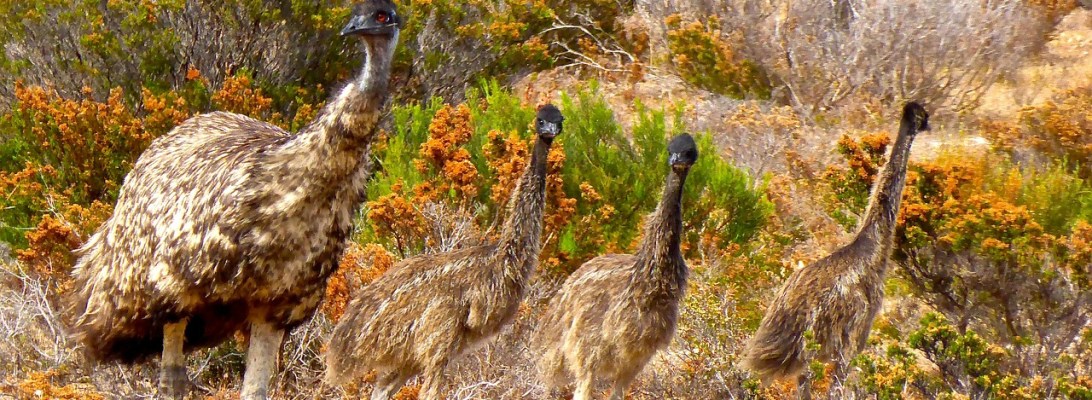
In another place, another time, we peak through the branches to look out into a clearing. Pecking at the undergrowth is something that looks a bit like an ostrich, or maybe an emu. Shaggy feathers, a toothless beak, and feather-duster wings all look like a big, flightless bird. But no bird has a long tail like that. That tail looks like it belongs on a lizard, if only it wasn’t covered in feathers.
Is it a bird?
At first glance, all three look very much like birds.
The first is an early bird called Sulcavis, which lived around the same time as T-rex, in China.
The second is Archaeopteryx. More dinosaur than bird, and from a much earlier time in Germany. It’s often reported as the first bird, but there are earlier cousins that are more bird than dinosaur.
The third is Gallimimus. If you’ve ever seen the original Jurassic park, these are the featherless “ostrich dinosaurs” that stampede around the heroes. Fossils now tell us that these dinosaurs would look very much like emus and ostriches with tails. 🙂
So how do we know which is which? We can’t define it based on feathers, eggs, or flight. In fact, paleontologists argue quite a bit on exactly what makes something a bird or a dinosaur.
The best answer I have on this insanely complicated subject (because let’s face it, I’m no expert. I’m just a couch enthusiast 😛 )…
All birds, past and present, are dinosaurs. But not all dinosaurs are birds. 😉
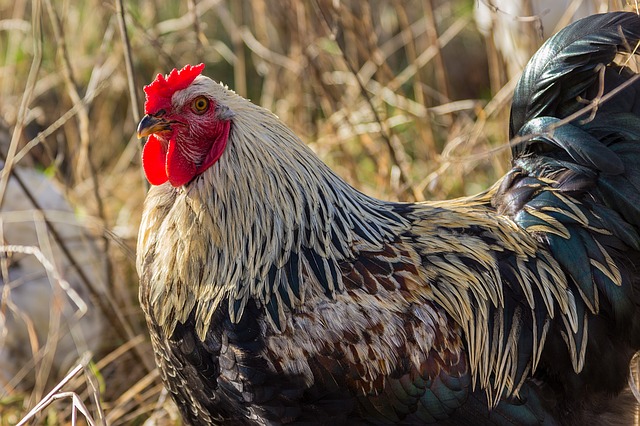
Even this handsome guy. I love the thought of dinosaurs running around my yard and giving me eggs.
Quick Question: What do you think about the relationship of birds and dinosaurs? The discovery of more and more dinosaurs with feathers has turned into a rather hot topic, with passionate feelings on both sides.
Me? I think our entire natural world (and our place in it) is amazing beyond words, so I’m cool with anything the latest research has to dish out. Birds jumping on the dinosaur wagon just adds a whole new dimension of awesome. 😀
When you think of an animal with wings, you usually think of something that can fly right? Bird is one of the first things that pops in my head, and when most of us think of birds, we usually think of birds that fly.
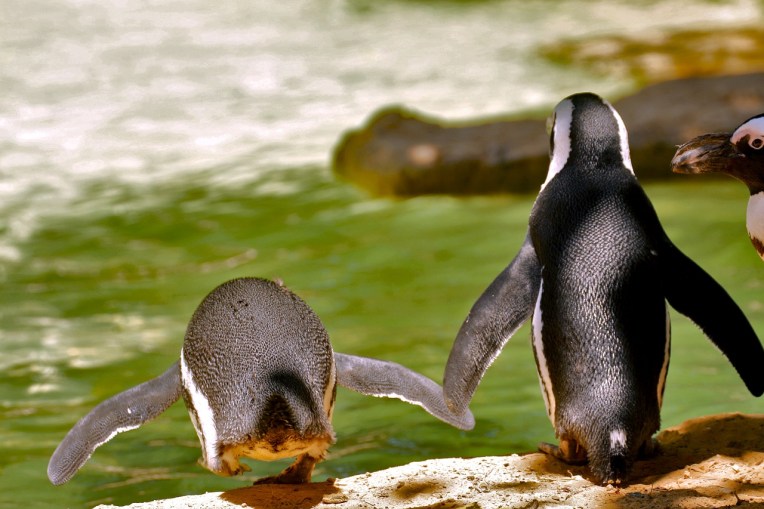
But not all birds fly. Of course, out of all the birds that can’t fly, what’s the first thing that comes to mind. Penguin? Ostrich? Kiwi?
“I believe I can flyyyy!”
Then there’s another category (wait, there’s more?).
Those are the birds that don’t usually fly, the sort of bird that we’re always a bit surprised to hear can actually fly.
Like turkeys. 🙂
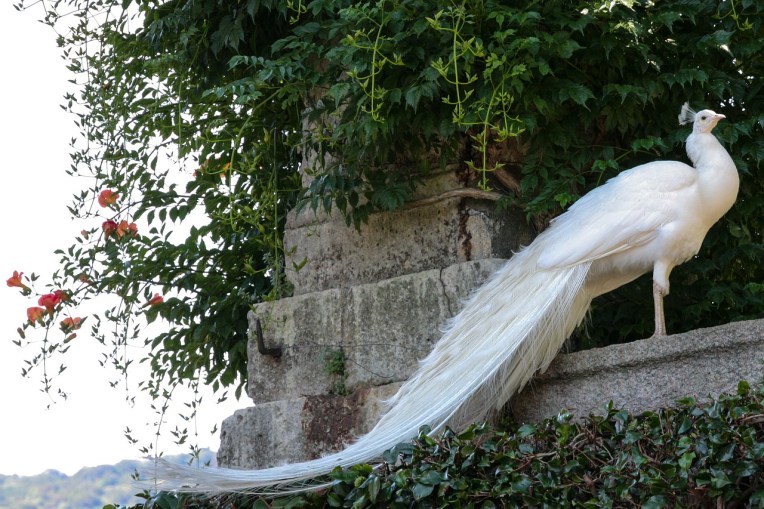
Or peacocks.
Glorious peacock in full formal attire looks down from his high tower and scoffs at human ignorance. He, not able to fly? Preposterous.
So how does this apply to prehistoric critters? Well, there are times when paleontologists aren’t so sure if a bird or other feathered dinosaur could fly. And then there are the times when paleontologists are so sure something could not fly, but then later on down the road new evidence shows up that it might…
So how can you tell for sure?
This is where the guessing game gets fun. We take a look at all the evidence we have, look at modern animals to get more insight on certain relevant details, and then propose our best hypothesis.
Next week, we’ll take a look at one of these discombobulating critters. Until then, enjoy the adorkable awkwardness of a hoatzin clambering about (a lovely bird of the South American Amazon). Landings don’t look like their strong point. 😛
Quick Question: What’s the first bird you think of when I say “bird”? I’ve got kiwis and penguins on the brain since I’ve written this post, but I do love the little songbirds that sing around our yard. I’d love to hear from you in the comments!
Oh, and if you’re seeing this in your inbox (and like what you see), please click on the post’s title. That would mean a lot to me, and help others find the site more easily. Thank you! 🙂
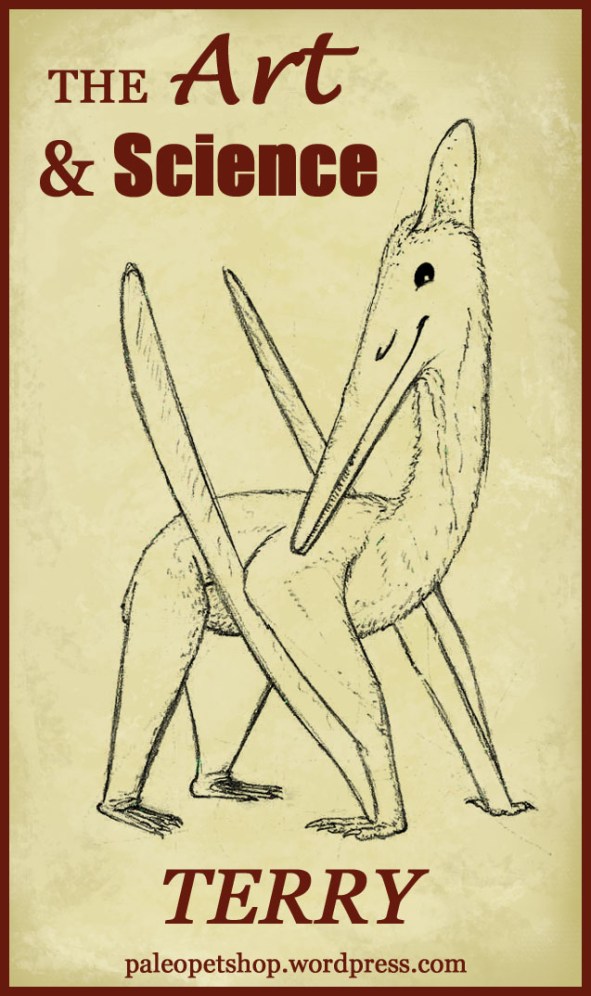
Hi there! Terry is here with us today, a rather odd looking critter isn’t she? If I asked you to tell me what she is, what would your answer be? Flying dinosaur? Terradactyl? Pterosaur?
If you said Pterosaur then clearly you’ve done your homework. If not, don’t feel bad (I’m not pointing fingers), because the sad fact is that most books, movies, toys, and pretty much anything to do with dinosaurs always lump Terry and her many relatives into the same pile.
Terry is a Pterosaur (Don’t mind the P there, it’s confusingly silent), a group of flying reptiles closely related to dinosaurs. To be specific, her wild cousins are Pterodactylus kochi. Pterodactylus is thepterosaur, where we get the name for the whole group. So now you know she’s special. 😀
1. Is that…fur?
Terry, like all pterosaurs, is covered in a fuzzy layer of pycnofibers. They’re made of the same keratinous proteins as our hair and fingernails. But they appear to be hollow inside, which makes them much more like feathers than fur.
I say “appear to be”, because not everyone agrees. Most of the fossils are a bit squashed, and even the 3d fossils can be hard to tell if what fills the space inside was part of the living animal or just more of the fossil (or a part of decomposition after the critter died, but before it fossilized).
Terry and her many relatives are related to dinosaurs in the same way that crocs are related to dinosaurs (They are all Archosaurs). A bit like a great aunt.
Since many dinosaurs are known to have feathers of various kinds, it would be pretty significant if pterosaur pycnofibers are determined to be feathers as well.
How significant? More fluffy dinosaurs! It’s possible that the earliest dinosaurs had a coat of fur-like feathers. 🙂
2. Hard Beak or Fuzzy Snout?
Terry & Ron are both pterosaurs, but look very different from each other. Fuzzy snout vs. hard beak. The difference in texture of fluffy pycnofibers is my own speculation. We don’t really know what these might’ve looked like in life.
Now I’m not quite sure where I first heard of the idea of hard-beaked pterosaurs…I think I remember Petrie from The Land Before Time had a beak. Come to think of it, I guess there are plenty of interpretations with beaky pterosaurs, but I’m not sure how many are based on fossil evidence.
Terry’s friend on the left is a Rhamphorynchus (that’s a mouthful, sorry, let’s call him…Ron). Some illustrate Ron and his wild relatives with just the toothless tip of his snout with a beak, but I’ve based mine off of Mark Witton’s lovely illustration.
Honestly, it’s hard to imagine those crazy teeth with any kind of soft tissue, and that seems to be the argument for a hard beak over the bone.
3. The original pole vaulting masters
Pterosaurs had powerful wings, but their legs weren’t really strong enough to jump up to fly like birds. So does that mean they’re helpless on the ground?
Not at all, look at Terry scamper around!
Pterosaurs were Earth’s first pole vaulting masters. Their powerful wing-arms were strong enough to push their bodies (even the biggest ones) up into the air. Mark Witton proposes that even the largest, giraffe-sized pterosaurs could lift off from the ground. Many could probably take off from the water!
Helpless? I think, not. 🙂 Here’s a quick video so you can see it in action. 🙂
How is it possible?
Unlike birds, pterosaurs have most of their muscle dedicated to their wings. Birds need enough muscle in their legs to jump up before flapping, while pterosaurs pole vault into the air with the same power they use for flying.
So no need to jump off a cliff or wait for warm updrafts of air. 🙂
Quick Question: Ah, the nostalgia of so many movies and documentaries…I must say I still rather like the leathery, cliff-clinging bats in Fantasia (so many great retro-saurs in that one). Are there any pterosaurs from books or movies that have colored how you see these animals? 🙂 I’d love to hear your answer in the comments!
It’s about time that we have a short chat on feathers. They are very complex, beautiful structures, and you could probably write entire books about them, but we’ll just cover a couple of things I didn’t know about until I researched it (Pretty cool when something so ordinary becomes amazing, just by taking a closer look).
Feathers are keratinous (like our hair or fingernails) structures that grow from the skin, and there are many different forms that serve many different functions. Here’s a video where we can see the basic structure of a feather quite nicely. 🙂
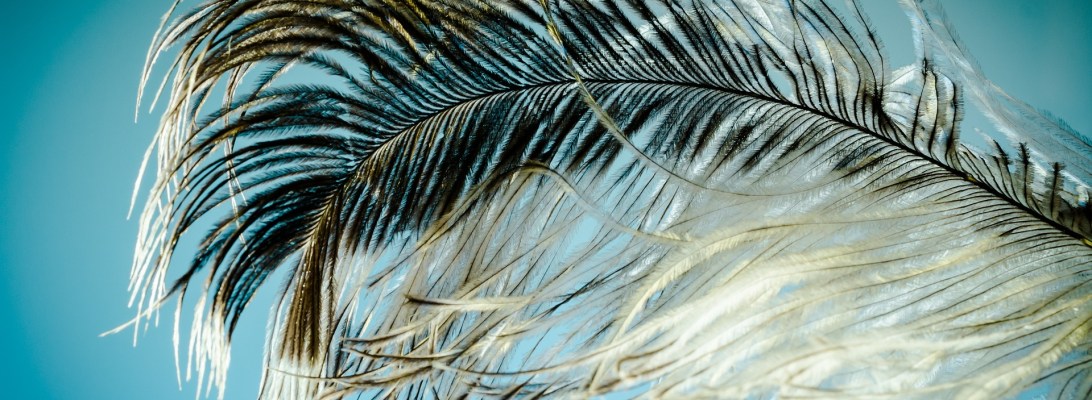
These feathers are like the peacock feather. The shaft, or rachis, branches off into many barbules, but those barbules don’t have the little hooks that ziplock together. Since Emu’s don’t fly or swim much, there’s no need for the streamlined contour feathers flying birds have.
Emus have no problem with staying dry in the rain, because just like any other bird, they spend a good part of their day combing their beaks through their feathers and coating them with oil from a gland near the base of their tails.
Here’s another video, this one about how varied feather shapes can be, and what they can be useful for. It focuses on birds of paradise and their crazy display plumage, but try to think about what it means for other feathered, flightless animals (like feathered dinos), and how they might use feathers. 🙂
Next week, we’ll finally get to see the Art & Science of little Terry. Keeping this post in mind will help keep that one short, because flying reptiles like Terry are rumored to have a fluffy coat of feathers… 😉
Quick Question: What was your favorite out of the wacky feathers displayed by the birds of paradise? Do you think feathered dinosaurs could’ve had similarly weird and wonderful feathers? I’d love to hear your answer in the comments! 😀
Hello there Steggy! She’s followed me here because she wants the bucket of tasty fern balls I’ve brought with me. That works out nicely, since she’ll stay here and munch while we point and chat about her for a few minutes. Just like when we talked about Ajax last week, I’ll stick with 3 research tidbits for now, to keep things short. 🙂
1. Soft or hard-shelled turtle?
Steggy’s a bit smaller than the average wild stegosaurus, but she’s still quite a bit taller than we are. If you reach up on your tip-toes you might be able to touch the biggest of her plates, the one right above her hips there.
There’s been some speculation in recent years on if these plates were hard and covered in keratin- like a turtle’s shell or cow’s horn- or if the plates were soft and covered in scales or skin.
Hesperosaurus. A much smaller spiketail, but so close a cousin that there was a bit of disagreement a couple years back if it should be lumped in with Stegosaurus.
So there you have it. Hesperosaurus is a very close cousin of Stegosaurus, so in the realm of phylogenetic bracketing that makes it more likely that Steggy had a smooth, hard sheath of horn on her plates and spikes.
2. Armed to the teeth.
One of Steggy’s wild relatives, a Stegosaurus ungulatus to be exact. We should probably back off. He doesn’t look too happy that we’re so close.
The same Hesperosaurus described had another very rare insight on spiketails- fossil skin. As you can see on Steggy here, most of her body is covered in small, non-overlapping scales, called tubercles. They look a bit like pave stones don’t they? Now look up here, a bit higher up on her side. Interesting isn’t it?
Steggy has some pretty tough scales. These large oval scales are called osteoderms, just like the large, hard scales on the backs of crocodiles. They’re covered in keratin, like our fingernails, and they do a pretty good job as armor. I’m sure Alfred‘s wild relatives had a tough time munching on wild stegosaurus. 🙂
Short front legs can bring head lower to the ground (harder to reach) and spiky end up, or push the body up to swivel on powerful hind legs. Awesome for quick, sharp turns. No way a hungry predator can get to anything soft and vulnerable if that spiked mace is always between it and the stego.
3. She might not be the sharpest rock, but she’s one tough cookie.
Yeesh, I definitely need to practice these guys more. Fun fact, there are track ways of stegosaurus in small family groups, with young juveniles with a few adults, or a few “teenagers” traveling together. 🙂
Steggy might have a brain the same size as a dog’s, but she’s not nearly as dumb as movies and the media would have you think. (I’m looking at you Spike, in The Land Before Time). I think most encounters would not have ended up like the stego in Disney’s Fantasia (which is totally what inspired my love for them in the first place 🙂 )
With all that armor, and tons of fossil evidence with some serious dino damage on Alfred‘s wild relatives, it looks to me that spiketails had an attitude to match their prickly array of spikes and plates.
Because of that, I’ve given Steggy a bright warning pattern. Someone told me it reminded her of a skunk, and that’s exactly what I’m going for. Steggy’s color is something that says “stay away!”
Good thing Steggy is a calm and peaceful pet then, a domesticated spiketail. Domestic spiketails have a tendency to be nervous, and spook easily (like horses), but Pete works with her a lot, and hardly anything bothers Steggy now. (horses can be trained like this too)
Just for fun, here’s my reasoning on why Steggy may not be as dumb as you think. A quick check on Youtube brings up plenty of smart tortoises. Yep, after discovering that it couldn’t fit through the pet door, this one figured out how to open a sliding glass door.
Quick Question: Animals do all sorts of crazy things we wouldn’t expect. Do you have a story about an animal or pet that did something unexpected? I’d love to hear your answer in the comments!
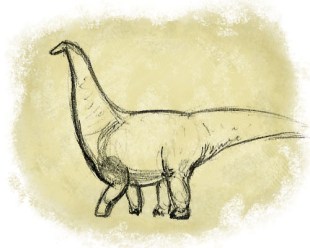
First up is Ajax (hi there Ajax! Give’em a smile), because really he’s the first critter of the lot I ever drew, and he shows up in my sketch book a lot. Plus he’s just an all around friendly guy, and anyone knows a brontosaurus (ahem, Apatosaurus) when they see one. 🙂
So what’s science and what’s art? To keep this post short, I’ll cover three main points (there are always more, but we can save those for later). All drawings in these posts are quick doodles to illustrate a point, with not as much reference as I usually use, so there are plenty of inaccuracies for you to point out for me. But I do have this great toymodel replica to look at when I’m clueless as to how something looks at certain angles. 😉
Clearly I have a lot to learn when it comes to photographing these things, but everyone starts somewhere right? Hehe, and yes, that’s a toy. Papo’s latest model of Apatosaurus to be exact, inspired by Sideshow Collectibles’ Apatosaurus, which is double levels of gorgeous and ten-thousand times more expensive. 😛
1. Toothy grin, or soft smile?
For starters, let’s talk about Ajax’s smile in the picture above. There’s a lot of discussion on dinosaur lips- did they have a toothy grin like crocs, or closed lizard-type lips?
On one hand there’s the study by Ashley Morhardt (unfortunately I can’t find it, so I’m relying on 3rd party sources). She compared the skulls of prehistoric and modern animals, and looked at the clues left behind by beaks, lips, etc…and her study suggests that sauropods like Ajax had a face more like a crocodile’s than the fleshy lips of mammals.
Ajax’s teeth, like most dinosaur teeth, have a pretty healthy coating of enamel, the same stuff that coats our teeth and makes them hard. Enamel does best when it’s bathed in saliva 24/7, which is why mostly all animals that have enamel-rich teeth have mouths sealed shut by lips of some sort.
Anyway, Ajax eats whatever he can get a hold of. He does replace his teeth every once and a while (unlike our permanent set of adult teeth), but still, it takes a while to get a replacement tooth, so he needs to use each set for as long as he can.
With that in mind, I’ve decided to reconstruct Ajax and the other sauropods with closed, lizard-like lips.
It’s one of those things that we can’t know for sure, because even a mummy can’t give you a perfect picture, anymore than a raisin can tell you what a grape looks like.
2. How far can he stretch?
Oh boy, paleontologists have gone back and forth on this one for over a century. First thin, graceful necks like swans, then BBC’s Walking With Dinosaurs comes out and shows the fruit of research claiming that Ajax & Dippy held their necks out like suspension bridges. They held their heads and tails in almost a straight line, and were unable to lift their heads higher than their shoulders.
He’s really trying to impress you
More recent work has pointed out that if you add space for cartilage between the bones, then the necks of many sauropods had the flexibility to loop in a complete circle. The brilliant minds behind the SV-POW! team over at svpow.com (always enjoyable to read, but definitely more on the technical side) helped rekindle my love for the long-necked giants by holding their heads high again, and regain neck flexibility by taking soft tissues into account.
In short, we don’t really know. But Ajax would probably have a great deal more flexibility than Walking With Dinosaurs would have you believe. The bendiest part would be the middle of Ajax’s neck, with the ends less flexible.
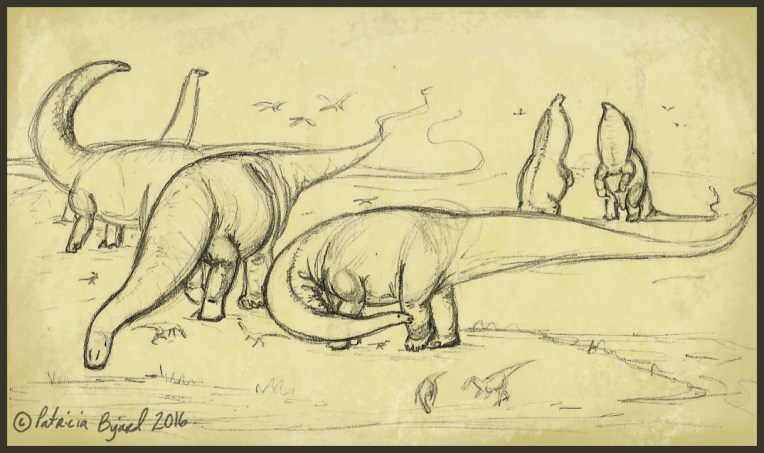
I always think that animals are more capable than we usually think, so one of Ajax’s buddies has reached back to scratch at an itch on his leg. 🙂
Oh, and those two in the back with the puffy necks…that’s entirely speculative. Something weird was going on with Ajax’s neck though, that’s for sure. 😉
Ajax’s legs are like solid pillers, and all the finger bones are wrapped together to form a fleshy, padded, hoof-like structure. Only the “thumb” has a claw, which has some limited mobility depending on the species. Ajax can move his thumb claw up and down a little bit. 🙂
Scientists disagree on how much Ajax could move his wrist. So how far he has his front foot bent at the wrist is a bit speculative.
I’ve done a terrible thing and made his wrist flexible based on an elephant’s range of movement. 😛
Quick Question: Is there anything in the popular media you can think of about Ajax and other sauropods? What common misconceptions do movies like Jurassic Park and The Land Before Time give about Ajax and his cousins? 🙂 I’d love to hear your answer in the comments!
So there’s a long and a short way to go about this. I do something really tedious and boring, and pull out the scientific papers, fossils, diagrams, anatomy jargon, and articles written by people much smarter and more knowledgeable than me in all things paleontology…
OR
I can save you the big snore (because the technical stuff is tough to read, and I like this sort of thing!) and have an excuse to draw yet more cute critters, while sneaking in a few quick fossil facts in a bite-size post or convenient picture. 🙂
Why am I doing this?
The truth is that I got a little frustrated. All the dinosaur books for kids fall into one of two categories-
Super cute story and dinosaurs, but no science. For example, “Pteradactyls” lumped in with the dinosaurs, and dinos stuck with the appearance of rubber toys from the 80s.
OR
“Educational”, but tough to read. Because after reading a list of names like Tyrannosaurus rex, Euplocephalosaurus, and Parasaurolophus 20 nights in a row, I know that book is going to put aside for “some other time”. Plus the computer graphics always look a bit unpleasant to me.
Pete’s Paleo Petshop is the best of both worlds. A cute story with illustrations based on the latest scientific research I can find. But I also want to make clear what part of the illustration is something we actually know as fact, or really just an educated guess. Speculation. A hypothesis. 🙂
So this is the start of a new series called The Art & Science of Pete’s Paleo Petshop. That’s super long though, so I’ll have to shorten it somehow. 🙂
For your convenience, I’ll keep a list of all posts in the series here on this page, and I’ll update the list with links as we go along. I’ll begin with the main cast, and we’ll see where we go from there. 🙂
Bonus Question: Any special requests? I’ll be going over these critters in no particular order, so if there’s one you really want to see first, let me know. First one to answer in the comments gets first pick! 🙂








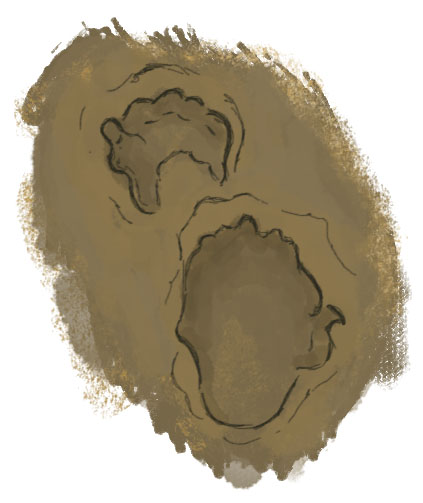 Ajax’s legs are like solid pillers, and all the finger bones are wrapped together to form a fleshy, padded, hoof-like structure. Only the “thumb” has a claw, which has some limited mobility depending on the species. Ajax can move his thumb claw up and down a little bit. 🙂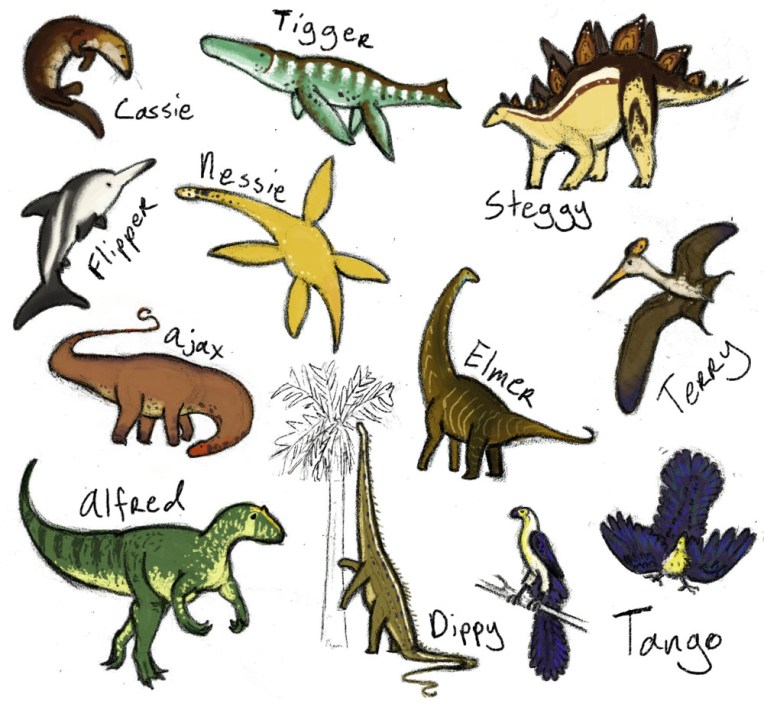
 Pete's Paleo Petshop