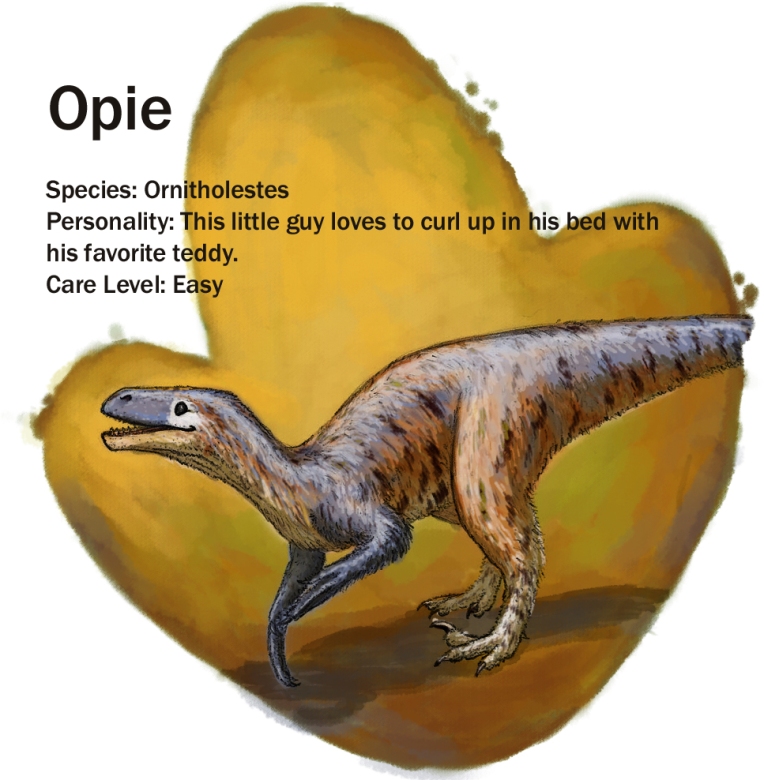
Meet Opie. He’s a happy little fella who loves to curl up in your lap, so it’s a good thing he’s about the size of a big dog!
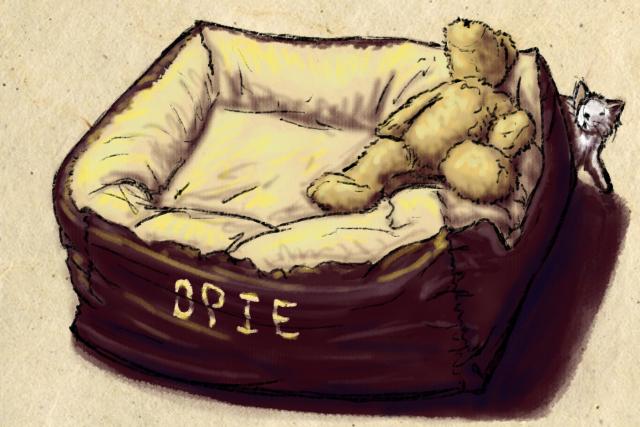
Yes, Opie seems to think he’s a big lapdog, and he loves it when you stroke his feathers. Where is he off to now? It looks like he’s going to show you his favorite toy…Opie carries Teddy around everywhere. He’s gone through quite a few “surgeries” to poke the stuffing back in after Opie nibbled on him.
Oh! That’s Miss Kitty peaking around the corner. She’s a little shy after Opie tried playing a game of snatch with her. He’s just a big softie though, and he only wants to play. He’ll get a little droopy when Miss Kitty doesn’t understand. So he’ll curl up in his bed to snuggle with Teddy, and he’ll chirp happy chirps when he snuggles. He sounds a lot like this…
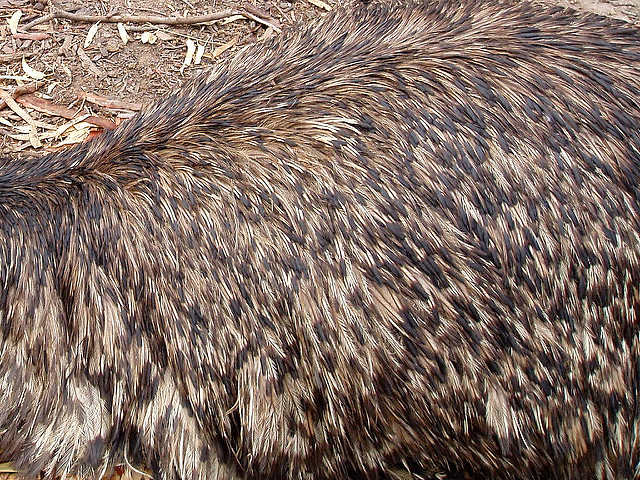
Speaking of soft and cuddly, those feathers are rather like those on an emu or kiwi. Looks a lot like fur, doesn’t it? 🙂
Emu feathers. Photo courtesy of Amanda Slater (2009)
Making progress…
Getting along spiffily (is that a word?) on my little storybook, Dippy vs. Ball. Here’s what I have so far on one of the spreads. A handy little map so we can take a little stroll around Dippy’s hometown to meet the neighbors.
Hello there! Alfred is super excited to see you, and look at how curious he is. Do you own a cat or dog? Because he seems to think you smell good. (stay back Alfred, be nice). Here we go, I’ve got a nice ball of cheese and bacon here. He’ll love it. Here Alfred, go get it!
While Alfred gets the ball, I can share this lovely disclaimer. Que elevator music…
I do the best I can with research, but I definitely don’t claim to be an expert. I try my best to keep up to date, and all my illustrations reflect this. (thank you internets, and to all hard-working paleo-nerds who are kind enough to make your papers open source!) 😀
That said, all the drawings in the A&S post series are quick doodles to illustrate a point, with not as much reference as I usually use, so there are plenty of inaccuracies for you to point out for me. 😉
Thank you disclaimer, you can go bother someone else now. 😛 Elevator music fades out…Oh and here comes Alfred! Looks like he wants more…
There we go, good boy Alfred!
Now Alfred here is an Allosaurus. He’s young, so only about 12 feet long so far, but he’ll grow to be a lot bigger. Not as big as his wild cousins though, a few of them could be as big as T-rex! (very few, gotta be old to get that big, and most dinos have a live fast, die young policy)
1. On Scaly Skin vs. Feathers
So you see Alfred here has these lovely bright yellow and forest green scales, the colors of youth. (They’ll mellow out a bit when he gets older, like monitor lizards do)
Also like a monitor lizard, you’ll notice that most of Alfred’s scales are quite small, with a rather pebbly texture. They get a bit larger and thicker on his back, which is good since adult Allosaurus tend to get into quite a lot of tussles with each other. But most of his scales have that nice cobblestone look to them.
Short answer as to why Alfred has scales…there’s a young Allosaurus with preserved scales somewhere on it’s body. (Unfortunately the report didn’t say where)
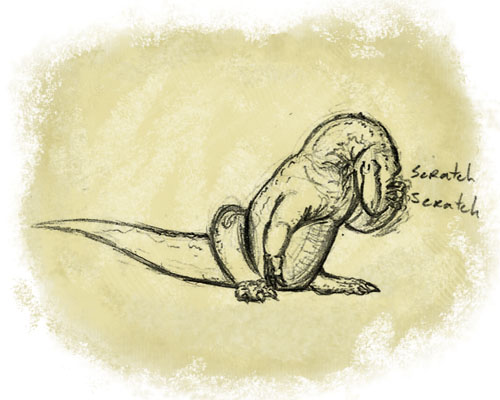
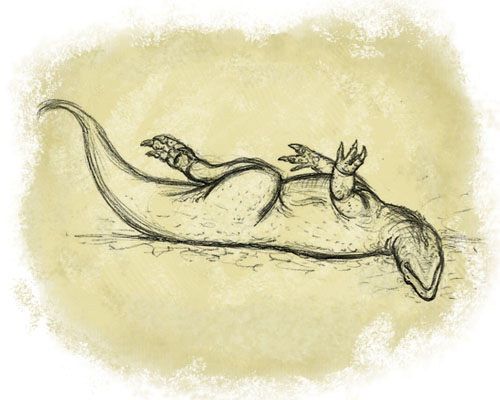
Looks like Alfred’s all worn out from chasing after that giant, cheesy bacon-ball. He hasn’t quite grown into his adult silhouette yet. He’s still young enough to think he can chase after stuff, but he’s starting to get to an age where it’s getting hard to make those quick turns.
When he fills out his more barrel-chested adult figure, he’ll be spending quite a bit of his leisure hours (think energy-efficient) laying around. Since his body is a bit taller than it’s wide (more lanky cat than double-wide gator), it’s more relaxing to be lounging on his side.
Of course, that doesn’t mean he can’t do other things to relax, even things that may surprise us (ever seen a large horse roll? It’s hilarious 😀 ).
Sit!Down!Good boy! Roll Over!
Oh, and here’s that horse… 😀 I can totally picture some “duckbill” dino doing this.
3. Where are His Teeth?!
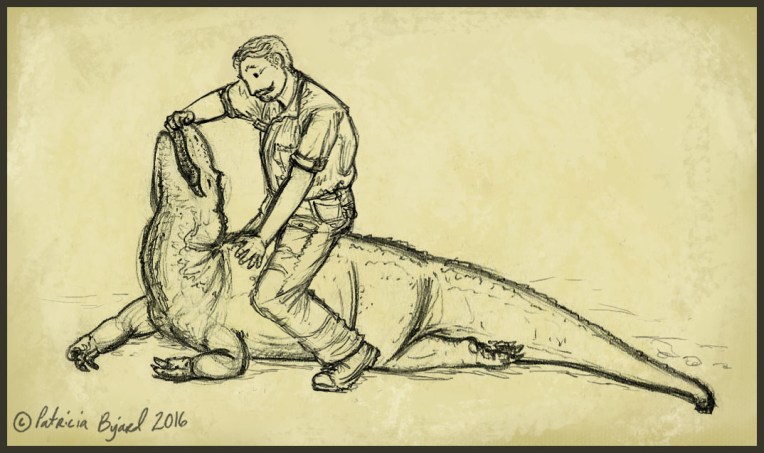
Clearly I need more practice drawing people. Thank you for volunteering Pete. 🙂
I hear ya, I wondered the same thing when I looked up pictures of Komodo Dragons and monitor lizards. But wait, what does that have anything to do with it?
Pete will help us out here. I know Alfred looks a little awkward, but he’s actually quite comfy. Ah- I’ll let Pete tell you the rest…
“Thank you. Yes, Alfred is quite at ease here. I’m not heavy to him at all, and he weighs at least a good 300 pounds at this age. So he doesn’t mind a bit.
I’m tilting his head back very gently- show us your teeth there Alfred, that’s it, nice and easy.
See this is the biggest difference between a domestic Allosaurus like Alfred here and a wild one. Look how completely relaxed he is. He’s not fighting me at all, and even his eyes are closed, look at that. (Alfred makes a gurgly, kinda purring sound in his throat)
Anyhow, I’m holding onto his lips here so I keep my fingers out of his mouth. My fingers can look a bit like treats, so I’ll be sure to keep them right at the edge here, at the gums.
All this, the lips, the gums, the saliva- it all keeps his teeth nice and moist. Dinosaurs have a healthy coat of enamel on their teeth, same as your teeth, and the key to healthy teeth is to keep them moist. Even better if you can give your teeth a constant bath of saliva.
Yes, drool is essential to healthy teeth!
Now Alfred will lose his teeth and grow new ones, just like crocodiles and alligators do, but if you look closely at these teeth-they’re serrated. They’re like steak knives- not like the cone-like teeth of crocodiles.
Thank you Alfred, you’ve been quite patient. Here’s some jerky.
But crocodiles don’t need serrated teeth. They’re eating different things, they have a different habitat, and different diet, they’re eating in a completely different way. Alfred has teeth like a bone saw.
Ever cut a roast turkey with an electric knife? That’s what Alfred’s teeth are doing when he eats, so they need to stay sharp, and they need to be strong in his mouth. So the gums hold his teeth, and his lips keep them nice and moist so they stay strong and don’t get brittle.”
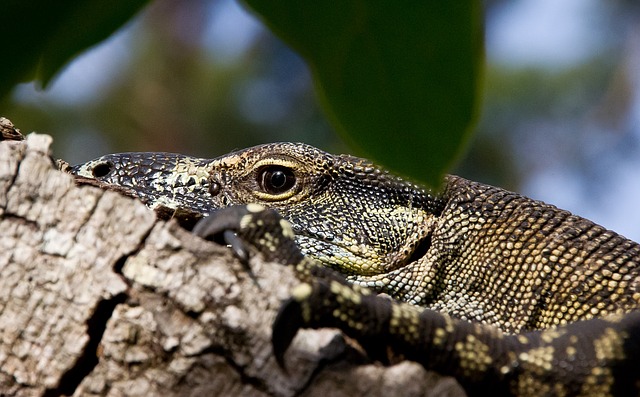
Thank you Pete, and Alfred. Just for comparison, here is a crocodile monitor lizard.
Looks friendly doesn’t he? Image not my own, but I couldn’t find who to credit. If you know who I should credit, please let me know. 🙂
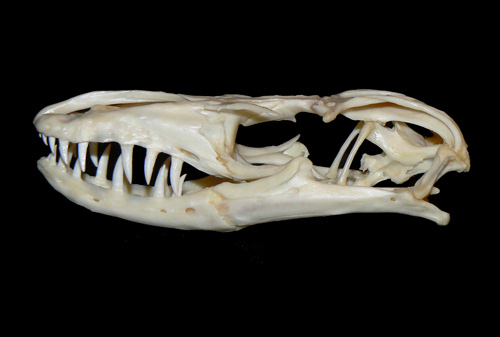
My first thought, “Where are the teeth?!” Then I noticed those sharp white triangular things inside the lip. Also interesting is that it looks like there are pockets for the bottom teeth to slip into. 🙂 Here’s the skull of the same animal…
Image not mine. If you know who I should credit, I’d love to give credit where credit is due. Thank you. 🙂
They look quite different from the other picture don’t they? Almost, shall I say, dinosauresqe? Take a look at an Allosaurus skull. 😀
Image copyright to Jason R. Abdale.
The one and only skull I could find that doesn’t have its teeth halfway falling out of their sockets (it happens when the dead critter decays). Jason has many more pictures of the Allosaurus mounts at the American Museum of Natural History, and I’d highly recommend you check out his blog post. You’ll also discover all my errors and where I need to fix Alfred. 😀
Quick Question: Help me find what I need to fix! If you wouldn’t mind checking out this blog post on Allosaurus, you’ll get to see some great pictures of excellent mounts, and you’ll see what I have to correct in my illustrations of Alfred.
I’d love to hear from you in the comments! I’ll be posting a comment on how many I find, and let’s see if we come up with the same ones or more. 😀
Every time I turn a corner, there’s a new feathered dinosaur to join the line up of “enfluffened” critters. T-rex, Velociraptor, Gallimimus…iconic dinosaurs from movies like Jurassic Park have bonified proof of some sort of floof covering their bodies. Even the plant eaters are getting floofy with critters like Hypsolophodon and Kulindadromeous.
Don’t get me wrong, I love feathery dinosaurs, and I’m a pretty big fan of a huge, fluffy, grizzly-hawk T-rex (that’s just epic 😀 ).
But sometimes artists can take this idea a little too far. “Woolly” Arctic ceratopsians (“three-horns” & cousins), and spike-tailed stegosaurus with porcupine quills is going a bit far on the speculation even for me.
There’s a fine line between reasonable speculation, and downright fantasy.
But let’s pause for just a moment. I know that a lot of paleoart is speculative, a way of illustrating hypotheses proposed by paleontologists, but there’s also a surprising amount of stuff we do know.
What I mean to say is…
The stuff you see in paleoart is not some wild guess, and just because the critters are long dead doesn’t mean anything goes. I’ve described the process of reconstructing prehistoric critters in my blog post series, Fleshing Out the Bones. You can click this link to read more on that if you’re interested.
So how do you decide if you’ll give your dinosaur feathers or scales?
“Butterfly!” Silly Alfred is just going to get worn out. He’s about the size of the young Allosaurus described below. About 12 feet long from nose to tail-tip.
Let’s take Allosaurus and my illustrations of Alfred as an example. How do I know if he should be covered in feathers or scales?
Based on the fossil, the young Allosaurus had small scales about 2-3 mm in diameter. So tiny, pebble-like, non-overlapping scales, rather like the sort you see on gila monsters and monitor lizards.
“Yo, ‘sup?”
But What if I didn’t Have Fossil Evidence?And for some, a patch of skin in one part of the body is not enough. Afterall, in some dinosaurs you get quite the mixture of feathers and scales. Compsognathus, for example, has close relatives with evidence of “full floof”, but the critter itself has scale impressions on its tail and legs.
Step 2: Look at Their Relatives.
Like we just did with Compsognathus up there, we can look at close relatives in the same family to figure out the scale/feather thing. In the case of the compy, the possibilities can get even more confusing, but let’s go back to Alfred.
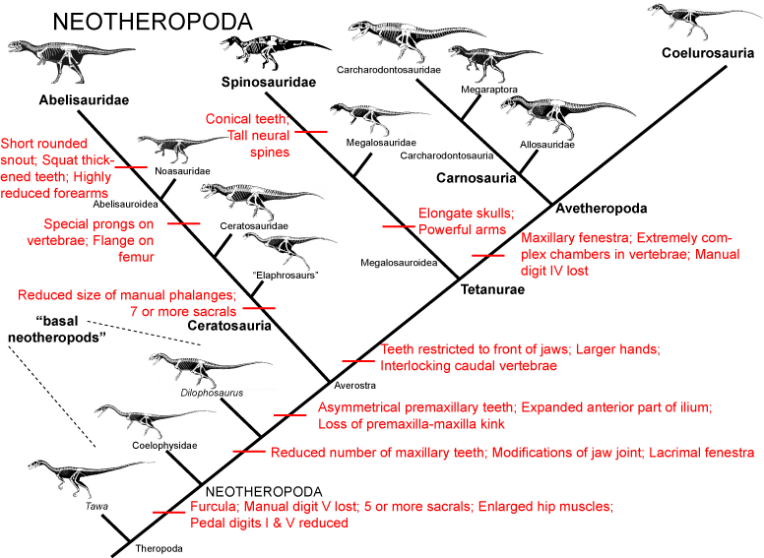
If you go back to last week’s post on Theropods, you’ll see that Allosaurus is in the family Carnosauria. One rather infamous member of this group is Concavenator. It has what looks like quill knobs on its arms, which in modern birds are small bumps on the bone where ligaments for flight feathers attach.
The “quill nobs” of Concavenator are a subject of much discussion. Duane Nash has a particularly interesting interpretation over at his blog, Antediluvian Salad. I’m not a fan of how monstrous he illustrated the poor critter, since I tend to see the beauty even in Earth’s homeliest of creatures, but the article is a very interesting read, and I’d recommend you check it out. 🙂
Step 3: Where is it in the Family Tree?
Pterosaurs are about as closely related to dinosaurs as alligators and crocodiles are. Neither are dinosaurs, but they’re all in a much larger group called Archosauria.
Because of this relationship, it’s a pretty big deal if the fuzzy pycnofibers on pterosaurs are the same as the fur-like fluff on certain dinosaurs (like Compsognathus & cousins).
Why? Because it’s much simpler to assume that the great-grandmother of dinosaurs & pterosaurs had the fuzzy feathery fluff.
Much more complicated to assume that dinosaurs & pterosaurs developed the same fuzzy feathery fluff each on their own.
What’s easier? Learning with a friend from a teacher, or each of you studying on your own? Not exactly the same, I know, but I think you get my drift. 🙂
With this in mind, let’s see where Alfred is on the family tree, and how far away he is from the main branch or outlying branches.
Image not my own. Cladogram copyright to Tom Holtz. Sourced from the University of Maryland Department of Geology website.
Alfred is on the branch labeled Carnosauria. This is quite a ways away from the base of the branch, with many critters in between that are known to be scaly. So feathers from that direction are very unlikely.
Once proof of scales appears we don’t see any real evidence of feathers until we get to the branch labeled Coelurosauria.
Final Verdict: Allosaurus is More Likely to Have Scales, Based on Current Knowledge.
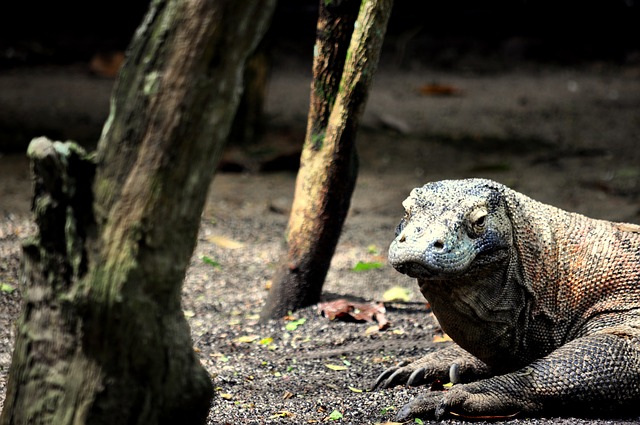
So what would that look like? The scales are small and non-overlapping in our sample, so let’s look at Komodo Dragons and Monitor lizards. 😀
“Nothin’ better than a warm rock on a sunny day…Zzzz” – Komodo Dragon“Hey. Nice day ain’ it?” – Komodo Dragon.“Hi! You wouldn’t have a snack handy would’ya?” – Monitor Lizard
Bonus Question: With this research, I think Alfred could use a bit of a makeover! What would you prefer to see?
A much needed nap after chasing that butterfly
Curious Alfred is curious
Is that the dinner bell?
Playtime!
Which scenario should I use to revamp his profile picture? I’d love to hear your answer in the comments! 🙂
Meet Alfred. The lion of the Jurassic! The prince of the Mesozoic! The…oh, there he goes after another butterfly. All he needs to be happy in life is his food, his chew toy, and a nice long nap.
Looks like Alfred has found something to chase. No worries though, that butterfly has nothing to fear, and he’ll give up soon enough. Allosaurus (ah-low-saw-rus) wasn’t very fast, but he can’t help it- if it runs off, he’s got to chase it! After a quick sprint, Alfred loves to settle under the shade of a tree and take a nice nap.
What’s that you say? He’s a fearsome predator? Well yes, yes he is. Take a quick look at lions, and tigers, and bears (oh my!), and most of the time you’ll actually catch them napping. Crocodiles and eagles, Alfred’s closest living relatives, also do a lot of nothing. Once you have a full belly, why not enjoy a siesta in the sun? 🙂
Fun Fact: This guy is the first critter that I kinda found my style. All the ones I drew before him were very inconsistent, but this one had the sketchiness and detailed painterly mixture I was looking for. All other critters after him I’ve been refining my technique and getting better.
Now I have to practice on my people!
Making progress…
I had a big surprise planned. The goal was to have Pete’s Postcards from the Shop all set up by my birthday (that’s today. I just set it as a convenient goal date. 🙂 )
The Critter Cards were done, I got the PDF file sorted out, Mailchimp all set up and ready to go…I run through the motions to test it out for myself and…
Nothing.
I wasn’t really surprised, since I can’t really use my personal email account to send you emails from the Paleo Petshop. But it was worth a try. I’m trying to spend as little money as possible until I start earning a little. This can turn into a really expensive hobby really fast if I’m not careful.
Not exactly what I’m going for. 🙂
So now I’m figuring out the best place to purchase a domain name, so that PaleoPetshop.wordpress.com can turn into PaleoPetshop.com. Only problem is that so many places offer so many different packages with bells and whistles I’m not ready for just yet. Like webhosting.
All I need is an official domain name, and the email address I can use with Mailchimp.
Wish me luck! I’ve got a couple of options I’m looking at, but it’s just a matter of figuring out which one’s a better fit. 🙂
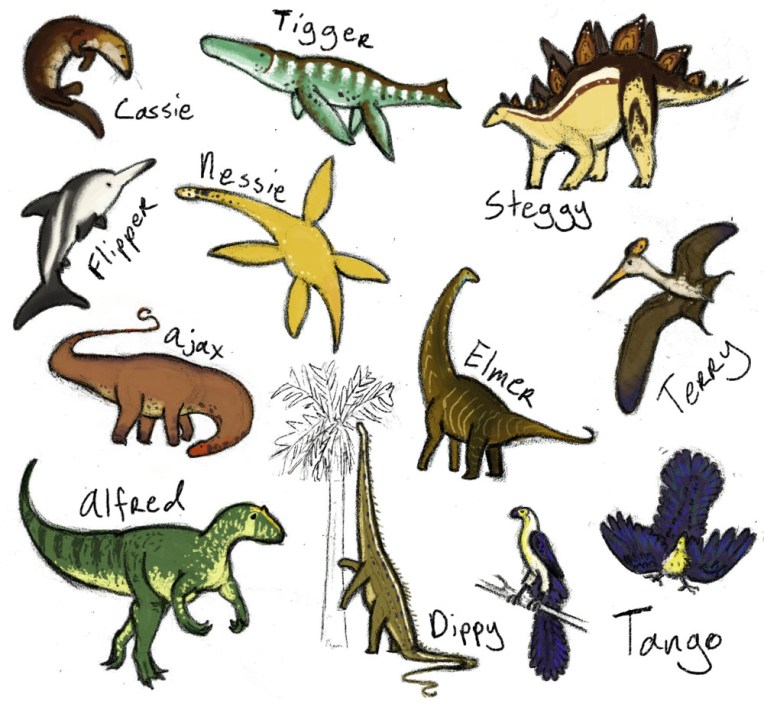
In the meantime, here’s the Critter Card chart with all dinosaurs colored in. 😀
Coming Next Week…
A giant with a heart of gold, life is never boring when this big guy is around. Nothing is out of reach! He’ll stick his nose into everything until every mystery is solved.
Meet Bella. She’s big, she’s loud, and she’s really happy to see you! She’s happy to see anyone really, except Alfred, but can you blame her? There’s about a-bazillion years of conflict going on there…
There she is! She is the most accommodating of Pete’s very large camarasaurus herd- voted least likely to accidentally trample the equipment. They can be an excitable bunch, and don’t always pay attention to what they’re bumping into. I’ll just say that when Pete finally got her separated from the herd there was a tractor, some flags, an air horn, and a rubber chicken involved…
These Camaras are more closely related to the smaller wild species, C. lentus (there are 3 🙂 ), which are only about 49 feet long. But that’s still a lot of sauropod on the move, especially when you multiply it by 80!
Why so many?
Paleontologists may call Bella the ugliest sauropod, but they’re pretty popular for anyone with plenty of pasture. Their friendly and calm, cow-like attitude makes them an easier alternative to the larger giants like Elmer.
If only they weren’t so loud! But some may call Bella’s singing endearing. It’s lovely to hear their chorus far out to pasture.
Have the video play in the background while you look at Bella above, I can’t help laughing at the mental picture of 50 or 100 of these fat, happy sauropods calling to each other constantly. In a herd of such large animals, you don’t really need stealth. 😀
Making progress…
The past couple of weeks it’s been tough to keep up. I need to rethink how I do things, or get better at more efficient use of my time during the day. One of the two. 😛
I’ve kind of fallen into the bad habit of keeping right on the posts. It feels a bit like plugging holes in a leaky dam. As I get one done, then I’m scrambling to get the next one done, half afraid I won’t be able to keep up.
I’m not saying this to complain of course, just as a way of evaluating where I’m at, in a way that I can look back later and remember where I came from. 🙂 Looking back at earlier posts has been the best way for me to see my progress, slow as it’s been. It keeps me going by knowing how far I’ve come. 🙂
Speaking of earlier posts, I used to have a list of future posts, and I would update information and write little snippets whenever I could. I’ve been kinda scrambling ever since I wrote all the posts on the list.
Time to write up another list! And perhaps have a couple of posts with relevant youtube videos like Monday. If you like those, I can do it a little more often. 🙂
Coming Next Week…
This giant likes to bask in warm, sunny waters. He’d be super easy to care for if only the tank didn’t need to be the size of the Mediterranean…
Hello there Steggy! She’s followed me here because she wants the bucket of tasty fern balls I’ve brought with me. That works out nicely, since she’ll stay here and munch while we point and chat about her for a few minutes. Just like when we talked about Ajax last week, I’ll stick with 3 research tidbits for now, to keep things short. 🙂
1. Soft or hard-shelled turtle?
Steggy’s a bit smaller than the average wild stegosaurus, but she’s still quite a bit taller than we are. If you reach up on your tip-toes you might be able to touch the biggest of her plates, the one right above her hips there.
There’s been some speculation in recent years on if these plates were hard and covered in keratin- like a turtle’s shell or cow’s horn- or if the plates were soft and covered in scales or skin.
Hesperosaurus. A much smaller spiketail, but so close a cousin that there was a bit of disagreement a couple years back if it should be lumped in with Stegosaurus.
So there you have it. Hesperosaurus is a very close cousin of Stegosaurus, so in the realm of phylogenetic bracketing that makes it more likely that Steggy had a smooth, hard sheath of horn on her plates and spikes.
2. Armed to the teeth.
One of Steggy’s wild relatives, a Stegosaurus ungulatus to be exact. We should probably back off. He doesn’t look too happy that we’re so close.
The same Hesperosaurus described had another very rare insight on spiketails- fossil skin. As you can see on Steggy here, most of her body is covered in small, non-overlapping scales, called tubercles. They look a bit like pave stones don’t they? Now look up here, a bit higher up on her side. Interesting isn’t it?
Steggy has some pretty tough scales. These large oval scales are called osteoderms, just like the large, hard scales on the backs of crocodiles. They’re covered in keratin, like our fingernails, and they do a pretty good job as armor. I’m sure Alfred‘s wild relatives had a tough time munching on wild stegosaurus. 🙂
Short front legs can bring head lower to the ground (harder to reach) and spiky end up, or push the body up to swivel on powerful hind legs. Awesome for quick, sharp turns. No way a hungry predator can get to anything soft and vulnerable if that spiked mace is always between it and the stego.
3. She might not be the sharpest rock, but she’s one tough cookie.
Yeesh, I definitely need to practice these guys more. Fun fact, there are track ways of stegosaurus in small family groups, with young juveniles with a few adults, or a few “teenagers” traveling together. 🙂
Steggy might have a brain the same size as a dog’s, but she’s not nearly as dumb as movies and the media would have you think. (I’m looking at you Spike, in The Land Before Time). I think most encounters would not have ended up like the stego in Disney’s Fantasia (which is totally what inspired my love for them in the first place 🙂 )
With all that armor, and tons of fossil evidence with some serious dino damage on Alfred‘s wild relatives, it looks to me that spiketails had an attitude to match their prickly array of spikes and plates.
Because of that, I’ve given Steggy a bright warning pattern. Someone told me it reminded her of a skunk, and that’s exactly what I’m going for. Steggy’s color is something that says “stay away!”
Good thing Steggy is a calm and peaceful pet then, a domesticated spiketail. Domestic spiketails have a tendency to be nervous, and spook easily (like horses), but Pete works with her a lot, and hardly anything bothers Steggy now. (horses can be trained like this too)
Just for fun, here’s my reasoning on why Steggy may not be as dumb as you think. A quick check on Youtube brings up plenty of smart tortoises. Yep, after discovering that it couldn’t fit through the pet door, this one figured out how to open a sliding glass door.
Quick Question: Animals do all sorts of crazy things we wouldn’t expect. Do you have a story about an animal or pet that did something unexpected? I’d love to hear your answer in the comments!
Meet Rosie. She’s a bit shy, and might need a little encouragement to come closer. A few treats should do the trick. Before you know it she’ll be perfectly content to snuggle close and put her head on your lap. 🙂
Rosie is smaller than your average dinosaur, about the size of a deer. Like a deer, she can be a bit jumpy, and she feels much better if she has friends to keep her company and watch out for troublesome, over-exuberant types like Opie. He’s far too excitable, and that makes her nervous. She’d much rather curl up under the shade of spiky cycad fronds for a little siesta.
Much safer there. And Rosie always wins at hide-and-seek. 😉
If you take the time to give her treats and coax her out of the thicket, then she’ll get to know you rather quickly. Then she’ll be your friend forever, and come running when you call. 🙂 I hope you don’t mind having a second shadow…
Making progress…
I’m working on something super top-secret at the moment. Well, not really super top-secret, since I told my family about it- but anyway, I want to mention it here too.
Since it may be a while before the picture book is finished, I want to work on a smaller, short term project so that you have something sooner.
In short, I want to create a collection of shortstories, mini-comics, illustrations, what-have-you. My question is about what topic to cover…
Pete’s adventures around the shop- Like the time Terry and her flock nabbed his lunch.
Feeding time at the shop- Walk with Pete as he shows us how he feeds Tigger at the lake, or takes care of Elmer’s stubbed toe.
Letters to Pete- Frustrated paleo pet owners send letters to Pete with their questions. What do you do when Big Al keeps tearing up the furniture?
Critter cam- So what do dinosaurs do when you’re not looking? Find out what happens if you give Dippy a giant ball.
The Paleo Pet handbook- a small book with all the basics of the care and feeding of your paleo pets.
Please let me know what looks the most interesting in the comments! Thank you for sharing a little of your time with me here on the site, you guys are awesome, and I want to do whatever I can to make your stay better than great. 🙂
Coming Next Week…
Food is the first (and just about only) thing in mind for this gentle giant. 🙂
So there’s a long and a short way to go about this. I do something really tedious and boring, and pull out the scientific papers, fossils, diagrams, anatomy jargon, and articles written by people much smarter and more knowledgeable than me in all things paleontology…
OR
I can save you the big snore (because the technical stuff is tough to read, and I like this sort of thing!) and have an excuse to draw yet more cute critters, while sneaking in a few quick fossil facts in a bite-size post or convenient picture. 🙂
Why am I doing this?
The truth is that I got a little frustrated. All the dinosaur books for kids fall into one of two categories-
Super cute story and dinosaurs, but no science. For example, “Pteradactyls” lumped in with the dinosaurs, and dinos stuck with the appearance of rubber toys from the 80s.
OR
“Educational”, but tough to read. Because after reading a list of names like Tyrannosaurus rex, Euplocephalosaurus, and Parasaurolophus 20 nights in a row, I know that book is going to put aside for “some other time”. Plus the computer graphics always look a bit unpleasant to me.
Pete’s Paleo Petshop is the best of both worlds. A cute story with illustrations based on the latest scientific research I can find. But I also want to make clear what part of the illustration is something we actually know as fact, or really just an educated guess. Speculation. A hypothesis. 🙂
So this is the start of a new series called The Art & Science of Pete’s Paleo Petshop. That’s super long though, so I’ll have to shorten it somehow. 🙂
For your convenience, I’ll keep a list of all posts in the series here on this page, and I’ll update the list with links as we go along. I’ll begin with the main cast, and we’ll see where we go from there. 🙂
Bonus Question: Any special requests? I’ll be going over these critters in no particular order, so if there’s one you really want to see first, let me know. First one to answer in the comments gets first pick! 🙂
Happy 4th of July everyone! I hope you are enjoying the hotdogs, fireworks, family time, and the all around patriotic spirit of the day. 🙂
I really love my country, and everything the founding fathers worked so hard to cultivate in the early years. So here we have some American dinosaurs to help us celebrate.









 Pete's Paleo Petshop