The Art & Science of Tango

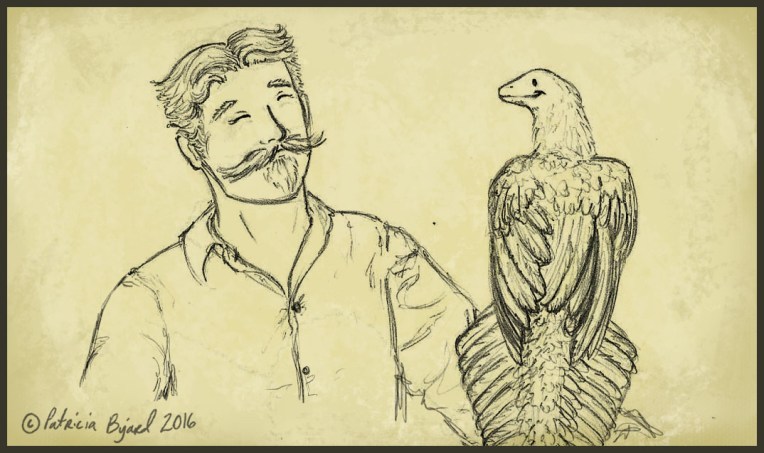
Tango is excited to see you!  Say hello Tango (Weeooh! Chip-chip!).  He gets pretty excited when he meets new people, so we’ll see if he’ll let us talk for a little while. (weep-weep!)
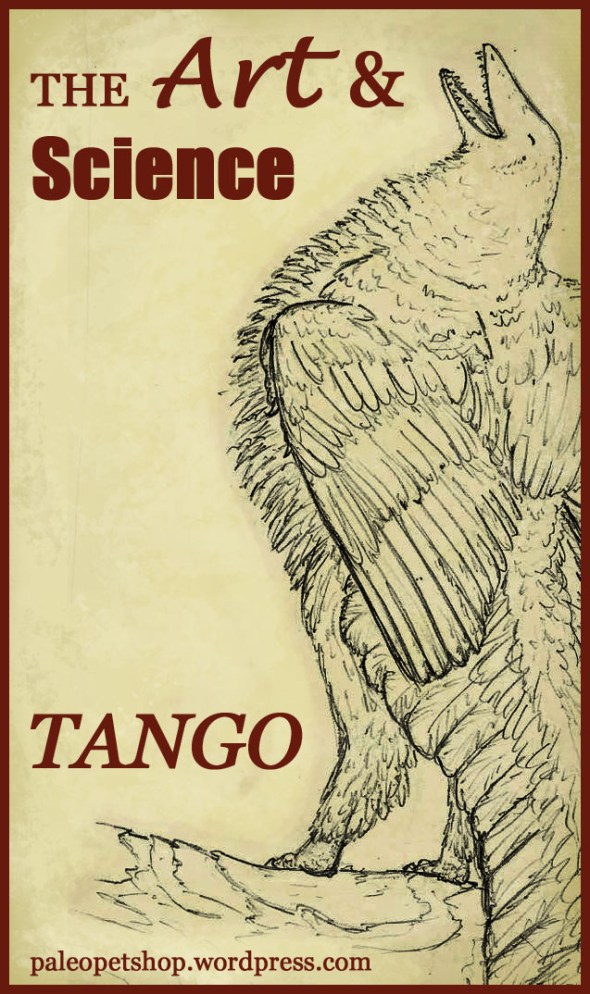


as_tango-copy


A rude (but necessary) disclaimer interrupts this post to say…

I do the best I can with research, but I’m a stay-at-home mom who’s always had a passion for all things prehistoric.  I’m not a paleontologist, and I don’t have access to all the scientific papers available.  But I try my best to keep up to date, and all my illustrations reflect this.

That said, all the drawings in the A&S post series are quick doodles to illustrate a point, with not as much reference as I usually use, so there are plenty of inaccuracies for you to point out for me. 😉

Thank you disclaimer, you can go bother someone else now.

Oh, and one more thing, before you start seeing the name Archaeopteryx everywhere (and trying to pronounce it in your head), here’s a quick pronunciation guide.  I wasn’t sure myself, so I thought I’d share it!


1. Ok, So What is He Really?


You probably recognize Tango from just about every book on dinosaurs out there.  They tend to announce him as the “first bird” a lot, and 8-year-old me would think, “then what’s a bird doing in a dinosaur book?”

So what is he, a dinosaur or a bird?

Well if you read last week’s post on birds, then of course you might say he’s a dinosaur, since all birds are dinosaurs anyway.  But we’re being more specific this time. 🙂

So let’s get into something called cladistics.

To put it simply (partly for my own benefit because I’ve just started getting my hands dirty with this stuff)…

cladistics is how scientists determine where an animal goes on the family tree, and how we explore animal’s relationships with each other.  Animals in any particular group are determined to have shared traits and characteristics, and must therefore have a common ancestor.  

For example.  All cats, wild and domestic, have a number of traits that are the same, so then they must have a single common ancestor that gave them all those traits.  Very much how your great grandmother passed down her characteristics to her daughter, grand daughter, and great-granddaughter. 🙂

I’ll start off with a group of dinosaurs called Theropods.  They’re the ones we typically think of as walking on two legs, and generally meat-eaters, like T-rex. 🙂
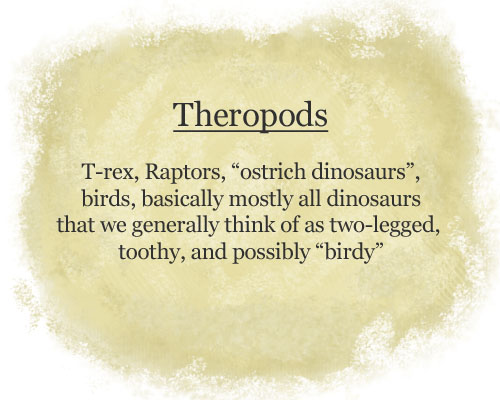
theropods-copy

Nestled inside the Theropod box are many groups.  You can think of them as smaller boxes inside the big box.  The box that we’re taking out of the Theropod box will be a group called Coelurosaurs (seel-ooh-row-saurs).

Most of the critters in this group are possibly feathered, and include the “ostrich dinos”, “velociraptors”, T-rex, and mostly all the animals we would think are birds at first glance.

coelurosaurs-copy

Inside the Coelurosaur box are other boxes, including the one with T-rex inside it.  But as much as I like T-rex, we’ll be ignoring his box for now and looking at a box labeled “Maniraptora”.

This box has animals that are more obviously bird-like.  If we were to see them in life (vs. the Jurassic Park version) we would think “bird” or “very strange bird”.  Very strange (and giant) when it comes to Therizinosaurus, but that’s a subject for another day. 🙂
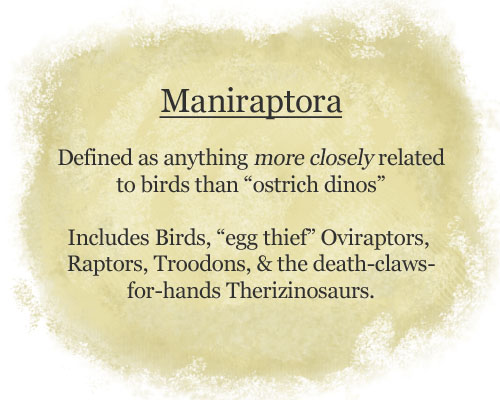
maniraptora-copy

Inside the Maniraptora box there are more boxes.  These boxes get reorganized about twice a year, because now things start getting a little difficult when it comes to separating true birds from non-avian dinosaurs.

We’ll find Archaeopteryx in a box labeled Avialae.

This box includes all modern birds and their direct grandparents and great-great-grandparents.  It also includes the toothy birds, and sometimes Troodontids (think mini raptors, but even more “birdy” and kinda like owls).
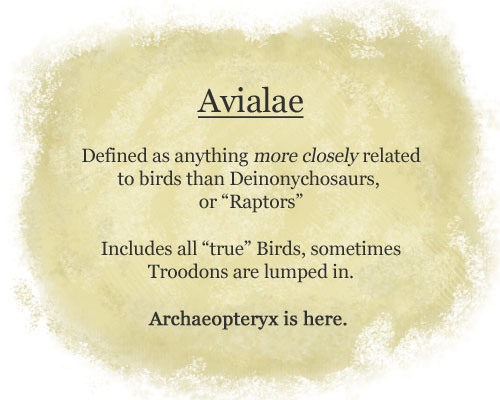
avialae-copy

Whew!  Thank you for sticking with me for all that. 🙂

The final verdict according to the family tree…

Archaeopteryx is a bird. 😀

And yes, it’s a dinosaur too, because birds fit in the “Dinosaur” box.


2. But is He the First?
diggletango-copy

Tango’s gotten a lot of press over the years as the “first bird”, but is he really the first?  It depends on if there was another dinosaur as closely related to modern birds as possible, but earlier in the timeline.

And it turns out there’s another one that’s earlier in the timeline…

Aurornis xui is a bird from Jurassic China, in sediments that are older than the rocks Archaeopteryx are typically found in Europe.  Pascal Godefroit et al. write in their paper on Aurornis that their studies determined it as the…

  • Earliest bird
  • It confirms that Archaeopteryx was indeed a bird

‘Nuff said. 🙂

3. Can He Fly?
flying-tango-copy
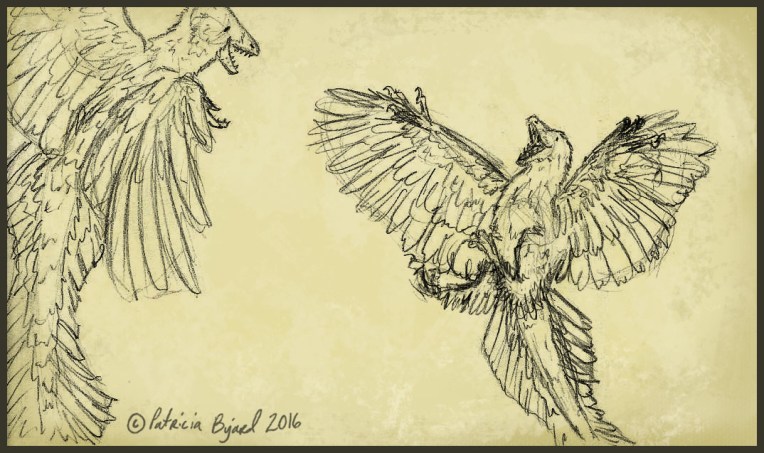
Flying, or falling with style?

Most of us may look at Tango and see a birdy critter with big wings- of course he can fly!  But wait, not so fast.  Flight, as you know, is a very difficult skill to master, and just because an animal has wings doesn’t really mean it has all the other things it needs to fly.

So poor Tango’s been in the middle of an argument.

Can he fly, or is he stuck clambering up into the branches to jump off and glide?  Here’s why many paleontologists believe he can fly…

  • A few amazing specimens have a wishbone (check out pictures of almost all 11 here!)
  • The wing feathers are asymmetrical, just like modern birds.  This gives the wings a more aerodynamic shape, which is useful for flying.


Tango’s muscles are a bit weak, and his tail is not the best for flying, but in nature, whatever you’ve got is good enough to thrive where you’re at.  Tango may’ve been just good enough a flyer to get across the river, from one branch to the next.  Landings were probably not his strong point.

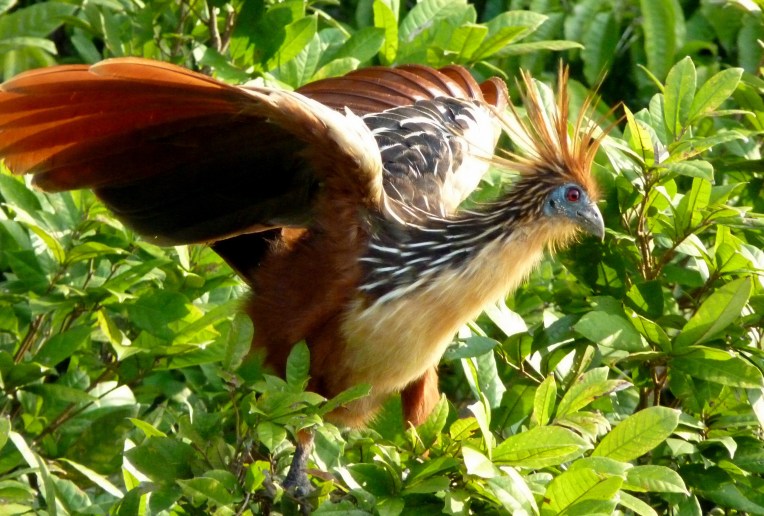
I’d be really curious to see what paleontologists would find if they compared Archaeopteryx flight muscles with those of a hoatzin. 🙂
Hoatzin_in_Peru.jpg
Photo Courtesy of Kate from UK – HoatzinUploaded by FunkMonk, CC BY-SA 2.0, https://commons.wikimedia.org


That’s all for now folks!  Say goodbye Tango…:D


Quick Question: Do you remember your first “encounter” with Archaeopteryx?  How has the media, books, and maybe your own research affected your thoughts of birds as living dinosaurs?  I’d love to hear from you in the comments!

P.S.- You can always hop over the the A&S page to pick out who you want to see next! 🙂
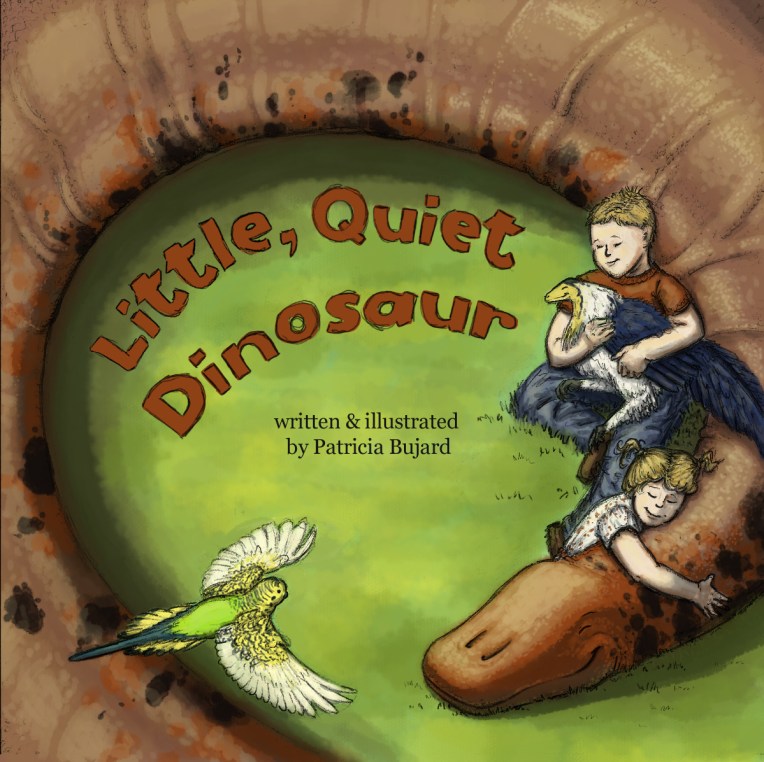
Designing a Book Cover

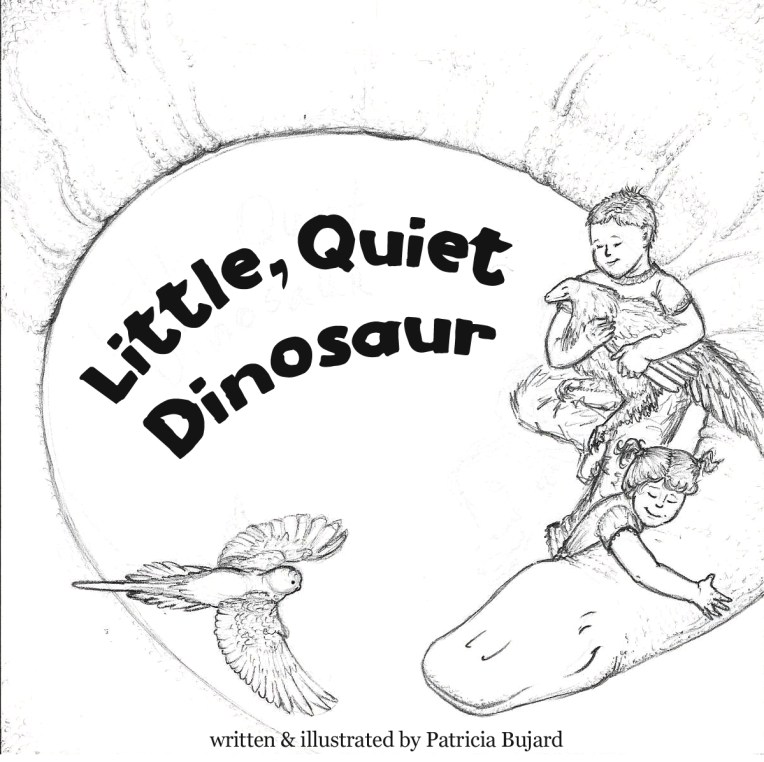
We interrupt our regular Monday program (The Art & Science of Pete’s Paleo Petshop) to give you a bit of quick behind-the-scenes sneak peak.  I’m deep in the heart of picture-book production, and I’m at the point where I want to have the front cover all nice and shiny, so it can be the proverbial carrot at the end of the stick for me.

If I have a clear image of what I’m headed for, then it may be easier to keep heading that direction. 🙂

I would like it very much indeedy if I could have a bit of feedback.  Doesn’t have to be much, just enough to help me steer in the right direction. 🙂

First though, a quick (and brief!) rundown of what’s needed in a picture book cover.

  • Visually appealing- obvious is of course obvious.  What’s your first reaction when you see it?  A resounding yes!  Or…not quite hitting the mark?
  • Gives hints about the story- it makes you want to know what happens.
  • Gives you a “feel” of the story.  Style, general mood, if it’s funny or serious, etc…
  • Text is clear, and can be read from a distance, or at least get you to take a closer look.
  • Would you buy it if you saw it on a shelf?


There’s more to designing a book cover, but those are the basics.  So I have a couple of questions for you…

  • What’s your first reaction when you see the picture?
  • Would you pick up the book if you saw it on a library shelf?  Please tell me why or why not. 🙂
  • Are there any questions you have about the characters or the illustration?  Does it make you want to know more, or know the story behind it?


With those questions in mind then, here is the sketch.

Cover copy.jpg


And here is the colored version as I have it now.  It’s only colored as much as necessary to get an idea of style and general look.  It doesn’t have fine details yet.


Cover_colored_test.jpg

Thank you for swinging by my little corner of the internet, and thank you for taking the time to chat with me today. 🙂  I think it’s pretty awesome that indie publishing is an option, and that you can be a part of this.

Here are those questions again, and it would be most helpful if you could answer the questions for each image above.  Whichever ones work best for each picture. 🙂

  • What’s your first reaction when you see the picture?
  • Would you pick up the book if you saw it on a library shelf?  Please tell me why or why not. 🙂
  • Are there any questions you have about the characters or the illustration?  Does it make you want to know more, or know the story behind it?

Thank you again for taking the time to help me give you something better. 🙂  I love to read your answers in the comments! 😀

The Art & Science: Steggy

Hello there Steggy!  She’s followed me here because she wants the bucket of tasty fern balls I’ve brought with me.  That works out nicely, since she’ll stay here and munch while we point and chat about her for a few minutes.  Just like when we talked about Ajax last week, I’ll stick with 3 research tidbits for now, to keep things short. 🙂


A&S_steggy copy


1. Soft or hard-shelled turtle?

Steggy’s a bit smaller than the average wild stegosaurus, but she’s still quite a bit taller than we are.  If you reach up on your tip-toes you might be able to touch the biggest of her plates, the one right above her hips there.

There’s been some speculation in recent years on if these plates were hard and covered in keratin- like a turtle’s shell or cow’s horn- or if the plates were soft and covered in scales or skin.

I did a bit of digging (research wise), and came across this lovely gem of information written by Darren Naish. He cites a paper provided by Christiansen & Tschopp (2010), who reported a continuous sheath-like covering on one of the plates they referred to another spiketail known as Hesperosaurus.

hesperosaurus copy.jpg
Hesperosaurus. A much smaller spiketail, but so close a cousin that there was a bit of disagreement a couple years back if it should be lumped in with Stegosaurus.

So there you have it.  Hesperosaurus is a very close cousin of Stegosaurus, so in the realm of phylogenetic bracketing that makes it more likely that Steggy had a smooth, hard sheath of horn on her plates and spikes.


2. Armed to the teeth.

tough steggy copy.jpg
One of Steggy’s wild relatives, a Stegosaurus ungulatus to be exact. We should probably back off.  He doesn’t look too happy that we’re so close.

The same Hesperosaurus described had another very rare insight on spiketails- fossil skin.  As you can see on Steggy here, most of her body is covered in small, non-overlapping scales, called tubercles.  They look a bit like pave stones don’t they?  Now look up here, a bit higher up on her side.  Interesting isn’t it?


steggy skin copy.jpg

Steggy has some pretty tough scales.  These large oval scales are called osteoderms, just like the large, hard scales on the backs of crocodiles.  They’re covered in keratin, like our fingernails, and they do a pretty good job as armor.  I’m sure Alfred‘s wild relatives had a tough time munching on wild stegosaurus. 🙂

  • Large, horn plates protect the spine
  • Bony neck armor protects neck from predators and prickly plants
  • Short front legs can bring head lower to the ground (harder to reach) and spiky end up, or push the body up to swivel on powerful hind legs.  Awesome for quick, sharp turns.  No way a hungry predator can get to anything soft and vulnerable if that spiked mace is always between it and the stego.


3. She might not be the sharpest rock, but she’s one tough cookie.


spiketails copy.jpg
Yeesh, I definitely need to practice these guys more.  Fun fact, there are track ways of stegosaurus in small family groups, with young juveniles with a few adults, or a few “teenagers” traveling together.  🙂

Steggy might have a brain the same size as a dog’s, but she’s not nearly as dumb as movies and the media would have you think.  (I’m looking at you Spike, in The Land Before Time).  I think most encounters would not have ended up like the stego in Disney’s Fantasia (which is totally what inspired my love for them in the first place 🙂 )

With all that armor, and tons of fossil evidence with some serious dino damage on Alfred‘s wild relatives, it looks to me that spiketails had an attitude to match their prickly array of spikes and plates.

Because of that, I’ve given Steggy a  bright warning pattern.  Someone told me it reminded her of a skunk, and that’s exactly what I’m going for.  Steggy’s color is something that says “stay away!”

Good thing Steggy is a calm and peaceful pet then, a domesticated spiketail.  Domestic spiketails have a tendency to be nervous, and spook easily (like horses), but Pete works with her a lot, and hardly anything bothers Steggy now. (horses can be trained like this too)

Just for fun, here’s my reasoning on why Steggy may not be as dumb as you think.  A quick check on Youtube brings up plenty of smart tortoises.  Yep, after discovering that it couldn’t fit through the pet door, this one figured out how to open a sliding glass door.


Quick Question: Animals do all sorts of crazy things we wouldn’t expect.  Do you have a story about an animal or pet that did something unexpected?  I’d love to hear your answer in the comments!  

P.S.- You can always hop over the the A&S page to pick out who you want to see next! 🙂
The Art & Science of Ajax

First up is Ajax (hi there Ajax! Give’em a smile), because really he’s the first critter of the lot I ever drew, and he shows up in my sketch book a lot.  Plus he’s just an all around friendly guy, and anyone knows a brontosaurus (ahem, Apatosaurus) when they see one. 🙂


A&S_ajax copy.jpg


So what’s science and what’s art?  To keep this post short, I’ll cover three main points (there are always more, but we can save those for later).  All drawings in these posts are quick doodles to illustrate a point, with not as much reference as I usually use, so there are plenty of inaccuracies for you to point out for me.  But I do have this great toy model replica to look at when I’m clueless as to how something looks at certain angles. 😉


apato toy.JPG
Clearly I have a lot to learn when it comes to photographing these things, but everyone starts somewhere right?  Hehe, and yes, that’s a toy.  Papo’s latest model of Apatosaurus to be exact, inspired by Sideshow Collectibles’ Apatosaurus, which is double levels of gorgeous and ten-thousand times more expensive. 😛

1. Toothy grin, or soft smile?

For starters, let’s talk about Ajax’s smile in the picture above.  There’s a lot of discussion on dinosaur lips-  did they have a toothy grin like crocs, or closed lizard-type lips?

On one hand there’s the study by Ashley Morhardt (unfortunately I can’t find it, so I’m relying on 3rd party sources).  She compared the skulls of prehistoric and modern animals, and looked at the clues left behind by beaks, lips, etc…and her study suggests that sauropods like Ajax had a face more like a crocodile’s than the fleshy lips of mammals.

But…

This article by Duane Nash on the giant canine teeth of saber-tooth tigers (smilodon & relatives) gives some food for thought.  The blog post has all sorts of cool info of what makes a tusk vs. a tooth. 🙂

Ajax’s teeth, like most dinosaur teeth, have a pretty healthy coating of enamel, the same stuff that coats our teeth and makes them hard.  Enamel does best when it’s bathed in saliva 24/7, which is why mostly all animals that have enamel-rich teeth have mouths sealed shut by lips of some sort.

Anyway, Ajax eats whatever he can get a hold of.  He does replace his teeth every once and a while (unlike our permanent set of adult teeth), but still, it takes a while to get a replacement tooth, so he needs to use each set for as long as he can.

With that in mind, I’ve decided to reconstruct Ajax and the other sauropods with closed, lizard-like lips.

It’s one of those things that we can’t know for sure, because even a mummy can’t give you a perfect picture, anymore than a raisin can tell you what a grape looks like.


2. How far can he stretch?

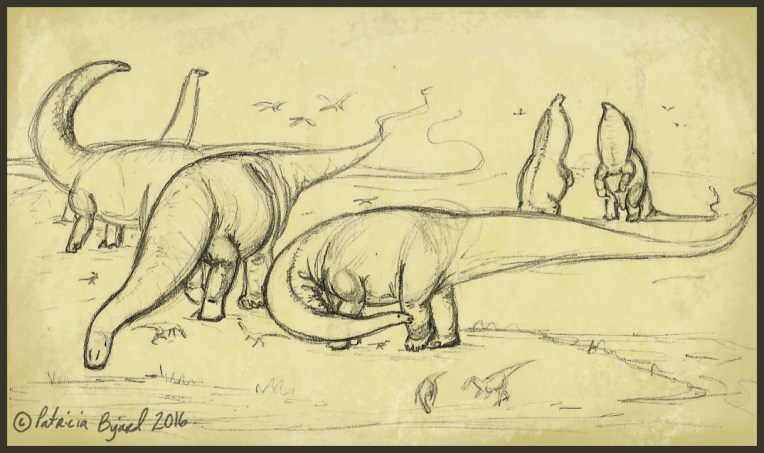
Bronty herd sketch_flat

Oh boy, paleontologists have gone back and forth on this one for over a century.  First thin, graceful necks like swans, then BBC’s Walking With Dinosaurs comes out and shows the fruit of research claiming that Ajax & Dippy held their necks out like suspension bridges.  They held their heads and tails in almost a straight line, and were unable to lift their heads higher than their shoulders.


ajax neck flex.jpg
He’s really trying to impress you

More recent work has pointed out that if you add space for cartilage between the bones, then the necks of many sauropods had the flexibility to loop in a complete circle.  The brilliant minds behind the SV-POW! team over at svpow.com (always enjoyable to read, but definitely more on the technical side) helped rekindle my love for the long-necked giants by holding their heads high again, and regain neck flexibility by taking soft tissues into account.


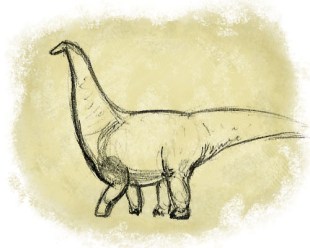
neutral ajax copy
Ajax noticed something interesting

My latest research just today, I come across a paper studying ostrich necks, and what that means for how far Ajax can stretch.

In short, we don’t really know.  But Ajax would probably have a great deal more flexibility than Walking With Dinosaurs would have you believe.  The bendiest part would be the middle of Ajax’s neck, with the ends less flexible.

I always think that animals are more capable than we usually think, so one of Ajax’s buddies has reached back to scratch at an itch on his leg. 🙂

Oh, and those two in the back with the puffy necks…that’s entirely speculative.  Something weird was going on with Ajax’s neck though, that’s for sure. 😉


3. I think we need some bigger horseshoes…

feeding Ajaz sketch copy
Pete bringing Ajax a bucket of fern spores, yum!

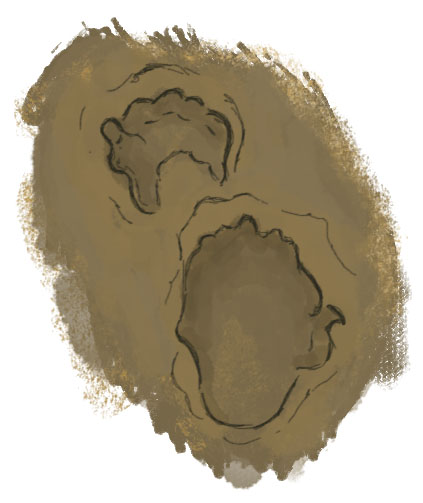
Feet, especially the front feet, are usually drawn very, very wrong when it comes Ajax and his relatives.  Many artists will slap elephant feet on them and call it a day.  But take a look at one of Ajax’s tracks…


Ajax tracks copy.jpgAjax’s legs are like solid pillers, and all the finger bones are wrapped together to form a fleshy, padded, hoof-like structure.  Only the “thumb” has a claw, which has some limited mobility depending on the species.  Ajax can move his thumb claw up and down a little bit. 🙂

Scientists disagree on how much Ajax could move his wrist.  So how far he has his front foot bent at the wrist is a bit speculative.

I’ve done a terrible thing and made his wrist flexible based on an elephant’s range of movement. 😛


Quick Question: Is there anything in the popular media you can think of about Ajax and other sauropods?  What common misconceptions do movies like Jurassic Park and The Land Before Time give about Ajax and his cousins? 🙂  I’d love to hear your answer in the comments!  

P.S.- You can always hop over the the A&S page to pick out who you want to see next! 🙂