
early crocodile
Fossil Friday: Eopneumatosuchus

Species: Eopneumatosuchus colberti (Ee-noo-ma-toh-soo-kus kol-brr-tye)
What it means: Pneumatic passage crocodile
Other species: None
Where I live: Arizona in the U.S.A.- The Kayenta formation
When to find me: The Early Jurassic period, about 196 million years ago.
My favorite food: I like fish the best! I’m a pisciivore.

The Kayenta Formation lies along the southern border of a great desert every bit as hostile as today’s Sahara. The transition of habitat from desert to savanna creates an environment called the sahel, or sahelian climate. Only the hardiest of cycads and stunted conifers grow here. 
The floodplain is savanna for most of the year. Drought-hardy ferns and cycadophytes replace the grasses and wildflowers of today. Cycad groves and the occasional hardy conifer dot the wide expanse. In the distance, we see the green of tree ferns, conifers, and ginkgo trees that trace the banks of the rivers that crisscross the plains. In the hot, wet summer, the rivers flood and turn the plains to marshes choked by horsetails. In the winter, the northern desert blasts sand and cool, dry wind for months of no rain. 
Habitat alongside the many rivers that crisscross the otherwise arid landscape. Mud and silt accumulate from seasonal flooding and sands blowing down from the deserts to the north. Horsetails thrive in places where we might imagine grass and cattails. Ferns, cycadoids, and cycads are the “bushes” of the Jurassic. Ginkgo trees and tree ferns stay close to the water.
My neighborhood: The Kayenta formation used to be a tropical floodplain, a bit like African savannah today- but no grass or flowers. Ferns cover the open plains, dotted with islands of spiky cycad groves. Rivers crisscross the land with lush tree ferns, ginkgo trees, and conifers. Every year during the wet season the plains turn into a flooded marsh, but the hottest months bring no rain, and the rivers shrink until the plains are almost as dry as the great desert that lies to the north.
A few of my neighbors: I’m surrounded by big and scary dinosaurs like Dilophosaurus, Coelophysis, and Kayentavenator, so I stay out of their way. Sarahsaurus (an early sauropod) and Scelidosaurus (armored dinosaur) are plant eaters, but also pretty tough neighbors. Little Scutellosaurus (small armored dinosaur) is quite a bit more friendly, and if I’m lucky might even join me for lunch. Mostly I hang close to the river with the frogs, turtles, or fellow crocodile cousins. I’ll often see a long-tailed pterosaur flying overhead for insects like beetles, dragonflies, an ancient cousin of the moth, and something called a snakefly.
Fun Facts:
- I look a bit like a crocodile, but I’m not! You might say we’re distant cousins.
- Even though there are very few fossils, paleontologists still try to make a good guess at who my closest relatives are. At first they thought I was related to a crocodile-ish critter called Protosuchus. But the latest theory is that I’m from a family called Teleosaurs. They’re crocodile-ish critters that look a lot like the modern gharial (think croc, but with a super skinny and long snout), and they specialized in living out on the ocean. Some of them look a bit like crocs trying to play shark.
- My name basically describes the bones that the paleontologists found. Eo (Latin for passage/ “to move along” + pneumaticus (latin for “operated with air pressure”). Describing the part of the skull that was found. The tympanic synuses in a crocodilian are at the very back of the head, almost where the neck connects. Suchus is from the Greek souchos, which is Greek for crocodile, and is pretty common in the names of croc-ish things.
Fossil Finds: A few fragmentary fossils from the back of the skull.
References:
“Eopneumatosuchus.” Wikipedia, https://en.wikipedia.org/wiki/Eopneumatosuchus
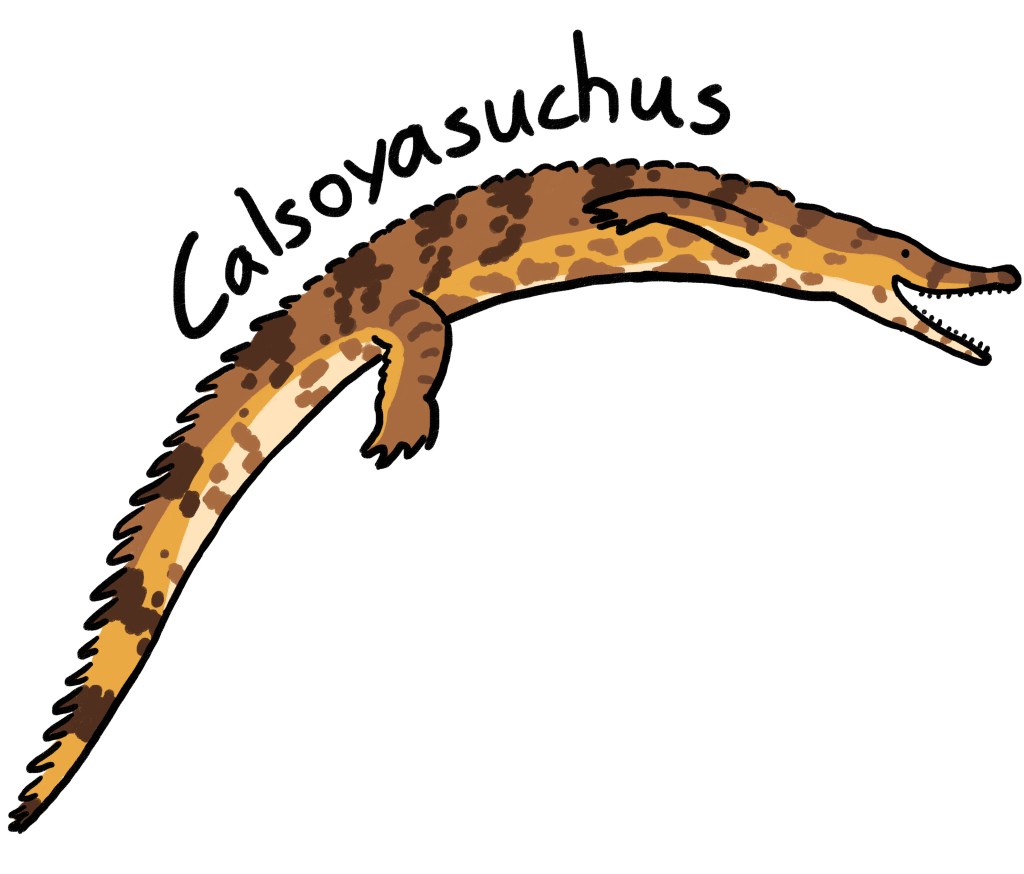
Fossil Friday: Calsoyasuchus
Fossil Friday: Kayentasuchus
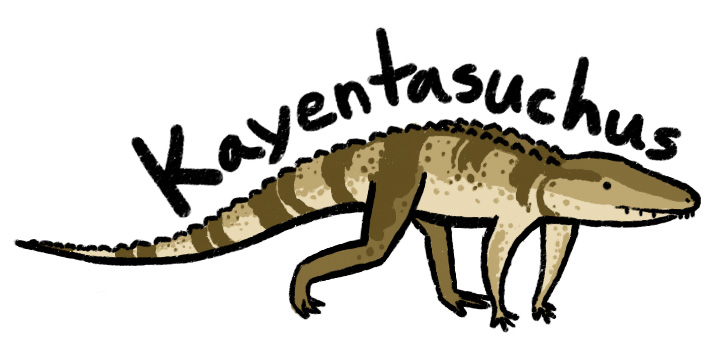

Species: Kayentasuchus walkeri (Kah-yen-tah-soo-kus wah-keh-rye)
What it means: Kayenta crocodile
Other species: none
Where I live: Arizona in the U.S.A.- The Kayenta formation
When to find me: The Early Jurassic period, about 196 million years ago.
My favorite food: Small animals, fish, or the occasional large insect. I’m a carnivore.
My neighborhood: The Kayenta formation used to be a tropical floodplain, a bit like African savannah today- but no grass or flowers. Ferns cover the open plains, dotted with islands of spiky cycad groves. Rivers crisscross the land with lush tree ferns, ginkgo trees, and conifers. Every year during the wet season the plains turn into a flooded marsh, but the hottest months bring no rain, and the rivers shrink until the plains are almost as dry as the great desert that lies to the north.


A few of my neighbors: I’m surrounded by big and scary dinosaurs like Dilophosaurus, Coelophysis, and Kayentavenator, so I stay out of their way. Giant Sarahsaurus (an early sauropod) and little Scutellosaurus (small armored dinosaur) are local plant eaters. Frogs, turtles, and fellow crocodile cousins stay by the river, but I don’t hang out there much. I may be related to crocs, but I like dry land better. I’ll often see a long-tailed pterosaur flying overhead for insects like beetles, dragonflies, an ancient cousin of the moth, and something called a snakefly.
Fun Facts:
- I might look a skinny crocodile, but I’m not a crocodile at all! I’m a crocodile-ish relative called a Sphenosuchian (Ss-fee-no-soo-key-an).
- My name comes from the place they found me, the Kayenta Formation + suchus (latin for crocodile). Suchus is a common word in the names of prehistoric crocs and croc-ish things, and comes from the word Soukhos, the ancient Greek form of the name Sobek, the Ancient Egyptian god that has the head of a crocodile. My species name, walkeri, is in memory of Alick Walker, a well known paleontologist.

Fossil Finds: A nearly complete but fragmentary skeleton, including an incomplete skull with articulated jaw hinge (mandibular rami), articulated torso, articulated right leg, and a few other postcranial bones. Articulated means the bones fit where they should be, instead of scattered everywhere. Postcranial bones are all the bones behind the head.
Resources:
James M. Clark, Hans-Dieter Sues, Two new basal crocodylomorph archosaurs from the Lower Jurassic and the monophyly of the Sphenosuchia, Zoological Journal of the Linnean Society, Volume 136, Issue 1, September 2002, Pages 77–95, https://doi.org/10.1046/j.1096-3642.2002.00026.x
 Pete's Paleo Petshop