Hi there! Terry is here with us today, a rather odd looking critter isn’t she? If I asked you to tell me what she is, what would your answer be? Flying dinosaur? Terradactyl? Pterosaur?
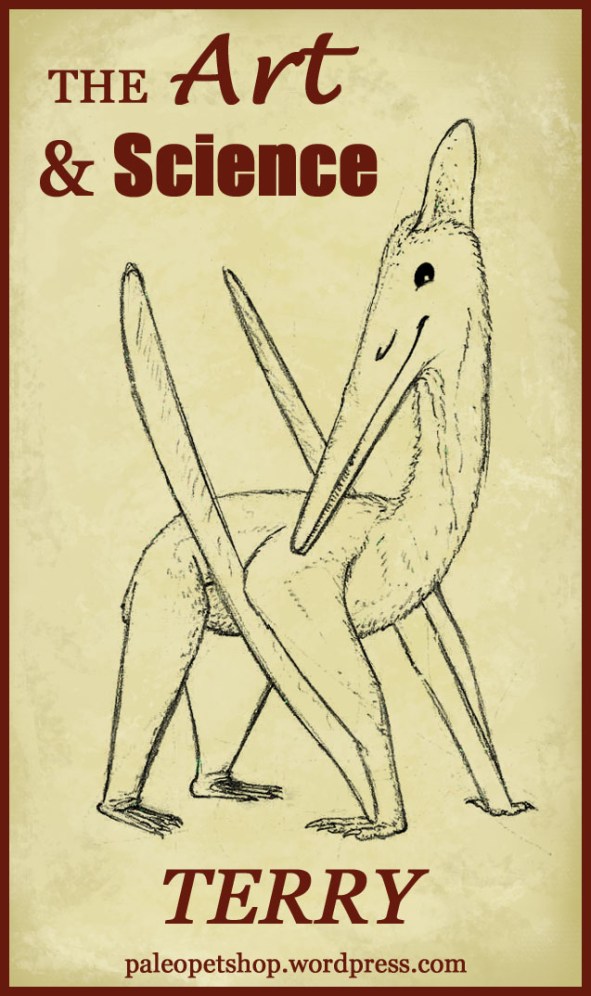
If you said Pterosaur then clearly you’ve done your homework. If not, don’t feel bad (I’m not pointing fingers), because the sad fact is that most books, movies, toys, and pretty much anything to do with dinosaurs always lump Terry and her many relatives into the same pile.
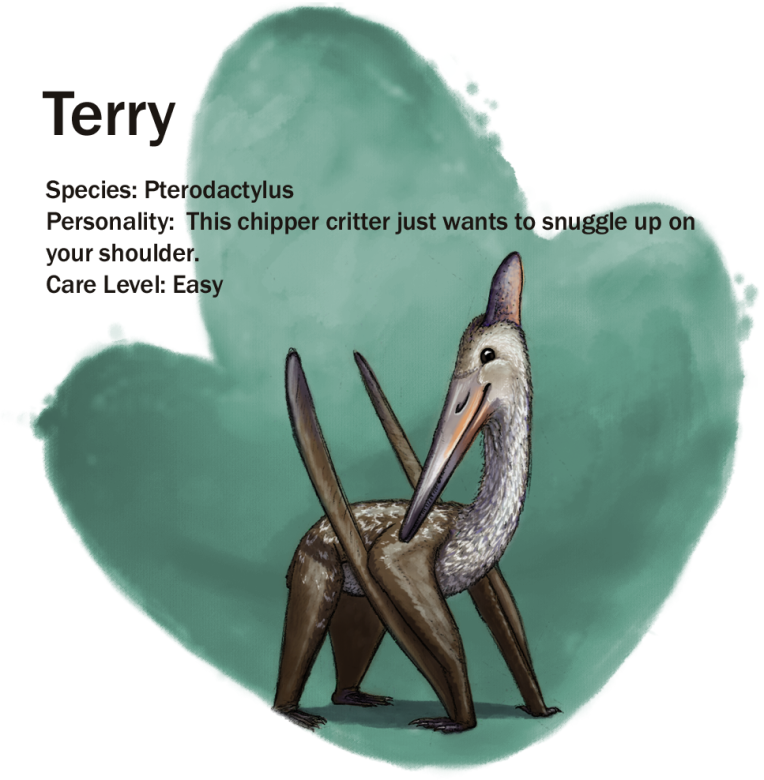
Terry is a Pterosaur (Don’t mind the P there, it’s confusingly silent), a group of flying reptiles closely related to dinosaurs. To be specific, her wild cousins are Pterodactylus kochi. Pterodactylus is the pterosaur, where we get the name for the whole group. So now you know she’s special. 😀
1. Is that…fur?
Terry, like all pterosaurs, is covered in a fuzzy layer of pycnofibers. They’re made of the same keratinous proteins as our hair and fingernails. But they appear to be hollow inside, which makes them much more like feathers than fur.
I say “appear to be”, because not everyone agrees. Most of the fossils are a bit squashed, and even the 3d fossils can be hard to tell if what fills the space inside was part of the living animal or just more of the fossil (or a part of decomposition after the critter died, but before it fossilized).
Last week we saw the basic structure of a feather. If pycnofibers are indeed hollow, then that could mean that they are similar in structure to feathers.
Terry and her many relatives are related to dinosaurs in the same way that crocs are related to dinosaurs (They are all Archosaurs). A bit like a great aunt.
Since many dinosaurs are known to have feathers of various kinds, it would be pretty significant if pterosaur pycnofibers are determined to be feathers as well.
How significant? More fluffy dinosaurs! It’s possible that the earliest dinosaurs had a coat of fur-like feathers. 🙂
2. Hard Beak or Fuzzy Snout?

Now I’m not quite sure where I first heard of the idea of hard-beaked pterosaurs…I think I remember Petrie from The Land Before Time had a beak. Come to think of it, I guess there are plenty of interpretations with beaky pterosaurs, but I’m not sure how many are based on fossil evidence.
So why does Terry have a soft, fuzzy snout?
The fossils don’t have a beak. In fact, in several beautifully preserved ones we see only soft tissues, complete with a soft crest and that lappet on the back of head. There’s a lovely diagram showing how clear the fossil is over at Mark Witton’s wonderful blog. I’d highly recommend you check it out, because he’s an excellent artist, and an expert on all things pterosaur. 🙂
Terry’s friend on the left is a Rhamphorynchus (that’s a mouthful, sorry, let’s call him…Ron). Some illustrate Ron and his wild relatives with just the toothless tip of his snout with a beak, but I’ve based mine off of Mark Witton’s lovely illustration.
Honestly, it’s hard to imagine those crazy teeth with any kind of soft tissue, and that seems to be the argument for a hard beak over the bone.
3. The original pole vaulting masters

Pterosaurs had powerful wings, but their legs weren’t really strong enough to jump up to fly like birds. So does that mean they’re helpless on the ground?
Not at all, look at Terry scamper around!
Pterosaurs were Earth’s first pole vaulting masters. Their powerful wing-arms were strong enough to push their bodies (even the biggest ones) up into the air. Mark Witton proposes that even the largest, giraffe-sized pterosaurs could lift off from the ground. Many could probably take off from the water!
Helpless? I think, not. 🙂 Here’s a quick video so you can see it in action. 🙂
How is it possible?
Unlike birds, pterosaurs have most of their muscle dedicated to their wings. Birds need enough muscle in their legs to jump up before flapping, while pterosaurs pole vault into the air with the same power they use for flying.
So no need to jump off a cliff or wait for warm updrafts of air. 🙂
Quick Question: Ah, the nostalgia of so many movies and documentaries…I must say I still rather like the leathery, cliff-clinging bats in Fantasia (so many great retro-saurs in that one). Are there any pterosaurs from books or movies that have colored how you see these animals? 🙂 I’d love to hear your answer in the comments!
P.S.- You can always hop over the the A&S page to pick out who you want to see next! 🙂
 Pete's Paleo Petshop