The Art & Science of Terry

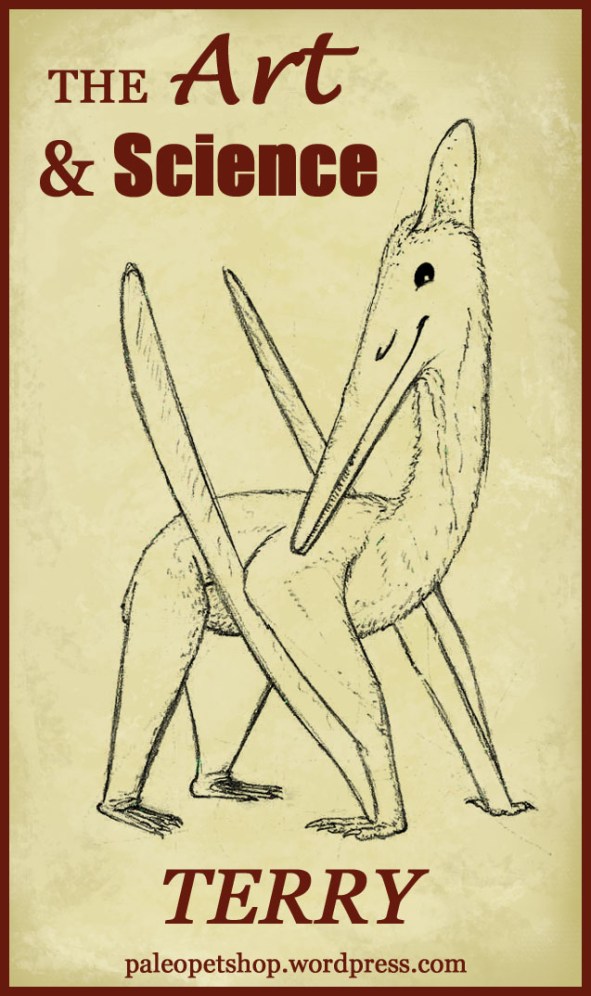
Hi there!  Terry is here with us today, a rather odd looking critter isn’t she?  If I asked you to tell me what she is, what would your answer be?  Flying dinosaur?  Terradactyl?  Pterosaur?
 

as_terry-copy


If you said Pterosaur then clearly you’ve done your homework.  If not, don’t feel bad (I’m not pointing fingers), because the sad fact is that most books, movies, toys, and pretty much anything to do with dinosaurs always lump Terry and her many relatives into the same pile.

Terry is a Pterosaur (Don’t mind the P there, it’s confusingly silent), a group of flying reptiles closely related to dinosaurs.  To be specific, her wild cousins are Pterodactylus kochi.  Pterodactylus is the pterosaur, where we get the name for the whole group.  So now you know she’s special. 😀


1. Is that…fur?

Terry, like all pterosaurs, is covered in a fuzzy layer of pycnofibers.  They’re made of the same keratinous proteins as our hair and fingernails.  But they appear to be hollow inside, which makes them much more like feathers than fur.

I say “appear to be”, because not everyone agrees.  Most of the fossils are a bit squashed, and even the 3d fossils can be hard to tell if what fills the space inside was part of the living animal or just more of the fossil (or a part of decomposition after the critter died, but before it fossilized).

Last week we saw the basic structure of a feather.  If pycnofibers are indeed hollow, then that could mean that they are similar in structure to feathers.

Terry and her many relatives are related to dinosaurs in the same way that crocs are related to dinosaurs (They are all Archosaurs).  A bit like a great aunt.

Since many dinosaurs are known to have feathers of various kinds, it would be pretty significant if pterosaur pycnofibers are determined to be feathers as well.

How significant?  More fluffy dinosaurs!  It’s possible that the earliest dinosaurs had a coat of fur-like feathers. 🙂


2. Hard Beak or Fuzzy Snout?

fuzzy beak copy.jpg
Terry & Ron are both pterosaurs, but look very different from each other.  Fuzzy snout vs. hard beak.  The difference in texture of fluffy pycnofibers is my own speculation.  We don’t really know what these might’ve looked like in life.

Now I’m not quite sure where I first heard of the idea of hard-beaked pterosaurs…I think I remember Petrie from The Land Before Time had a beak.  Come to think of it, I guess there are plenty of interpretations with beaky pterosaurs, but I’m not sure how many are based on fossil evidence.

So why does Terry have a soft, fuzzy snout?

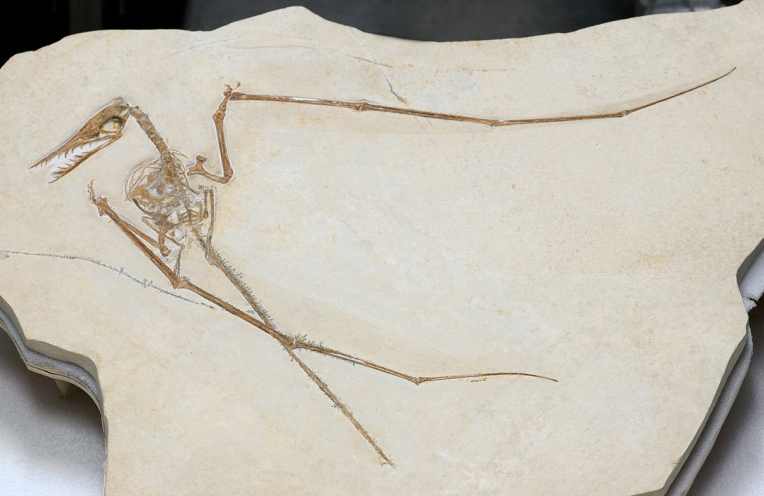
The fossils don’t have a beak.  In fact, in several beautifully preserved ones we see only soft tissues, complete with a soft crest and that lappet on the back of head.  There’s a lovely diagram showing how clear the fossil is over at Mark Witton’s wonderful blog.  I’d highly recommend you check it out, because he’s an excellent artist, and an expert on all things pterosaur. 🙂

Terry’s friend on the left is a Rhamphorynchus (that’s a mouthful, sorry, let’s call him…Ron).  Some illustrate Ron and his wild relatives with just the toothless tip of his snout with a beak, but I’ve based mine off of Mark Witton’s lovely illustration.

Honestly, it’s hard to imagine those crazy teeth with any kind of soft tissue, and that seems to be the argument for a hard beak over the bone.


3. The original pole vaulting masters

terry-take-off-copy

Pterosaurs had powerful wings, but their legs weren’t really strong enough to jump up to fly like birds.  So does that mean they’re helpless on the ground?

Not at all, look at Terry scamper around!

Pterosaurs were Earth’s first pole vaulting masters.  Their powerful wing-arms were strong enough to push their bodies (even the biggest ones) up into the air.  Mark Witton proposes that even the largest, giraffe-sized pterosaurs could lift off from the ground.  Many could probably take off from the water!

Helpless?  I think, not. 🙂  Here’s a quick video so you can see it in action. 🙂

How is it possible?

Unlike birds, pterosaurs have most of their muscle dedicated to their wings.  Birds need enough muscle in their legs to jump up before flapping, while pterosaurs pole vault into the air with the same power they use for flying.

So no need to jump off a cliff or wait for warm updrafts of air. 🙂


Quick Question: Ah, the nostalgia of so many movies and documentaries…I must say I still rather like the leathery, cliff-clinging bats in Fantasia (so many great retro-saurs in that one).  Are there any pterosaurs from books or movies that have colored how you see these animals? 🙂  I’d love to hear your answer in the comments!  

P.S.- You can always hop over the the A&S page to pick out who you want to see next! 🙂
A Few Fast Feather Facts

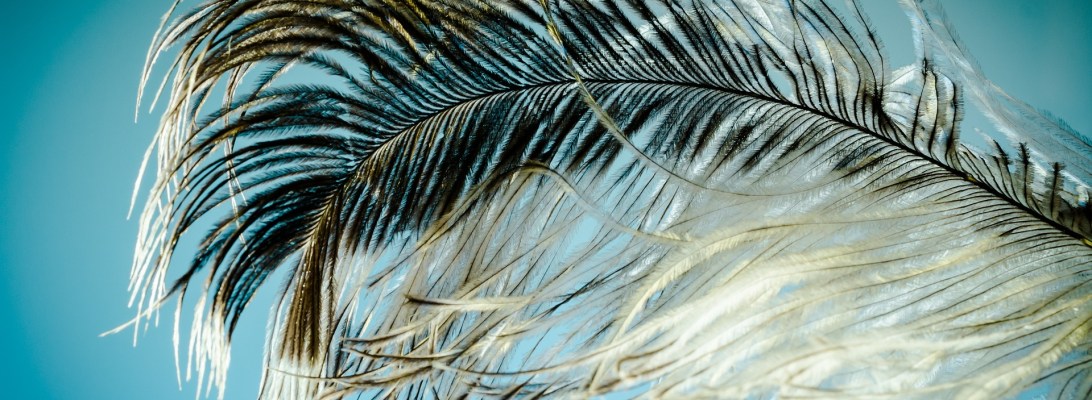
It’s about time that we have a short chat on feathers.  They are very complex, beautiful structures, and you could probably write entire books about them, but we’ll just cover a couple of things I didn’t know about until I researched it (Pretty cool when something so ordinary becomes amazing, just by taking a closer look).


Feathers are keratinous (like our hair or fingernails) structures that grow from the skin, and there are many different forms that serve many different functions.  Here’s a video where we can see the basic structure of a feather quite nicely. 🙂


Remember our emu friend a while back?  Here’s a closer look at its feathers…


emu-feathers-332572_1920


These feathers are like the peacock feather.  The shaft, or rachis, branches off into many barbules, but those barbules don’t have the little hooks that ziplock together.  Since Emu’s don’t fly or swim much, there’s no need for the streamlined contour feathers flying birds have.

Emus have no problem with staying dry in the rain, because just like any other bird, they spend a good part of their day combing their beaks through their feathers and coating them with oil from a gland near the base of their tails.

Here’s another video, this one about how varied feather shapes can be, and what they can be useful for.  It focuses on birds of paradise and their crazy display plumage, but try to think about what it means for other feathered, flightless animals (like feathered dinos), and how they might use feathers. 🙂


Next week, we’ll finally get to see the Art & Science of little Terry.  Keeping this post in mind will help keep that one short, because flying reptiles like Terry are rumored to have a fluffy coat of feathers… 😉

If you want to know more about feathers, here’s a spiffy (yes, I said spiffy) link- everything you need to know about feathers. 😀

Quick Question:  What was your favorite out of the wacky feathers displayed by the birds of paradise?  Do you think feathered dinosaurs could’ve had similarly weird and wonderful feathers?  I’d love to hear your answer in the comments! 😀


Critter of the Week: Pterodactylus

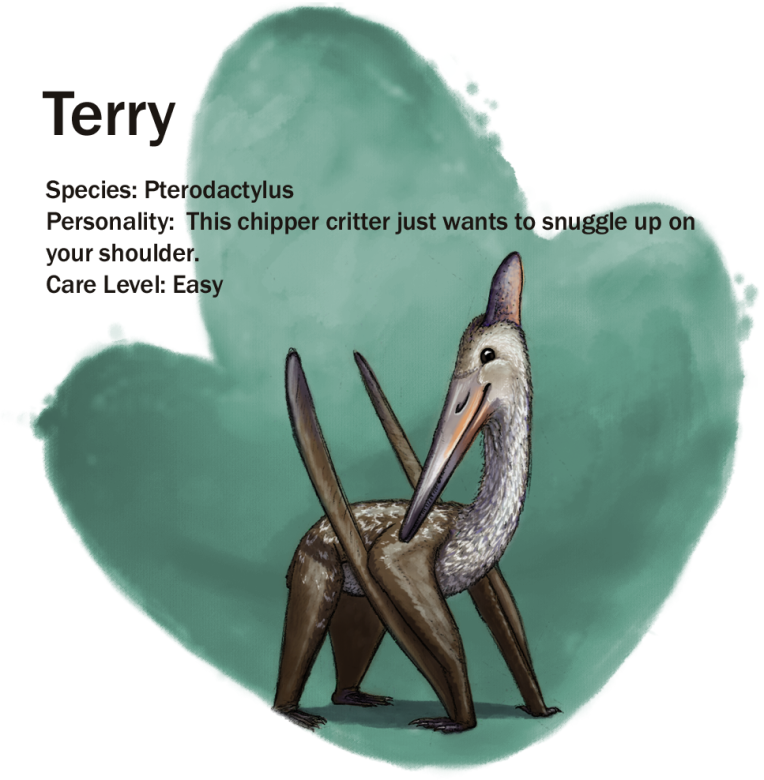
Meet Terry. He’s a chipper little guy who would love to scramble up onto your shoulder and nibble your ear (just a little nibble, it tickles).  And could he please, pretty please have a tiny bit of that sandwich?


Terry.png


Terry always likes a snack, especially small morsels like snails, grubs, and worms he digs up.  That sandwich looks quite tempting though, and he won’t turn his nose up at an opportunity to snatch it out of your hand, so keep an eye and a firm hold on it. 😀

He might not look it, but this little pterosaur (not dinosaur), is very good at walking and running around on the ground.  He spends a lot of his time poking his sensitive beak in the dirt for all sorts of burrowing creepy crawlies.  When he feels one, he nabs it with his tiny teeth and gulps it down.  Yum!

These flying reptiles have a layer of furry fuzz covering their bodies. To make a long (and possibly boring) story short, we know this covering is not fur, but we’re not 100% sure if it’s some kind of feather or not. It might be something totally new.  If the fuzzies are feathers, as some paleontologists suggest, then that says a lot for how many dinosaurs probably had feathers.  Pterosaurs aren’t dinosaurs, but they’re like 2nd cousins. 🙂

Also notice how the wings are not saggy skin.  The wings are actually super awesome (insane genius levels of cool!), and they deserve their own post, but I’ll try to give you the short version.  They’re “smart” wings with layers of muscle and inflatable air pockets, and they behave a bit like the wings on a plane.  I can tell you this for sure, they’re not anything like bird or bat wings.

Oh yes, one more thing.  The beak is speculation on my part.  I read a paleo article somewhere about the possibility of terries having beaks, so I figured I’d draw it and see how it looks.  I’ll have to do more research from more paleo experts to figure out if this is just a wild idea or actually plausible.

Just to clarify, this beak is a thin, keratinous layer over the skull, so not exactly like a bird’s beak.  Similar, but this little guy still has teeth. 🙂


Making progress…

Well, after about a month I’ve determined that trying to get a buffer down is failing.  All it takes is a little hiccup in the week, and then I’m back to working on my posts the weekend they’re due. 😛

So I’ll be trying something else to help streamline things.  Two posts  per week is a realistic number, so I can stick to that, but I think I’ll trying incorporating actual work on the picture book into my Monday posts. 🙂  That way I can make progress on the whole reason this site exists.

Critter of the Week is here to stay.  It’s too much fun!  And I like having a new critter to practice on each week. 🙂  So we’ll see what I can do for Monday.  Hehe, experiment time. 😀


Coming Next Week…

This little guy loves to curl up in his bed with his favorite teddy. 🙂

Share your guess in the comments! He’s one of the critters over on the critter page. 🙂

Time to Get Wild! (how we can guess about behavior, and how crazy it can get!)

Now we’ve put all the pieces together and figured out what they mean (sort of).  We’ve done our best to cloth the muscle and bone with fatty tissue, skin, and maybe even feathers.  Now we can really get wild.


But surely there’s no way to have any clues on behavior?  It’s all just guesswork right?

Well no, fossils can leave behind clues even for how an animal lived.  Here are a few ways we can speculate (or make an educated guess based on fossil evidence) how wild these critters could get. 🙂


Bones & Teeth             

  • Teeth can tell us a lot about what an animal ate, and the rest of the skeleton can give clues as to how it ate.  For example: the slender, notched jaw of Dilophosaurus suggests that it usually ate fast, slippery prey.
Image courtesy of Jaime A. Headden (2011).  Check out his blog to see more beautiful diagrams & illustrations, or if you want to look up more detailed info on all things paleontology. 🙂  Qilong.wordpress.com
  • It’s not fool proof though, just look at pandas and fruit bats.


  • Sometimes an animal that looks specialized in one thing is just specialized to survive during hard times. Example: seals that have teeth “specialized” for eating krill don’t only eat krill.  They eat everything they can get their teeth on, with the added bonus of pigging out on krill when they can, just because they can.


Articulated Skeletons      

  • Sometimes animals are buried suddenly and quickly.  In especially rare cases, these complete skeletons preserve “candid shots”, moments frozen in time by a collapsing sand dune, mudslide, or drifting down into a deep, cold lake.
  • Click on the pictures for more info. 🙂


Track Ways                                 

dino_09.jpg
Photo courtesy of R. T. Bird
  • There are many more tracks than bones, and they offer a unique look at prehistoric animals in action.  Here are a few things we can learn from tracks…
    • How they moved
    • How fast they moved
    • How different animals interact (like traveling herds, or pursuit of prey)
    • Swimming pterosaurs!  There are many tracks of the flying critters swimming.  Interestingly enough, the tracks only have back paw prints.
Witton 2013 swim traces.png
Image courtesy of Witton 2013


Other Trace Fossils        

Coprolite.png
Wikipedia commons


  • Fossil dino poo is even better at telling us what a dino ate than its teeth.  The only problem is figuring out who it came from (unless you have a fossil of an animal mid-poop!)
pterosaur_henderson_4090
This little Pterosaur drifted to the bottom of a very deep lake. If you follow the spine with your eyes to just below the blobby rib cage at the base of the tail, there’s a tiny shadow that looks like a cucumber shape. This critter was fossilized mid potty-break. Image courtesy of the Royal Tyrrell Museum of Palaeontology.
fig-4-2x
Here’s a closer image. The little arrows labeled cp are pointing to the coprolite, or fossil poo. 🙂 Image courtesy of Hone et al. (2015)
  • Dino burrows give great insight into the social nesting behavior of some dinos.
  • Nests, teeth marks on bones, and dino bottom prints (true story) are all great clues left behind by living prehistoric animals.  Put together, they offer a glimpse into the animal’s story.


Modern Family             

  • Since crocs are living relatives of dinosaurs, and birds are dinosaurs, then they are a great place to look for clues.  Take a closer look, and we may get a glimpse of exactly how strange, beautiful, and wonderful dinosaurs could be.
  • The croc family may look tough and mean, but here are a couple of normal behaviors that show how gentle and social they can be.


  • Here are a few funky bird dances.  Bright colors not required. 😉


Quick Question: Which was your favorite dancing bird? How do you think looking at modern animals like these can inspire our vision of prehistoric animals?  I’d love to hear from you in the comments! 🙂


Fleshing out the Bones Series: