Meet Alfred. The lion of the Jurassic! The prince of the Mesozoic! The…oh, there he goes after another butterfly. All he needs to be happy in life is his food, his chew toy, and a nice long nap.
Looks like Alfred has found something to chase. No worries though, that butterfly has nothing to fear, and he’ll give up soon enough. Allosaurus (ah-low-saw-rus) wasn’t very fast, but he can’t help it- if it runs off, he’s got to chase it! After a quick sprint, Alfred loves to settle under the shade of a tree and take a nice nap.
What’s that you say? He’s a fearsome predator? Well yes, yes he is. Take a quick look at lions, and tigers, and bears (oh my!), and most of the time you’ll actually catch them napping. Crocodiles and eagles, Alfred’s closest living relatives, also do a lot of nothing. Once you have a full belly, why not enjoy a siesta in the sun? 🙂
Fun Fact: This guy is the first critter that I kinda found my style. All the ones I drew before him were very inconsistent, but this one had the sketchiness and detailed painterly mixture I was looking for. All other critters after him I’ve been refining my technique and getting better.
Now I have to practice on my people!
Making progress…
I had a big surprise planned. The goal was to have Pete’s Postcards from the Shop all set up by my birthday (that’s today. I just set it as a convenient goal date. 🙂 )
The Critter Cards were done, I got the PDF file sorted out, Mailchimp all set up and ready to go…I run through the motions to test it out for myself and…
Nothing.
I wasn’t really surprised, since I can’t really use my personal email account to send you emails from the Paleo Petshop. But it was worth a try. I’m trying to spend as little money as possible until I start earning a little. This can turn into a really expensive hobby really fast if I’m not careful.
Not exactly what I’m going for. 🙂
So now I’m figuring out the best place to purchase a domain name, so that PaleoPetshop.wordpress.com can turn into PaleoPetshop.com. Only problem is that so many places offer so many different packages with bells and whistles I’m not ready for just yet. Like webhosting.
All I need is an official domain name, and the email address I can use with Mailchimp.
Wish me luck! I’ve got a couple of options I’m looking at, but it’s just a matter of figuring out which one’s a better fit. 🙂
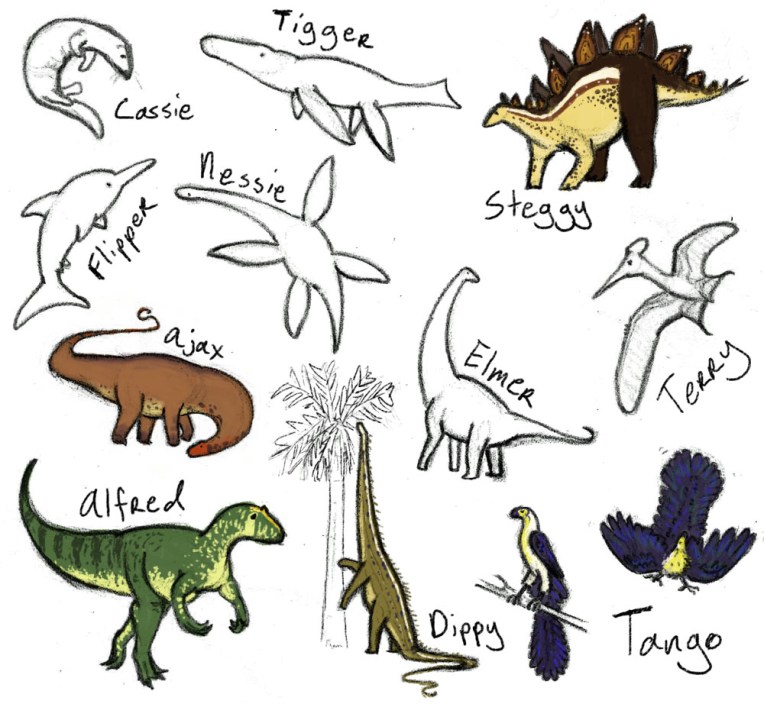
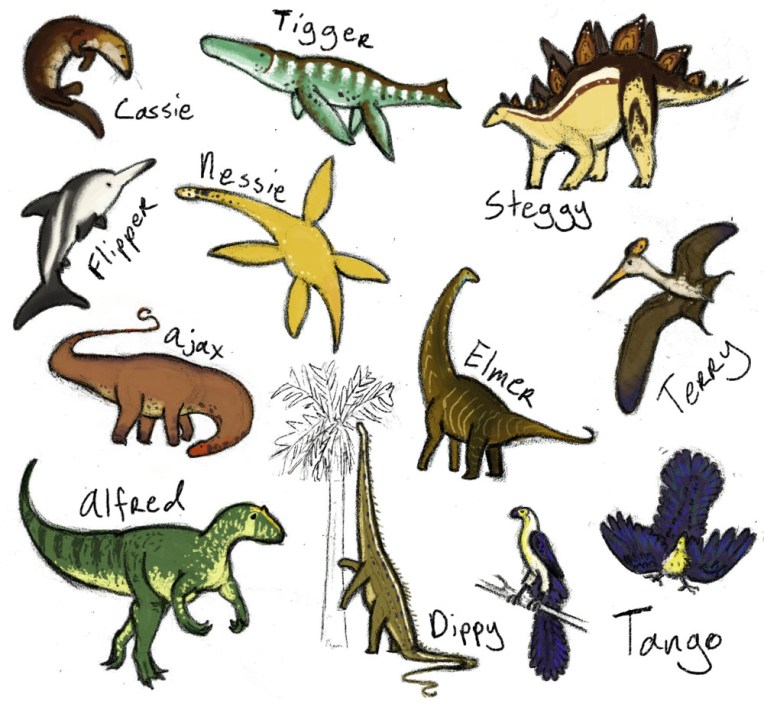
In the meantime, here’s the Critter Card chart with all dinosaurs colored in. 😀
Coming Next Week…
A giant with a heart of gold, life is never boring when this big guy is around. Nothing is out of reach! He’ll stick his nose into everything until every mystery is solved.
Meet Tango. This bird likes to party, and loves being the center of attention even more!
Tango is a pretty good example of when you should check with your neighbors before you choose your pet. Of course, if you live out in the sticks like I do, then it doesn’t matter so long as you don’t mind going deaf.
Ok, ok, I exaggerate. But really, unless you like a whole lot of this going on, I’d reconsider a quieter critter.
Making progress…
I’ve got profile pictures for all the critters on the critter page! (I’m super super excited, because that’s the most obvious sign of my progress so far XD )
Speaking of profile pics, notice how Tango got a shiny updated one? (hint hint, nod nod)
Now I’m starting on their official character pages. You can go to the critter page and click on Tango (or if you’re lazy, just click here 😛 ) It’s pretty basic, and not very shiny yet, but hey, it’s a start. 🙂
I also got Tango’s card done. One more dinosaur to complete the series, and I’ll open up the official sign up for Postcards From the Shop!
Coming Next Week…
This guy will chase after anything that moves, or smells good… 😉
Tango is excited to see you! Say hello Tango (Weeooh! Chip-chip!). He gets pretty excited when he meets new people, so we’ll see if he’ll let us talk for a little while. (weep-weep!)
A rude (but necessary) disclaimer interrupts this post to say…
I do the best I can with research, but I’m a stay-at-home mom who’s always had a passion for all things prehistoric. I’m not a paleontologist, and I don’t have access to all the scientific papers available. But I try my best to keep up to date, and all my illustrations reflect this.
That said, all the drawings in the A&S post series are quick doodles to illustrate a point, with not as much reference as I usually use, so there are plenty of inaccuracies for you to point out for me. 😉
Thank you disclaimer, you can go bother someone else now.
Oh, and one more thing, before you start seeing the name Archaeopteryx everywhere (and trying to pronounce it in your head), here’s a quick pronunciation guide. I wasn’t sure myself, so I thought I’d share it!
1. Ok, So What is He Really?
You probably recognize Tango from just about every book on dinosaurs out there. They tend to announce him as the “first bird” a lot, and 8-year-old me would think, “then what’s a bird doing in a dinosaur book?”
So what is he, a dinosaur or a bird?
Well if you read last week’s post on birds, then of course you might say he’s a dinosaur, since all birds are dinosaurs anyway. But we’re being more specific this time. 🙂
So let’s get into something called cladistics.
To put it simply (partly for my own benefit because I’ve just started getting my hands dirty with this stuff)…
cladistics is how scientists determine where an animal goes on the family tree, and how we explore animal’s relationships with each other. Animals in any particular group are determined to have shared traits and characteristics, and must therefore have a common ancestor.
For example. All cats, wild and domestic, have a number of traits that are the same, so then they must have a single common ancestor that gave them all those traits. Very much how your great grandmother passed down her characteristics to her daughter, grand daughter, and great-granddaughter. 🙂
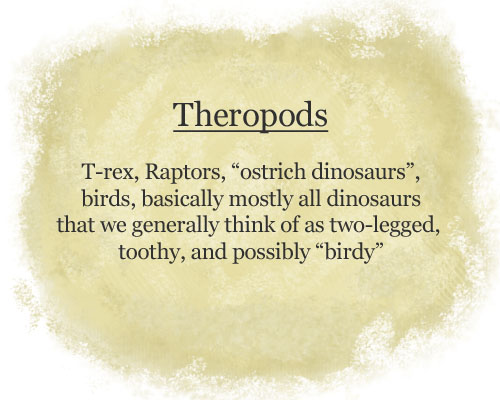
I’ll start off with a group of dinosaurs called Theropods. They’re the ones we typically think of as walking on two legs, and generally meat-eaters, like T-rex. 🙂
Nestled inside the Theropod box are many groups. You can think of them as smaller boxes inside the big box. The box that we’re taking out of the Theropod box will be a group called Coelurosaurs (seel-ooh-row-saurs).
Most of the critters in this group are possibly feathered, and include the “ostrich dinos”, “velociraptors”, T-rex, and mostly all the animals we would think are birds at first glance.
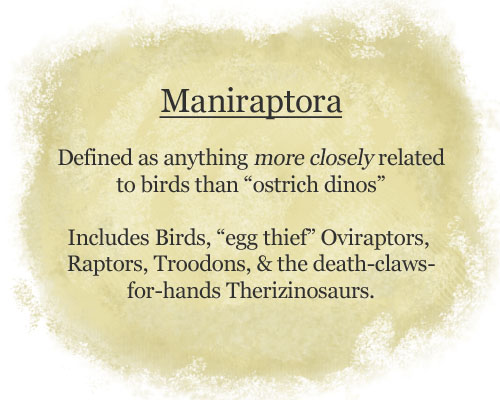
Inside the Coelurosaur box are other boxes, including the one with T-rex inside it. But as much as I like T-rex, we’ll be ignoring his box for now and looking at a box labeled “Maniraptora”.
This box has animals that are more obviously bird-like. If we were to see them in life (vs. the Jurassic Park version) we would think “bird” or “very strange bird”. Very strange (and giant) when it comes to Therizinosaurus, but that’s a subject for another day. 🙂
Inside the Maniraptora box there are more boxes. These boxes get reorganized about twice a year, because now things start getting a little difficult when it comes to separating true birds from non-avian dinosaurs.
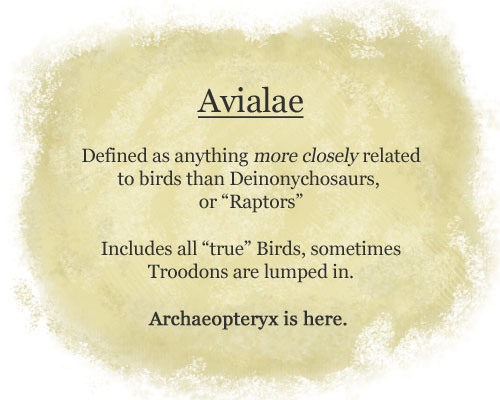
We’ll find Archaeopteryx in a box labeled Avialae.
This box includes all modern birds and their direct grandparents and great-great-grandparents. It also includes the toothy birds, and sometimes Troodontids (think mini raptors, but even more “birdy” and kinda like owls).
Whew! Thank you for sticking with me for all that. 🙂
The final verdict according to the family tree…
Archaeopteryx is a bird. 😀
And yes, it’s a dinosaur too, because birds fit in the “Dinosaur” box.
2. But is He the First?
Tango’s gotten a lot of press over the years as the “first bird”, but is he really the first? It depends on if there was another dinosaur as closely related to modern birds as possible, but earlier in the timeline.
And it turns out there’s another one that’s earlier in the timeline…
Most of us may look at Tango and see a birdy critter with big wings- of course he can fly! But wait, not so fast. Flight, as you know, is a very difficult skill to master, and just because an animal has wings doesn’t really mean it has all the other things it needs to fly.
So poor Tango’s been in the middle of an argument.
The wing feathers are asymmetrical, just like modern birds. This gives the wings a more aerodynamic shape, which is useful for flying.
Tango’s muscles are a bit weak, and his tail is not the best for flying, but in nature, whatever you’ve got is good enough to thrive where you’re at. Tango may’ve been just good enough a flyer to get across the river, from one branch to the next. Landings were probably not his strong point.
I’d be really curious to see what paleontologists would find if they compared Archaeopteryx flight muscles with those of a hoatzin. 🙂
Quick Question: Do you remember your first “encounter” with Archaeopteryx? How has the media, books, and maybe your own research affected your thoughts of birds as living dinosaurs? I’d love to hear from you in the comments!
If I asked you, “What is a bird?” What would you say? For most of us (at least for me) the first things that come to mind are feathers, a beak, and usually flight. Oh yes, and lays eggs. If you look out your window, go on a hike, or visit the zoo, it’s easy to recognize birds for what they are.
But what if we went back in time a few million years? It may be harder to pick out the bird from the…not bird, than you think.
Let’s say you’re picking your way through the thick undergrowth of a pine grove. You hear twittering from a branch above you, and you look up to see the tiny singer. It looks like a bird, it acts like a bird, but when it opens its beak to sing you notice tiny teeth.
Is it a bird?
Let’s try another one. Another place, another time.
You look up when you hear the sound of flapping wings above you. At first glance it looks like a bird, but then you notice those long tail feathers are not just feathers. Instead of a long train like a parrot or peacock, this fan is supported by a long tail. A closer look and you notice that this bird has claws on its wings, and a beakless snout with tiny teeth.
Is it a bird?
Let’s take a look at one more.
In another place, another time, we peak through the branches to look out into a clearing. Pecking at the undergrowth is something that looks a bit like an ostrich, or maybe an emu. Shaggy feathers, a toothless beak, and feather-duster wings all look like a big, flightless bird. But no bird has a long tail like that. That tail looks like it belongs on a lizard, if only it wasn’t covered in feathers.
Is it a bird?
At first glance, all three look very much like birds.
The first is an early bird called Sulcavis, which lived around the same time as T-rex, in China.
The second is Archaeopteryx. More dinosaur than bird, and from a much earlier time in Germany. It’s often reported as the first bird, but there are earlier cousins that are more bird than dinosaur.
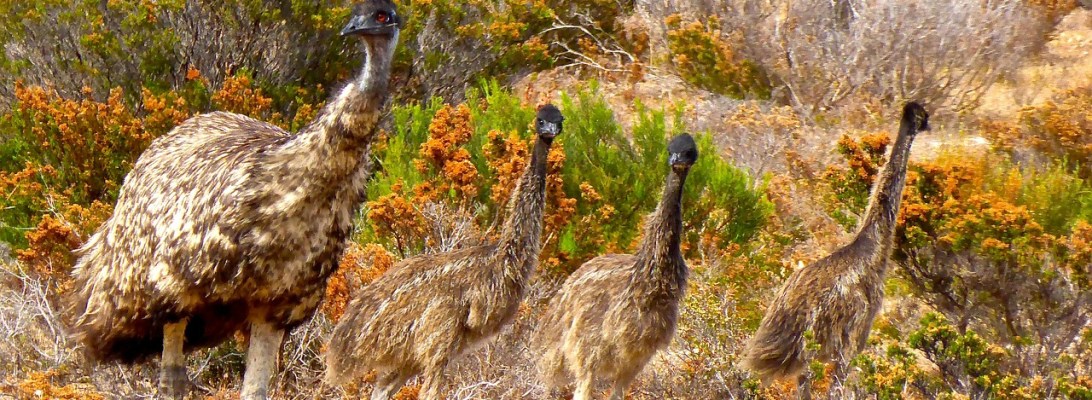
The third is Gallimimus. If you’ve ever seen the original Jurassic park, these are the featherless “ostrich dinosaurs” that stampede around the heroes. Fossils now tell us that these dinosaurs would look very much like emus and ostriches with tails. 🙂
So how do we know which is which? We can’t define it based on feathers, eggs, or flight. In fact, paleontologists argue quite a bit on exactly what makes something a bird or a dinosaur.
The best answer I have on this insanely complicated subject (because let’s face it, I’m no expert. I’m just a couch enthusiast 😛 )…
All birds, past and present, are dinosaurs. But not all dinosaurs are birds. 😉
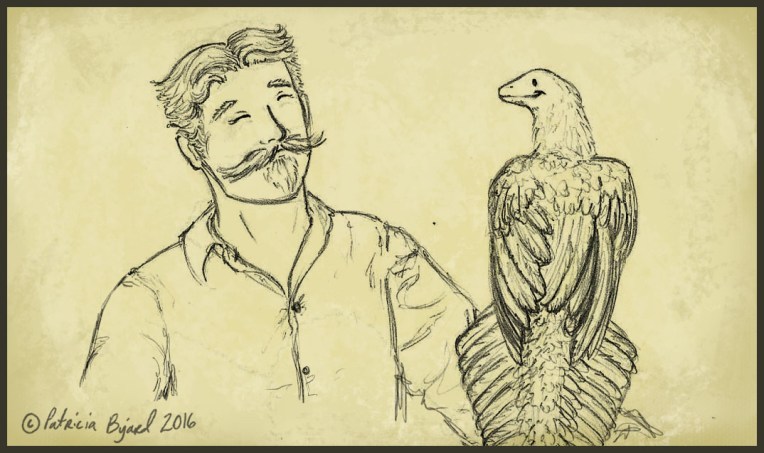
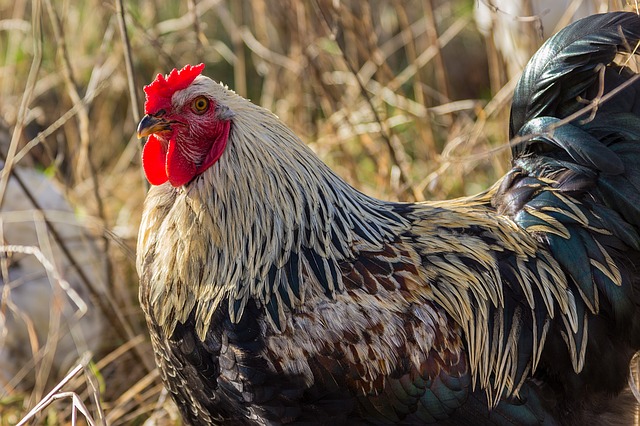
Even this handsome guy. I love the thought of dinosaurs running around my yard and giving me eggs.
Quick Question: What do you think about the relationship of birds and dinosaurs? The discovery of more and more dinosaurs with feathers has turned into a rather hot topic, with passionate feelings on both sides.
Me? I think our entire natural world (and our place in it) is amazing beyond words, so I’m cool with anything the latest research has to dish out. Birds jumping on the dinosaur wagon just adds a whole new dimension of awesome. 😀
When you think of an animal with wings, you usually think of something that can fly right? Bird is one of the first things that pops in my head, and when most of us think of birds, we usually think of birds that fly.
But not all birds fly. Of course, out of all the birds that can’t fly, what’s the first thing that comes to mind. Penguin? Ostrich? Kiwi?
“I believe I can flyyyy!”
Then there’s another category (wait, there’s more?).
Those are the birds that don’t usually fly, the sort of bird that we’re always a bit surprised to hear can actually fly.
Like turkeys. 🙂
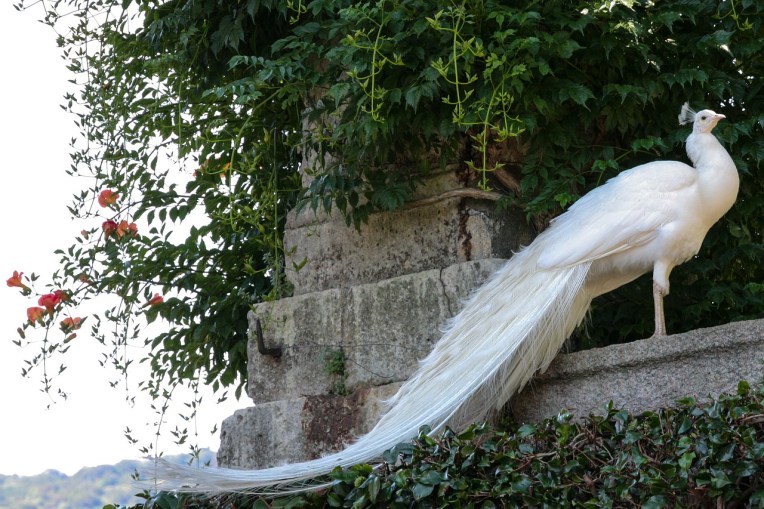
Or peacocks.
Glorious peacock in full formal attire looks down from his high tower and scoffs at human ignorance. He, not able to fly? Preposterous.
So how does this apply to prehistoric critters? Well, there are times when paleontologists aren’t so sure if a bird or other feathered dinosaur could fly. And then there are the times when paleontologists are so sure something could not fly, but then later on down the road new evidence shows up that it might…
So how can you tell for sure?
This is where the guessing game gets fun. We take a look at all the evidence we have, look at modern animals to get more insight on certain relevant details, and then propose our best hypothesis.
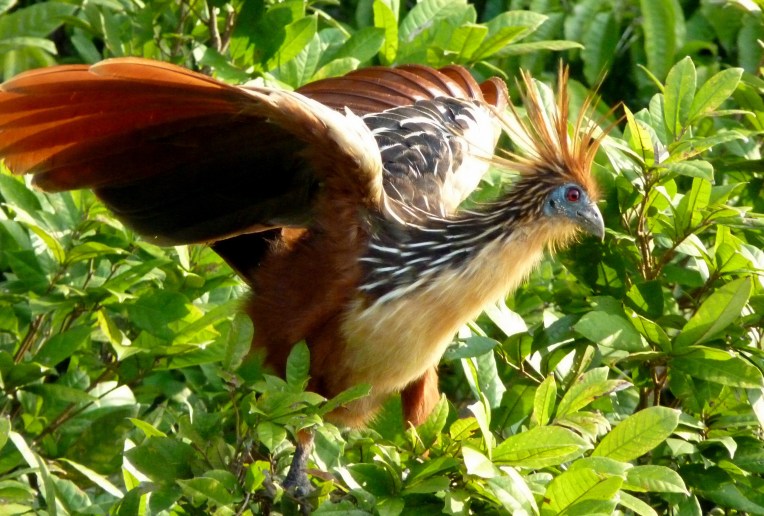
Next week, we’ll take a look at one of these discombobulating critters. Until then, enjoy the adorkable awkwardness of a hoatzin clambering about (a lovely bird of the South American Amazon). Landings don’t look like their strong point. 😛
Quick Question: What’s the first bird you think of when I say “bird”? I’ve got kiwis and penguins on the brain since I’ve written this post, but I do love the little songbirds that sing around our yard. I’d love to hear from you in the comments!
Oh, and if you’re seeing this in your inbox (and like what you see), please click on the post’s title. That would mean a lot to me, and help others find the site more easily. Thank you! 🙂
So there’s a long and a short way to go about this. I do something really tedious and boring, and pull out the scientific papers, fossils, diagrams, anatomy jargon, and articles written by people much smarter and more knowledgeable than me in all things paleontology…
OR
I can save you the big snore (because the technical stuff is tough to read, and I like this sort of thing!) and have an excuse to draw yet more cute critters, while sneaking in a few quick fossil facts in a bite-size post or convenient picture. 🙂
Why am I doing this?
The truth is that I got a little frustrated. All the dinosaur books for kids fall into one of two categories-
Super cute story and dinosaurs, but no science. For example, “Pteradactyls” lumped in with the dinosaurs, and dinos stuck with the appearance of rubber toys from the 80s.
OR
“Educational”, but tough to read. Because after reading a list of names like Tyrannosaurus rex, Euplocephalosaurus, and Parasaurolophus 20 nights in a row, I know that book is going to put aside for “some other time”. Plus the computer graphics always look a bit unpleasant to me.
Pete’s Paleo Petshop is the best of both worlds. A cute story with illustrations based on the latest scientific research I can find. But I also want to make clear what part of the illustration is something we actually know as fact, or really just an educated guess. Speculation. A hypothesis. 🙂
So this is the start of a new series called The Art & Science of Pete’s Paleo Petshop. That’s super long though, so I’ll have to shorten it somehow. 🙂
For your convenience, I’ll keep a list of all posts in the series here on this page, and I’ll update the list with links as we go along. I’ll begin with the main cast, and we’ll see where we go from there. 🙂
Bonus Question: Any special requests? I’ll be going over these critters in no particular order, so if there’s one you really want to see first, let me know. First one to answer in the comments gets first pick! 🙂
Life is full of everyday miracles. The sort of things that are so unlikely to happen, it’s amazing they happen at all.
Take fossils for example. Let’s start with something big- a sauropod, or long-necked dinosaur. Should be easy to fossilize right?
Unfortunately we need a dead one for our fossil, so let’s skip the sad story.
Let’s just say an old brachiosaurus (Let’s call him old Mr. B) came to the riverbank for one last drink of water…Now we have a very large feast for scavengers all up and down the riverbank. They won’t have to worry about hunting for months! Well, maybe weeks, depending on how many critters are joining the buffet.
Mr. B is not going to stay in one piece. A leg over here…head gone…a chunk of tail in the belly of another…By the time the scavengers are done picking the bones clean, bits and pieces are going to be scattered and broken all over the riverbank.
That pile of bones bleaches in the sun for a few more months. The bones dry out and turn brittle. Insects and small, nocturnal mammals with ever-growing teeth gnaw on them.
The skies turn dark, storm clouds gather, and a week of constant rain raises the river. More rain from the north rushes in, and in a few short hours, flood waters pour in strong enough to uproot trees and toss huge rocks as easily as pebbles.
The rush of water and debris lifts the heavy bones and carries them downriver. A few ribs catch on the roots of a thick, strong tree, but the other bones are torn free and get carried on. A leg bone settles in a small undercurrent and sinks into a deeper spot in the river. The rest of the bones get carried on…
On and on, the skeleton is fragmented by the force of the water.
Silt- dirt and debris carried by the current- covers the bones.
Over time, enough layers of silt build up and are flattened by the layers above them. Water, pressure, and time cement the layers of silt into sedimentary rock like sandstone and mudstone.
Water seeps down through the rock. Bone is porous, and so water can seep through it. The water leaves mineral deposits behind, like the hard water deposits that build up in the dishwasher.
Like a sponge drenched in salt water and left to dry in the sun, the bones slowly harden like solid rock.
But that’s not all. It’s not enough to be fossilized. The rock needs to stay intact.
The earth is constantly moving. Rocks that hold fossils can be pushed down and melted in Earth’s liquid mantle. Or pushed up into mountains, only to be erased by wind and rain.
As if that wasn’t enough, we have to find these fossils. Exposed fossil bone erodes quickly in the face of wind, rain, and sun. Scientists usually have good ideas where to find fossils based on previous discoveries, but many times it’s the kid playing by the bluff who finds them. Or the hiker who sees that spot in the rock that doesn’t look like the rest…
Even when the fossil is found, it can be lost, destroyed, or stolen.
My point here is, it’s amazing we have any fossils at all! More amazing still, the exquisite beauty of fossils like the Lagerstatten of Germany and places like it. Just look at the archaeopteryx at the top of the paragraph here (those feathers are so perfect, they look better than my chickens’ feathers!).
I am truly humbled to think about the beauty of the world around us, of humanity, of life. That it’s possible to see remnants of creatures gone for millions of years. That we can even dream of what they might have looked like.
I look at a fossil like this, and I see a miracle. And then I look at the world today, see the people in my life…or even just take a moment to watch my hands and the way they move as I type these words…the complexity behind the mechanics of their movement.
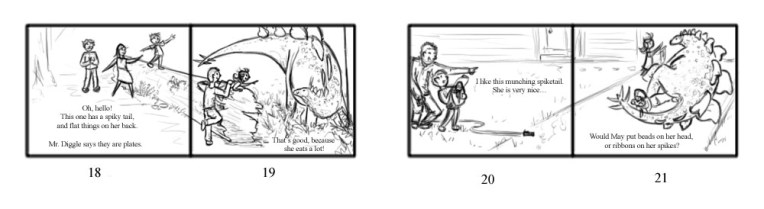
It’s time for a behind-the-scenes sneak peak on the first installment in the series of Pete’s Paleo Petshop, where anyone can go to find a prehistoric friend to take home. Time has stopped in the Jurassic Period, the “golden age” of dinosaurs, and Danny and his family have come to the shop to find a quiet, little dinosaur. Hard to find in an age of giants!
Now here we have a few thumbnails. Thumbnails are small, quick sketches that are used to give the artist an idea for the composition of an image. In this case, thumbnails are useful for getting an idea for the layout of the illustrations. Which characters to use, where words might go, how the picture will help the words tell the story…it all starts gelling together in the thumbnail. Keeping thumbnails small helps force you to leave out detail, which helps to focus on the basic shapes.
Once I figured out which thumbnail I liked best I made it larger and cleaned it up a little. These drawings are mostly to figure out exactly what I need to find references for.
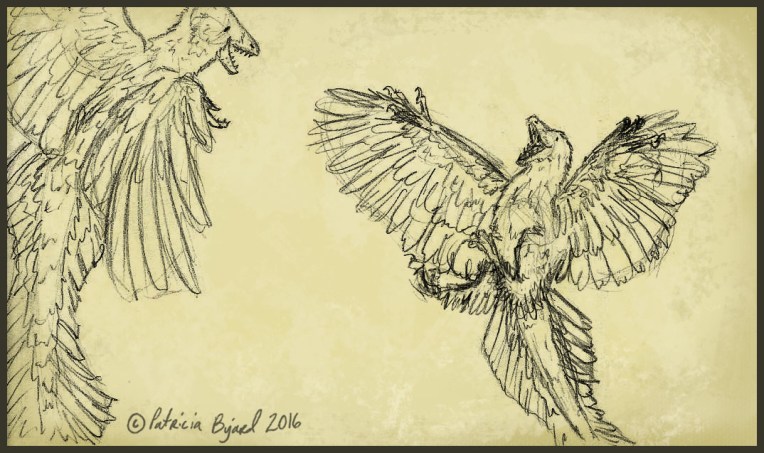
For example. I looked at a couple of pictures of flying birds to help me with Tango and his buddy on the left here (learn more about him here). It’s not known if these dinosaurs could actually fly or just glide, so this is speculation on my part. Short, broad wings are great for maneuvering thick forest, and you don’t need a lot of muscle for short bursts of flight. 🙂
In this case, I needed pictures to get ideas for poses! And for Terry and her friends on the right…well I needed a few reference pictures to have a clue what I was drawing. These critters are tough if you don’t draw the classic “silhouette from above/below” pose. 😛
Which makes a great example of what happens in the sketch stage.
In the thumbnail, I had one pterosaur (teh-roh-saw-r) flying past the corner of the page. An overhead flying view is so overdone I decided to have them perch on the branch instead. I also changed the species to pterodactylus (teh-roh-dak-tih-lus) since they worked out better for what I needed. Bonus that these guys are the poster children of the pterosaur group. 🙂
Elmer the Brachiosaurus (brak-ee-oh-saw-rus). Yep, his head is the right shape. The critter in Jurassic Park is actually a Giraffatitan (giraffe-ah-ty-tan). I’ll write a post on that at some point. For now, let’s just say that the Jurassic Park variety is the African breed, and this is the American breed. They’re completely different species, and have lots of things that make them unique, not just head shape. 🙂
I’ve been doing lots of research on the necks for these guys, so that awesome snakey neck is not random. And yes, it is an awesome python neck (though this is about the limit of its bendiness.)
Also, can I just say how awesome it is to use a toy as a reference? Yes, you heard me. I went out and got a few toys (as accurate as possible) and I’m using those for pose reference. I don’t have the dippy, but for that one I got pictures of the toy online. 😛
Here we have Steggy the Stegosaurus (steg-oh-saw-rus). Original name, I know 😛
I used a toy I have for reference here too, but this one isn’t the best model, so I’ll be doing research to make sure I correct those inaccuracies.
I hope you’ve enjoyed this sneak preview! I’m starting to get an idea of what things will actually look like, and that’s pretty exciting after it’s been stuck in my head for so long! The words need a lot of work (they kinda suck at the moment), but the gist of the story is there.
I’ll never be fooled into thinking a picture book is easy again! 😀
Now my question for you is…Do you have any questions? Anything you want to know about what happens behind the scenes? Let me know in the comments! I’d love to hear from you! 🙂







 Pete's Paleo Petshop