Opie the Ornitholestes has been a critter at Pete’s Paleo Petshop since August of 2016. He’s not the oldest, but he’s definitely part of the original cast of characters…
#12 to be exact.
Why Ornitholestes, out of all the possible critters I could start off with? I watched BBC’s Walking with Dinosaurs when I was young, and I loved the section of the series that focused on the giants of the Jurassic.
The young Diplodocus had a gauntlet to run from the moment they first hatched, and one of the many predators they had to watch out for was Ornitholestes. This dinosaur had small display quills on its head and on its arms, and the idea of a dinosaur with something that looked like feathers was absolutely fascinating at the time. Little did I know that an explosion in new discoveries would bring about a renaissance in prehistoric art full of feathers and all sorts of amazing squishy bits!
Long story short, the WWD Ornitholestes would stay in my memory and become one of the first creatures I thought of when developing Pete’s Paleo Petshop. By 2016, talk of feathers and other soft tissues was in full swing, and of course I wanted a critter that would give me an opportunity to play on this imaginary playground.
The only question is, how much and what kind of feathers did Ornitholestes have?
There is no way of knowing, since we don’t have any direct evidence, so it was the perfect dinosaur to add that would give me free reign to imagine. This first illustration was drawn back when I was still hunting for a style, and the other critters had black dot eyes. Ornitholestes had large eyes, so the simple black eyes don’t work as well as they did with the others…
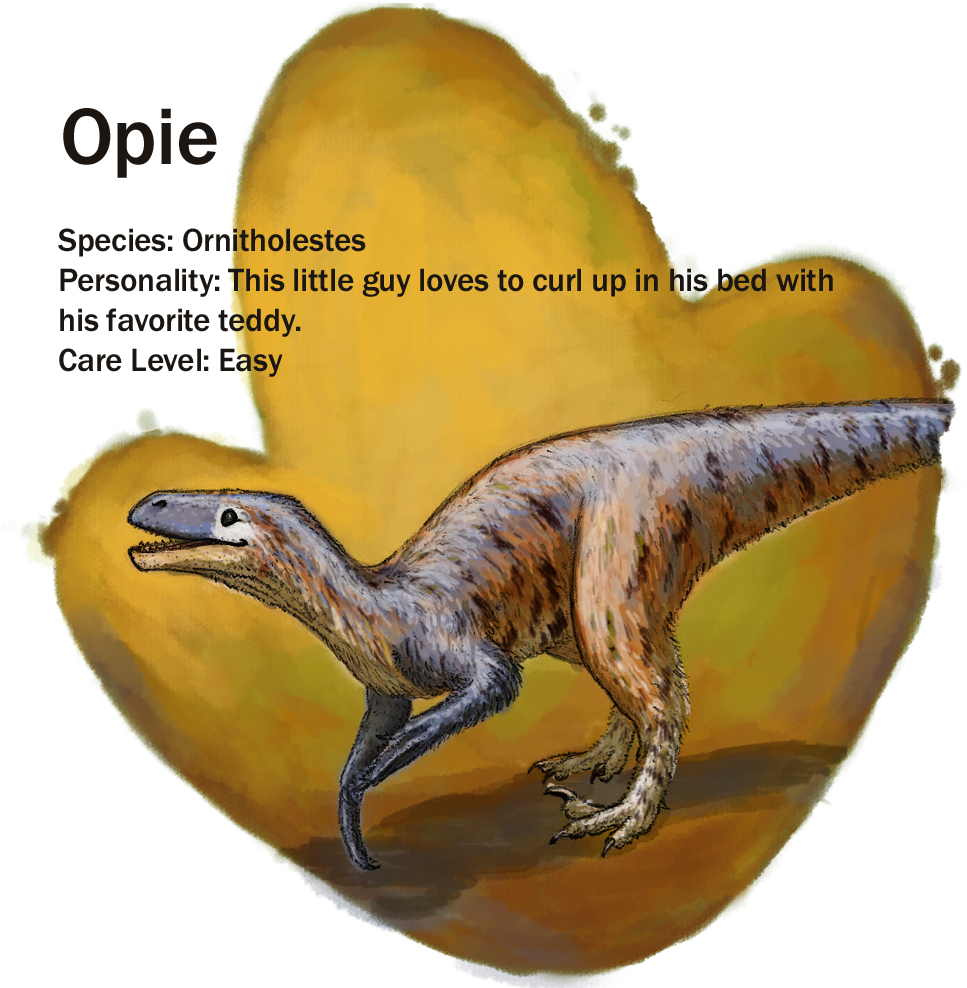
October in 2017 saw the first small update to Opie’s character. Not much, just a different eye, but that small change is a step closer to the style I find myself using for the critters today. This was back when I was still drawing everything in pencil in a sketchbook, then scanning it to color in Photoshop with my Wacom tablet.


The next update for Opie was in March of 2020, and included the short story now featured in my collection, Dinosaurs Don’t Don’t Play Fetch. I cleaned him up a little bit so that I could feature him in the book. The box background was also a cleaner and less confusing way to frame him, though he wasn’t the first. Skippy was the first for that, while Elmer was the first critter to have a background that hints at his environment.
Below are a couple of sketches also featured in the book, which I started putting together in 2021. I used these as an opportunity to experiment a little with Opie’s feathers.
Jurassic North America was hot, with wet and dry seasons, so Ornitholestes was unlikely to be completely covered in feathers. Birds usually have special reasons for fuzzy feet, so I gave him scaly feet and made his feathery fuzz shorter except for the tuft at the end of the tail. This looked a little too much like a furry suit though, so in the very next sketch I made the fluff a little longer again.


Later that same year Ornitholestes got a feature for Fossil Friday. Here I wanted to experiment a little with colors. In my mind, this Ornitholestes is not Opie, so his colors and pattern needed to be a little different.
I’m sure you see that again, I couldn’t quite decide on his feathers. Should the furry feathers behave more like fur, or should I look more to birds? It doesn’t really help to see what other people’s opinions are, because we only have one skeleton, and looking at relatives can only take us so far. Plus people have quite heated debates on what those relatives should look like also, and habitats are often very different.
Another thing that gave me plenty of food for thought was the long arms. If you give a bird arms instead of wings, how would it use them? Ornitholestes seems to have nice long arms that are good for grabbing things, so how would feather work there?
Here I tried experimenting again with the very short fuzz, a bit how fur may get shorter and thinner down the leg. But then I have the same problem as the first of the two sketches above. Would feathers really be so similar to fur, just because they look like fur at first glance?

And now that brings us to Opie’s new look!
I truly think that if we were to go back in time and see what dinosaurs actually looked like, there would be many that we would not recognize. The covering of skin, scales, feathers, and other soft tissues over the bones can change an animal’s basic shapes. Because of this, I always love paleoart that shows a little more speculation, while still being grounded by the overall appearance of Earth’s many wonderful creatures.
A pattern can be striking to the human eye even though it also makes for good camouflage in the proper habitat…like a tiger’s bold stripes help break up its form so that it is almost invisible. Or how the stately antlers of a deer inspire admiration, but the body is mostly shades of brown. Really it is mostly in the tropics, surrounded by bright and colorful foliage, that animals can hide in plain sight with bright colors and often turn to other flashy bits to gain attention.
Opie comes from a place that is a bit like the African Savanna. Floodplains crisscrossed by rivers that swell and turn to marsh during the wet season, but are dry and arid at other times of the year. Ornitholestes was small, perhaps preferred the cover of thickets and open woodlands, and would have needed to stay hidden from larger predators. Perhaps like the Jurassic version of a fox or jackal.
I looked at the fur colors of foxes and jackals, and also looked at hawks and other predatory birds that live in the places between forest and grassland. I really liked the colors of grey foxes and certain kinds of kestrel (a bird similar to a hawk).
For a sense of weight and possible muscle for a bird-like animal of its size, I looked at a bird called a greater rhea. Like their much larger cousins, emus and ostriches, greater rheas cannot fly. Their feathers are simpler than most bird feathers we think of- there’s a central shaft of keratin, and the filaments branch off from that shaft all fluffy and loose. Like the fluffy feathers you might see on a feather duster.
Since many birds have different kinds of feathers in different parts of the body, I gave Opie feathers like a Rhea at the end of his tail and perhaps along his back for sun protection and display, while the rest are simpler, more furry feathers. Like the downy fluff of ducklings, only longer.
These feathers would most likely be coated in oil from a gland to make them water-proof and clean, and would be very much like wearing a sun hat to keep off the heat. Scaly patches like the legs, underarms, and possibly the belly would also help in staying cool. He could even dig a shallow hole in the ground with those strong legs, and settle in a little patch of shade with bare scales against cool earth.
This time I experimented a lot more with how feathers often change the shape of the body. Opie is definitely more bird-like now, and I’m very happy with how he turned out! Of course, this is definitely not a “this is what Ornitholestes most likely looked like”…but more of a “what if” to think about and talk about. Perhaps Ornitholestes had a bare head, or different kinds of feathers completely? It’s fun to think about the possibilities!

My lessons for this month…
- It’s a lot of fun to see one’s progress and change of style over time.
- Each look into a creature brings up new research that I missed the first time or the second time, and new angles and ways of seeing that research.
- We truly don’t know what these animals really looked like, and I find hunting for inspiration for paleoart gives me an even greater appreciation for the wonderful world we live in today. There is so much to explore!
And the Critter of the Month is…

Thank you for joining me today! I hope you enjoy the video.
If you really like Opie’s painting and wish to support me, you can find him on Redbubble. Just click on the picture below or CLICK HERE to go to Redbubble and take a closer look.

See you Dec. 1st for the next Critter of the Month!
This little guy loves to sing and dance!
Share your guess in the comments! He’ll be one of the critters over on the critter page. 🙂
 Pete's Paleo Petshop
Tango is next
LikeLiked by 1 person
This is me by the way
LikeLike
Yes! Tango is up next 🙂
LikeLike