Day #5 on our Christmas Countdown is…
Eolambia!






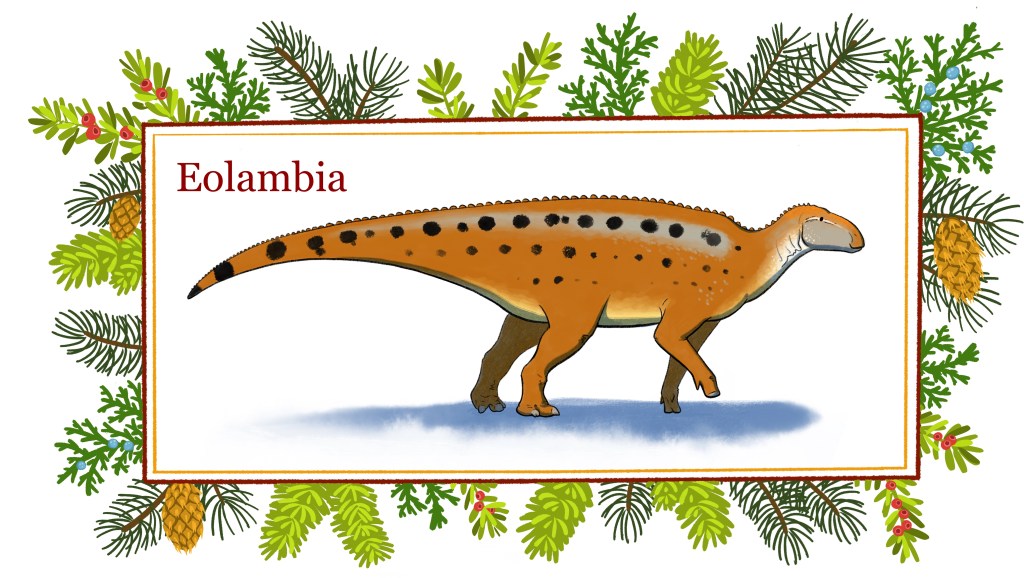
Eolambia: the “Dawn Lambeosaurine”
Eolambia were large hadrosaurs from Late Cretaceous North America. The layer of rock where their fossils can be found is known as Cedar Mountain Formation, which also has even thinner layers of time that make it easier to figure out when certain animals lived. These layers are known as members, and dividing fossils by these layers of rock makes things much easier to stay organized, because the Earth can change a lot over the course of a million years or two.
Today, certain parts of Utah and neighboring western states are dry, hot, and have cliffs, hills, buttes, and other rock formations that look like multicolored layers on a cake, or those bottles filled with layers of colored sand. The different hues of brown, cream, red, or grey each represent a slice of time in Earth’s history.
A slice of time that gives us a small glimpse into what life was like long ago, and can help us see how the world changes over time.
For example. Underneath the layers of rock known as the Cedar Mountain Formation, which has streaks of grey and dull brown like the pages of a dusty book, lies the Morrison Formation.
The Late Jurassic Morrison Formation is famous for dinosaurs like Allosaurus, Stegosaurus, Brachiosaurus, and Apatosaurus, and its rock has beautiful hues of cream, red, grey, and even a little green. A combination of mudstone, sandstone, siltstone, and limestone, depending on when the area was covered in marsh, floodplains, or even sea shores or desert as the land changed.
The Cedar Mountain Formation seems a little more stable than the Morrison. The mostly grey rock comes from layers of mud and silt from rivers and lakes on a floodplain. The top layer of this formation, the Mussentuchit Member, is grey mudstone that is mixed with volcanic ash. And it is in this layer that we find Eolambia.
This “duckbill dinosaur” was big enough as an adult that the only thing it feared was a large predator called Siats. Unfortunately, there are too few fossils of this theropod to know what group it belonged to (allosaurs, tyrannosaurs, etc.), we just know it was the biggest and toughest predator at this time and place.
Younger Eolambia had far more to worry about from dinosaurs like Deinonychus and large crocodile relatives. Some herbivores that lived in the same neighborhood are armored dinosaurs like Animantarx (big shoulder spikes, no club tail), a long necked sauropod called Abydosaurus, and some bits and pieces of other critters that look like earlier relatives of iguanodon, triceratops, and oviraptor.
Quite the change from a land once dominated by giant sauropods and spike-tailed stegosaurs…
As the Cretaceous marched on, a shallow sea would wash in with predators like Deinosuchus cruising its waters…then the water recedes to reveal the floodplains once more. Different stories told in the layers of rock, deposits of sediment with new names to catalogue the march of time. These plains were roamed by famous dinosaurs like Tyrannosaurus, Torosaurus, and the giant Alamosaurus right up until that infamous asteroid brought their reign to an abrupt end.
Of course, the world keeps turning, and life finds a way…The North Horn Formation gives way to the Green River Formation, a layer of rock famous for its beautifully preserved fossils of fish and even the very first horse!
So many amazing slices of time in this one area of land. A large area, true, but still it gives us a fascinating picture to put all these familiar prehistoric animals on a timeline. To give them context instead of blind facts on a blank page.
Do you have any favorite critters among the ones I mentioned? How does their place in the grand scale of time affect how you think of them?
See you tomorrow for day 6 of the Critter Christmas Countdown!
 Pete's Paleo Petshop
I feel like you should expand into the Triassic, but I still appreciate Eolambia getting spotlight nonetheless. An early hadrosauroid described the same year as another, Protohadros, with a quite interesting name.
For today, I will cover one of the earliest ornithischians to exist: Laquintasaura. Laquintasaura was the first dinosaur identified from Venezuela and is known from extensive remains originally discovered in the 1980s. It is one of the most primitive and earliest-known ornithischians known as of now, though there have been conflicting theories on whether it was at the base of Ornithischia or at the base of Thyreophora. It likely was omnivorous and bipedal, and numerous autapomorphies within its unique teeth and coexisted with a larger dinosaur known as Tachiraptor; this would have been its natural predator. The presence of at least four individuals likely dying together also shows that herding behavior was present in ornithischians as far back as the Early Jurassic.
In short, Laquintasaura is a remarkable taxon because its discovery is an important one in our understanding of early ornithischians and because it was the first fully-described genus of dinosaur to be known from northern South America.
LikeLike
I forgot my name ideas for each critter if I could decide:
Eolambia: Elia
Laquintasaura: Quinta
LikeLike
I’d like to draw your attention to two errors in this article. Firstly, the name “Mussentuchit Member” is mis-spelled. Secondly, the Cedar Mountain Formation covers far more geologic time than the Morrison Formation. The Morrison Formation of the late Jurassic Period spans ten million years from 155-145 MYA. By contrast, the Cedar Mountain Formation of the early and middle Cretaceous Period spans forty-nine million years, from 144-95 MYA.
LikeLiked by 1 person
Good to see that I’m not the only proofreader. And I also appreciate the research you do in your blog, Jason.
LikeLiked by 1 person
Thank you. I’ve got a few more articles and drawings which I’m currently working on and trying to finish before the year ends.
LikeLike
Thank you for catching the typo and the misinformation. I try my best, but things can easily slip through the cracks, especially when I do a lot of back-to-back posts like these for the count down. I have edited the post. 🙂
LikeLiked by 1 person
I became extremely interested in the Cedar Mountain Formation in early 2022, and I’ve created many articles and illustrations of the various species that dwelled there since then. Seeing you do one here gladdens my heart. Keep up the great work!
LikeLiked by 1 person
The Cedar Mountain Formation is fascinating, and I don’t know near as much as I would like about it. I do thoroughly enjoy your posts on the subject, and it means a lot to me that you enjoyed this tiny contribution of mine. 🙂
LikeLiked by 1 person