Day #12 on our Christmas Countdown is…
LAMBeosaurus!






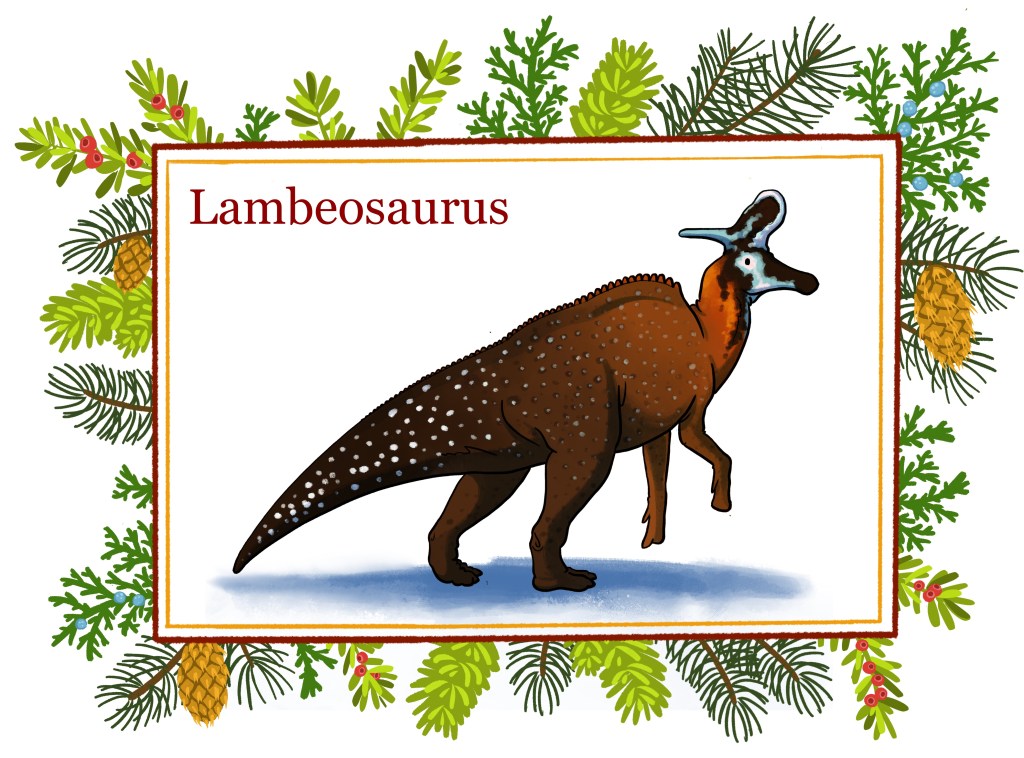
Lambeosaurus: the “Lambe’s Lizard”
Lambeosaurus was a large “duck-bill” dinosaur from Late Cretaceous North America.
Like its close cousin Corythosaurus, the crest on its head was partially hollow and connected to nasal air passages. This would have given it an excellent sense of smell, and a fancy sound system for making all sorts of noise. It’s possible that the crest had air pockets and chambers not seen on the bone itself, like what is seen in animals like Dilophosaurus and some modern birds.
Also like birds, the crest changed a lot in shape as the animal grew. In fact, it changes so much that for a number of years there were multiple species of Lambeosaurus, Corythosaurus, and completely different dinosaurs. Then, very much like Dracorex, Stygimoloch, and Pachycephalosaurus, these different animals were determined to be different growth stages of Lambeosaurus or female Lambeosaurus.
Here’s a handy list of the different critters and what growth stage they are now proposed to be…
- Procheneosaurus praeceps: A very young juvenile, with only a small nub on the forehead to show where the crest will grow.
- Procheneosaurus cranibrevis: Another young juvenile. The nub has grown into a small crest that looks a bit like the sweep of a wave on its forehead.
- Corythosaurus frontalis: An older juvenile. This one has a crest that looks just like a small Corythosaurus.
- Lambeosaurus clavinitialis: This species has some variation in its crest shape. Some are smaller versions of the “hatchet” shape, whereas others are missing the “handle” that sweeps towards the back entirely. This could be due to individual variation, or possibly age, but the general consensus is that this species of Lambeosaurus are actually females of Lambeosaurus lambei.
- Lambeosaurus lambei: The species of Lambeosaurus that usually comes to mind. The ones with the large crests typical of this species are considered male, like the one pictured above in full breeding regalia. It has a large crest that is often described as a hatchet, and was most definitely covered in horn and possibly bright in color. Like cassowaries and other horn-crested birds, it’s possible that individual crests varied a bit in their exact shape and color, especially as the animal grew older.
The different ages, females, and males must have all sounded quite different from each other! The crest shape, chambers within the skull, and any soft tissue such as a voice box would all have affected the sounds they could make. If we could travel back in time and spend a few weeks or months hiking through the forests of Alberta, Canada, then we could learn those sounds and identify the age and animal just by its call, like bird watchers do today.
And what might they sound like? The video below shows some of the experimentation being done. The skull is of a Corythosaurus, and of course it’s not a perfect match because we are missing the soft tissue, but it’s still a fascinating experiment!
Late Cretaceous Canada must have been a noisy place! Just imagine hiking through the thick forest of conifers, tree ferns, and ginkgoes…it would be both wondrous and terrifying to hear the many alien animal calls, and yet they remain hidden in the thick foliage.
Which ones are the horned Chasmosaurus or Styracosaurus? That haunting, musical tone could be a Parasaurolophus, or perhaps we would hear the low grunting of an armored Euoplocephalus, or maybe it’s the whistle…certainly it would be a relief to hear the crocodilian hiss of what could be a Gorgosaurus, because if we hear its call then at least we can be assured that the enormous predator is not stalking us for lunch!
One can only hope that as humans, we can remain small and unnoticed in the thick underbrush of ferns and cycads as we hear the thunderous voices of giants all around us.
I’d love to hear how you would imagine exploring this place! Would it be exciting? Frightening? Or a combination of too many emotions at once?
See you tomorrow for day 13 of the Critter Christmas Countdown!
 Pete's Paleo Petshop
Lambeosaurus is definitely interesting as both a unique hadrosaur and a dinosaur with a somewhat complicated past. It was very good to hear your thoughts and entry on the dinosaur.
For today, I will talk about another bizarre creature with distinctive structures on their heads: Estemmenosuchus. This synapsid, known from the Middle Permian of the Perm region of Russia, was an early, omnivorous therapsid with distinct horn-like structures probably used for display. Two species are known: E. uralensis and E. mirabilis. Many complete and incomplete skeletons of this genus were found together.
Estemmenosuchus could be over 10 feet (3 meters) in body length. It had a massive skull (reaching up to 26 inches (65 cm) in length) and possessed several large horns, which were similar to moose antlers. It walked with its legs splayed out to each side.
The therapsid was found in Russia alongside two other therapsids: Eotitanosuchus and Biarmosuchus. Although two species are known, originally, all specimens were included in E. uralensis. Since then, however, it was realized there were more species. However, some of those species, particularly two formerly separate genera (Anoplosuchus and Zopherosuchua) were considered synonymous to the aforementioned type species.
It has been suggested that Estemmenosuchus had a fairly constant internal temperature, with its large body and compact build giving it a small surface-to-volume ratio. This suggests it wouldn’t lose of gain temperature quickly.
Skin impression have been reported to belong to Estemmenosuchus in 1968. The skin described was like that of a hairless mammal or frog.
Names for each if I could decide:
Lambeosaurus: Lambert
Estemmenosuchus: Esteban
LikeLike
Thank you, I’m glad you like my fancy gentleman 🙂 I have dubbed him Leonardo. These critters don’t all have names, but some of them practically walk off the screen and say it out loud once they’re finished.
I’ve always really liked Estemmenosuchus. Some day I’ll get to explore the Permian!
LikeLike