
Day #13 on our Christmas Countdown is…
METRIORHYNCHUS!






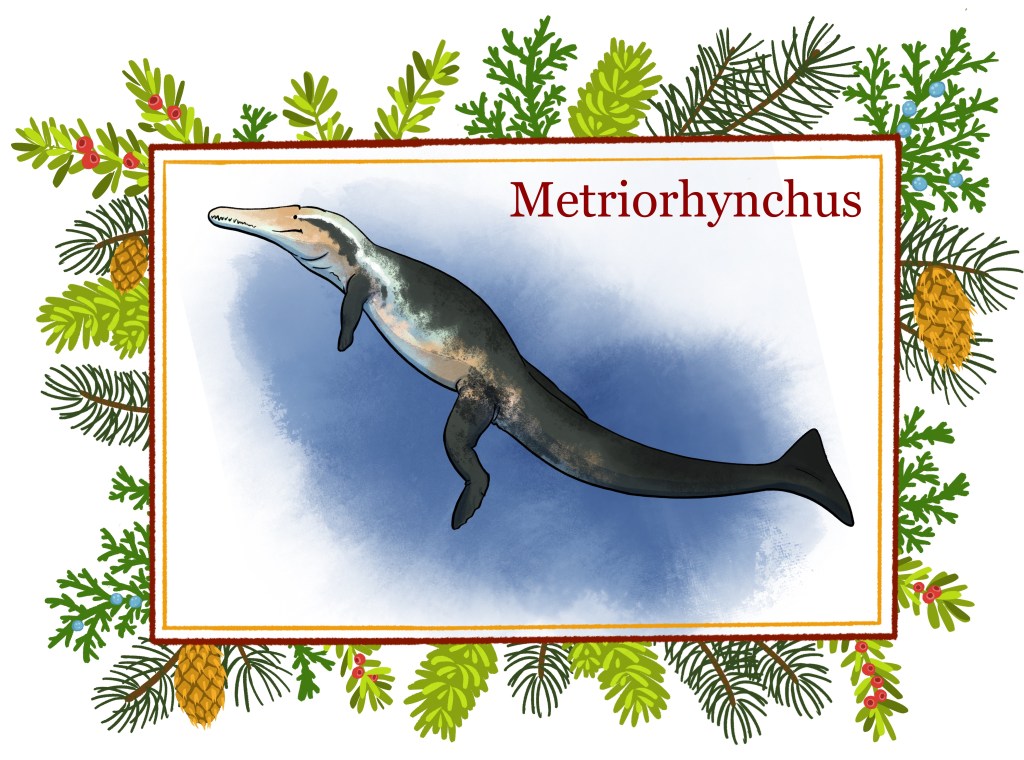
Metriorhynchus: the “Moderate Snout”
Metriorhynchus is a distant relative of crocodiles from Late Jurassic France, and is the namesake genus for a group of croc-ish critters specialized for life in the water.
This might seem a little strange, since alligators and crocodiles are already very well suited for an aquatic life-style, but this particular group had traded in their legs for paddles, and had tail flukes like sharks.
If we were to get a little technical, alligators and crocodiles would be considered semi-aquatic, while Metriorhynchus and its relatives were fully aquatic. Let’s dive into the subject, since it gets thrown about quite a bit (especially when it comes to Spinosaurus).
Semi-aquatic refers to animals that live a portion of their lives in the water, but also spend quite a bit of time on land. This seems fairly obvious, but it can get a little more complicated when you consider that this can range quite a bit on the scale.
On one end of the spectrum, an animal could spend a little bit of every day in water and/or land, as in the case of crocodiles, capybaras, moose, or beavers…and then there is the extreme on either side- only spending a single stage or brief portion of the animal’s life in water or on land. For example, sea turtles only come to shore to lay eggs, while toads must live almost entirely on land and can drown in a bucket of water, but depend on water for their early life as tadpoles.
A fully aquatic animal spends its entire life in the water. Whales, ichthyosaurs, plesiosaurs, and mosasaurs are excellent examples here. They feed, breed, and give birth without ever venturing on land.
Were Metriorhynchus and its relatives in this category?
Let’s look at the evidence.
- Their limbs are more paddle-shaped, and most of their front legs are greatly reduced. It’s almost like they were in the process of being lost completely.
- The muscles in their limbs were weaker, more suited for steering, and unable to support their weight on land.
- The tail was flattened and had a tail fluke like a shark.
- They lost the ridged scutes that most crocodilians have, and instead have smooth skin like dolphins, ichthyosaurs, and plesiosaurs.
- Their body shape was even more streamlined and smooth than most crocodilians, to make movement through the water more efficient.
- The rear hip joints were in a position similar to other marine reptiles known to give birth to live young.
- Finally, some fossils of a pregnant Dakosaurus (also a marine, croc-ish critter, though not a direct relative), show that the very young were just as ill-suited for weight-bearing on land as the adults. Which gives further clues that these marine crocodilians gave birth to live young in the water.
When we think of crocodilians, we usually tend to think of the same general body plan, so it can be fascinating to discover more about critters like Metriorhynchus. They are an example of just how diverse crocodilians and their relatives were, and a reminder of just how small a fraction we have surviving today.
28 species that can be grouped into 9 genera. And those can be grouped into only 3 separate families. Alligators and caimans in one, true crocodiles in another, and gharials and false gharials in a third. All of them have very similar body plans and lifestyles, to the point that most people do not know that some of them go out into marine environments (it doesn’t help when books and kid’s shows save the hero by making the croc or gator magically turn around when they taste salt water).
Because of this, I always enjoy learning more about the subtle differences in modern crocodilians, and discovering more about the huge diversity of their prehistoric relatives.
Do you have a favorite crocodilian, modern or ancient?
See you tomorrow for day 14 of the Critter Christmas Countdown!
 Pete's Paleo Petshop
My favorite Paleo crocodilian is Simosuchus, because it’s so cute
LikeLike
I remember the time you showcased Dakosaurus and I brought up a bit more info on marine crocs. And here’s another one. Not gonna lie though, the Jurassic World: The Game Metriorhynchus is an “interesting” take…on how not to reconstruct the creature. It’s classed as a land creature when it should be an aquatic like all the other marine crocs (it even has weight-supporting limbs for moving on land) and osteoderms.
My focus will be on a recently-described prehistoric cetacean, Perucetus. Known from Peru (which, as I’ve said before with the Thalassocnus entry I did last year, is my mother’s home country), it may have rivaled the modern blue whale in weight. This is due to the dense bones found coupled with its immense size. It was likely a slow moving inhabitant of shallow sea habitats and it have been suggested that it may have preyed on benthic organisms that live on the ocean floor. With it being known from only a few vertebrae and ribs, estimates of the animal’s total length can vary. Its most characteristic feature is the large degree of thickening and then densification of its bones. The characteristics of Perucetus’s known bones make it impossible for it to go on land and the great degree of thickening and densification of its bones show that it was best suited for shallow waters and the animal would’ve resisted crashing waves in more turbulent water. It’s possible that the whale may have swam similarly to manatees.
Names for each if I could decide:
Metriorhynchus: Meredith
Perucetus: Percy
LikeLike
Question: When you do these paleo advent calendars, do you already have all 24 creatures selected when you start, or do you pick your animals as you go along?
LikeLike
I’d guess the former but I feel like if the latter were the answer, then Patricia could come to a realization of the current absence of any Triassic-specific creatures (I’m really hoping that Nothosaurus is talked about tomorrow).
LikeLike
Admittedly, I too have a lack of Triassic animals on my blog, although there are many on my to-do list including Nothosaurus. Here is a list of the ones I’ve done so far, if you’d care to take a look at them:
– Two Triassic Pycnodont Fishes: Brembodus and Eomesodon
– Ceratodus
– Promastodonsaurus
– Panphagia
– Saurosuchus
– Gracilisuchus
– Synechodus
LikeLike
I have a list I prepare in advance. There are a few Triassic critters that haven’t appeared yet, but mostly I didn’t pay too much attention to time period. I just started with a letter and went for a cool critter I wanted to draw 🙂
LikeLike
Sorry about this, I was trying to see if I could post on a different device yesterday, to see if I could at least respond to comments easier even with all the chaos, but it looks like it was doing some wonky stuff lol.
LikeLike
Hello, and thank you for your question! These count downs always end up being a mad dash to try and keep up with the frequency of the posts, so I try to save time by coming up with a list a month or two in advance and get started on them early.
The list is always whatever I am most excited to draw at the time, usually with some sort of challenge or limitation- in this case ABC’s. 🙂
I also start with a buffer and schedule posts ahead of time, but with the busyness of the holiday season I always lose this buffer and it often ends up being a scramble. I’m not sure I’ll be able to keep up this time, because Babysaurus was born at 1 this morning! I’ll try my best to keep posting, but I hope you can forgive me if I’m a bit late on a post or replying to a comment. 🙂
LikeLiked by 1 person
If you will be busy later on, then finalizing the posts in advance is the right way to go. Additionally, my reply from the third and fifth and every reply from CC2023 blogposts 6-13 are waiting for your thoughts/replies. I am not trying to be rude to you, I’m just trying to let you know assuming you don’t as of now.
LikeLike
I know, I just responded to what I could yesterday. Baby decided to come early, so I’m afraid it may be a while before I can reply to every comment. I always read everything, but there are many times I can’t reply just yet.
LikeLike