Day #14 on our Christmas Countdown is…
Nyctosaurus!






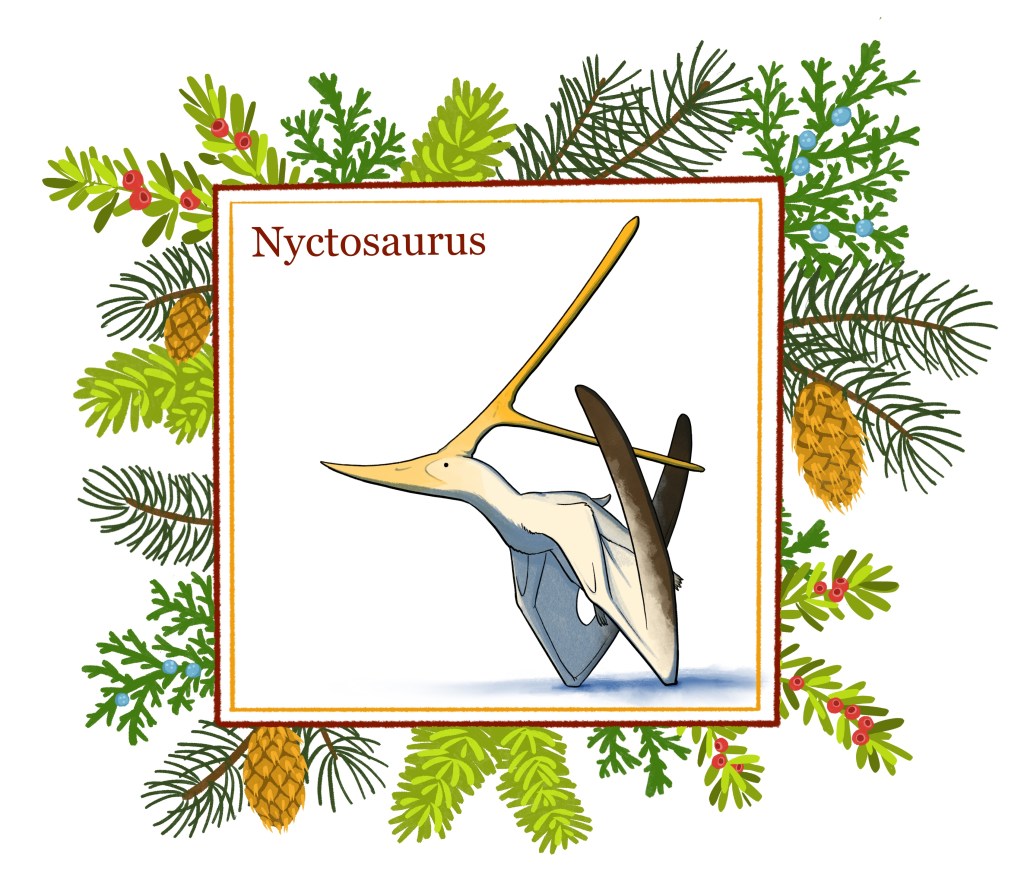
Nyctosaurus: the “Night Lizard” or “Bat Lizard”
Nyctosaurus was a relatively small pterosaur from Late Cretaceous North America. It was discovered during the earlier days of paleontology, in 1876, and so was named after the “bat like” wings.
It soared over the shallow sea that divided the western and eastern sides of the continent, and shared the sky with the much larger Pteranodon. Compared to Pteranodon’s wingspan of over 20 feet, Nyctosaurus had a modest wingspan of about nine and a half feet (larger estimates can be up to 13 feet), and is estimated to only weigh about five pounds.
There are many interesting things to discover about this unusual pterosaur, but we’ll start with the obvious…
How on earth could it fly with fancy head gear like that?
As in many animals, the young were not born with these elaborate head crests, and they grew as the individual grew. Unlike most other pterosaurs, like Pteranodon, it appears that both male and female Nyctosaurus had crests, though they were a bit different in shape. There is no evidence of any soft tissue connecting the two points of the crest in a “sail.”
The fact that the young did not have a crest, but both adults did, shows that it could be a sign of maturity. A way of proving that an individual was mature enough and healthy enough to raise a clutch of eggs.
Why? Fancy feathers, horns, antlers, and other head gear like these crests take nutrients and energy to grow- not to mention they can be a bit inconvenient and cumbersome compared to not having a crest- so it’s good to have proof to show off to others of your kind that you’re in good shape and are a good choice for making more healthy babies. Always a good goal when it comes to the survival of a species.
But how could they fly? Their crests were thin and very light weight. Tests in aerodynamics and how air flows past the crest and wings show that Nyctosaurus would not have had any problems flying. In fact, their wings are like those of an albatross, and they would have spent a great deal of time in the air. Soaring, with only the occasional bit of flapping, and it might have been a bit…interesting on land.
The back legs are rather short in comparison to other pterosaurs, and they do not have the little wing fingers we see on most pterosaurs. I don’t think this means they couldn’t walk or run, but I do think that maybe they weren’t quite as comfortable walking as other pterosaurs, or at least were doing something a little different.
Perhaps they walked a bit more like kangaroos? With a sort of pole-vaulting hop of their back legs, while the strong, stumpy end of the wing carried most of the weight. Kangaroos do a bit of a hop-walk by supporting their weight on their arms and thick tails while they swing their legs forward. Or perhaps a better comparison would be how a person can hop-walk with crutches under each arm.
I must say that I find the mental picture of Nyctosaurus hop-walking along a beach if it wanted to get somewhere fast quite amusing. Of course if there are any trackways this idea can be quickly disproven, but for now I can be entertained by the idea.
What is a scene you would like to imagine for this critter? Soaring majestically through the air? Diving down into the water or alighting upon a floating mosasaur carcass? The sky is the limit!
See you tomorrow for day 15 of the Critter Christmas Countdown!
 Pete's Paleo Petshop
I’m finally glad you covered a critter capable of moving through the air. I’m sure The Good Dinosaur helped bring Nyctosaurus to the general public, but at the same time, Thunderclap has a great amount of scientific inaccuracies (watch Trey the Explainer’s video: The Good Dinosaur Trailer Accuracies and Inaccuracies for more detail). Here, you understood the assignment and succeeded gratefully.
For the 14th, I will cover a potential early flier from the Palaeozoic: Rhyniognatha. This arthropod from the Early Devonian of Scotland is known from a partial head and appeared when terrestrial ecosystems were starting to form. Analyses have recovered the creature as either an insect or a myriapod. Named in 1928, the realization of the animal potentially having wings came in 2004 after its mouthparts were analyzed and determined to resemble those of a mayfly. Thirteen years later, a reanalysis came to the conclusion that Rhyniognatha was a centipede, which was better supported by the available evidence.
Names for each if I could decide:
Nyctosaurus: Nicholas (shortened to Nick)
Rhyniognatha: Rhys
LikeLike