Day #20 on our Christmas Countdown is…
TANYSTROPHEUS!






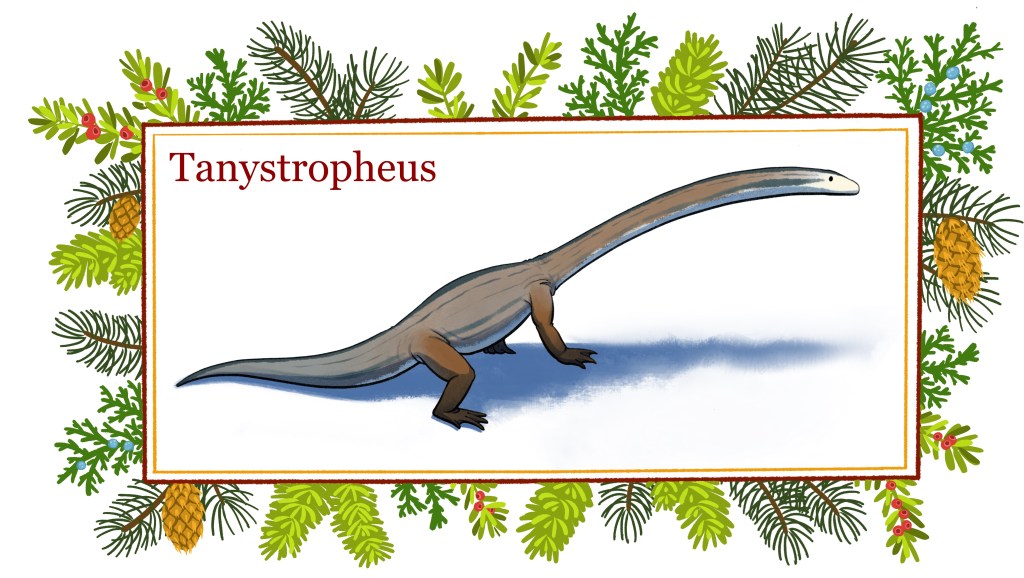
Tanystropheus: the “Long Hinged”
There are many wonderfully wacky creatures that lived during the Triassic Period, and Tanystropheus is one that even more casual dinosaur enthusiasts are likely to recognize on sight, even if they don’t remember its name.
Tanystropheus lived from the Middle to Late Triassic Period in Europe, Asia, and North America, because most of the Earth was joined together in a huge landmass at the time. It was not a dinosaur, but some popular dinosaur games still include it, and its easy to see why. Just look at that neck!
The interesting thing is that the neck vertebrae are very long and thin, and not like a sauropod or plesiosaur at all. Plus there are long, thin, overlapping struts of bone for even more support.
These unusual neck bones are what give the animal its name.
This means Tanystropheus can have a very long neck that is light weight and doesn’t need very much muscle to support it. Mark Witton describes it as a living crane, with most of the flexibility and movement at the base of the neck and head. Tendons and ligaments act as pulleys to lift and lower the entire neck and head with very little effort.
Having such a light and efficient neck also means that Tanystropheus was most likely quite comfortable on land, and not in any danger of falling on its face.
So what did it use its long neck for?
Tanystropheus was a fish eater, so the question has long been how it would go after said fish. An underwater fish hunter like a plesiosaur? Or fishing from above?
It seems that the neck is actually not well suited to being underwater. It doesn’t have the flexibility to dart after speedy fish for one thing. Instead it seems to have a closer approach to modern herons.
Imagine Tanystropheus sitting on the shore, or wading out into the shallows, head poised out over a prime fishing spot. It stands motionless for a long time, waiting for a fish to swim close…
Snap! The head suddenly lunges down and captures the fish with its sharp teeth. Sushi for lunch. Or calamari. Squid turn up close to shore all the time. Yum!
Mark Witton has two wonderful blog posts all about this wonderful creature, and I highly recommend heading over there to check it out!
Mark Witton’s Tanystropheus post: Part 1
Mark Witton’s Tanystropheus post: Part 2
See you tomorrow for day 21 of the Critter Christmas Countdown!
 Pete's Paleo Petshop
Another Triassic critter being represented in today’s Christmas Critter Countdown? I’m so happy. Tanystropheus has always been interesting due to its extremely long neck and its potential function. One of the best-known archosauromorphs that wasn’t a true archosaur known for its unusually long neck, interesting history (with a strange misinterpretation that occurred I believe until the 1920s), and suggested lifestyle. This was once-again, well done.
For the 20th, I will review a different long-bodied animal: the conodont Promissum. Conodonts were an extinct group of aquatic vertebrates resembling eels that lived during the Palaeozoic era and survived into the Mesozoic (the youngest fossils known are from the Jurassic). For many years, they were only known for their tooth structures, and this comes to show how much our knowledge on organisms changes as more and more fossil are found from said group of organisms. Their fossilized body parts are widely used to define and identify periods.
Promissum was from the Late Ordovician of South Africa. It had a primitive mouth under its eyes with mineralized teeth. It also had a primitive backbone and lacked fins aside from perhaps a small tail fin. It was relatively large for a conodont, reaching about 16 inches (40 centimeters) in length.
It was probably capable of a cruising speed, though not in the form of bursts.
The creature, when first discovered, was thought to have been the earliest land plant and it wasn’t until another conodont, Clydagnathus, that Promissum was given a second look and was redescribed as the early vertebrate we know it to be.
Name ideas for each:
Tanystropheus: Tanya
Promissum: Isidore (derived, in this context, from the word “promise”, which is what this creature’s name means)
LikeLike
Cute one with a loooong neck
LikeLiked by 1 person