We interrupt our regular Monday program (The Art & Science of Pete’s Paleo Petshop) to give you a bit of quick behind-the-scenes sneak peak. I’m deep in the heart of picture-book production, and I’m at the point where I want to have the front cover all nice and shiny, so it can be the proverbial carrot at the end of the stick for me.
If I have a clear image of what I’m headed for, then it may be easier to keep heading that direction. 🙂
I would like it very much indeedy if I could have a bit of feedback. Doesn’t have to be much, just enough to help me steer in the right direction. 🙂
First though, a quick (and brief!) rundown of what’s needed in a picture book cover.
Visually appealing- obvious is of course obvious. What’s your first reaction when you see it? A resounding yes! Or…not quite hitting the mark?
Gives hints about the story- it makes you want to know what happens.
Gives you a “feel” of the story. Style, general mood, if it’s funny or serious, etc…
Text is clear, and can be read from a distance, or at least get you to take a closer look.
Would you buy it if you saw it on a shelf?
There’s more to designing a book cover, but those are the basics. So I have a couple of questions for you…
What’s your first reaction when you see the picture?
Would you pick up the book if you saw it on a library shelf? Please tell me why or why not. 🙂
Are there any questions you have about the characters or the illustration? Does it make you want to know more, or know the story behind it?
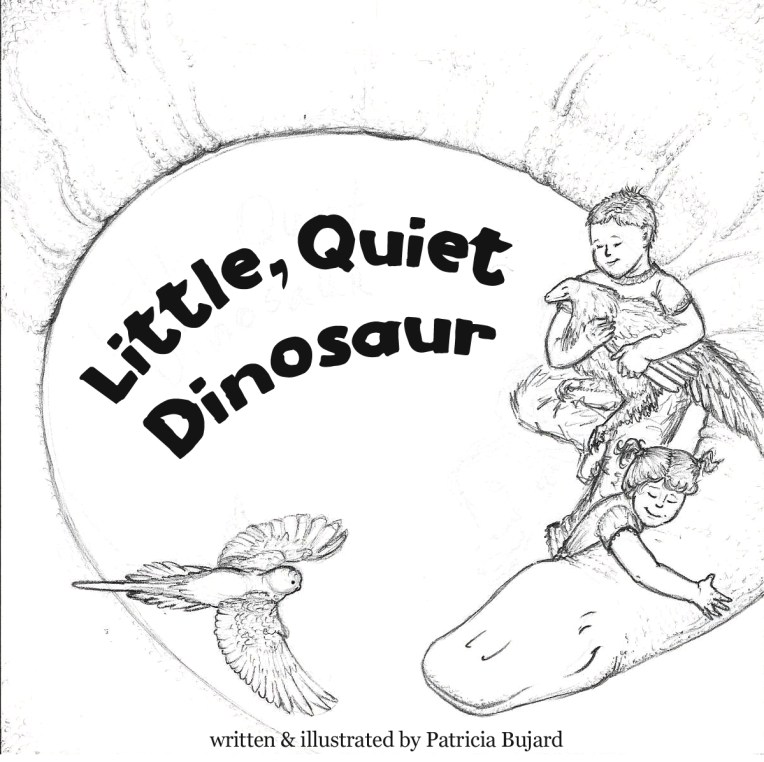
With those questions in mind then, here is the sketch.
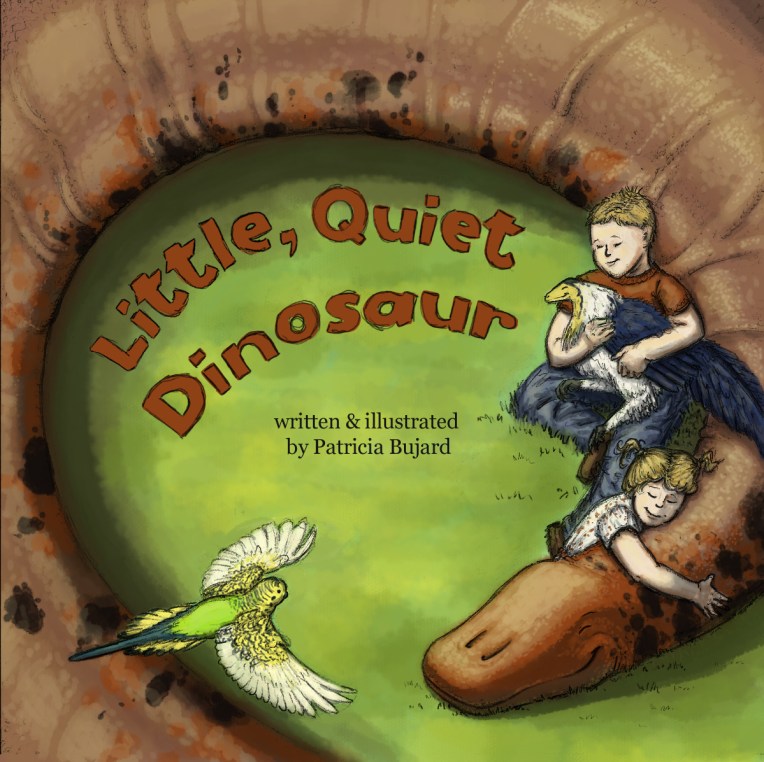
And here is the colored version as I have it now. It’s only colored as much as necessary to get an idea of style and general look. It doesn’t have fine details yet.
Thank you for swinging by my little corner of the internet, and thank you for taking the time to chat with me today. 🙂 I think it’s pretty awesome that indie publishing is an option, and that you can be a part of this.
Here are those questions again, and it would be most helpful if you could answer the questions for each image above. Whichever ones work best for each picture. 🙂
What’s your first reaction when you see the picture?
Would you pick up the book if you saw it on a library shelf? Please tell me why or why not. 🙂
Are there any questions you have about the characters or the illustration? Does it make you want to know more, or know the story behind it?
Thank you again for taking the time to help me give you something better. 🙂 I love to read your answers in the comments! 😀
Meet Twig. He’s a lot more travel-sized, if you’re looking for a dinosaur that’s not a bird. He makes up for his size by being extra fluffy and huggable. Can you resist that fuzzy tail?
Twig may be small, but he’s not nearly as teeny as most “educational” sources would have you believe. Almost all the dinosaur books I’ve come across claim this little guy as the smallest dinosaur. “As big as a chicken” is the phrase often used.
Twig would have you know he’s the size of a turkey, not a chicken (makes a big difference if you’re standing right next to it). All those other reports are actually based off a German fossil of a juvenile compy, not an adult. Another well-preserved fossil was discovered in France in the 1970’s, but paleontologists weren’t sure it was a compy until more recent years.
Twig doesn’t mind the confusion though. He’s not really bothered by much as long as he can snatch a lizard or two out of the bushes. 🙂
Just for fun, here’s a picture of Jurassic Park’s Compsognathus. This picture is from the Jurassic Park Wikia, but did not have any credit associated with it. It looks like it was cut from a screenshot of Jurassic Park: The Lost World. It’s really quite a nice little puppet, and the film makers were able to give it the very lifelike, birdy movements described in the first book of the series.
The model has a few glaring inaccuracies, but I really enjoyed watching it in the film anyway.
Shrinkwrapped skin on muscle on bone, with no soft tissue in between.
Two fingers instead of three
Broken bunny arms
The lack of feathers is not technically inaccurate, because some relatives preserve feathers, and others preserve scales on the tail. So it’s a coin toss really, at least until we can find more data. 🙂
Making progress…
Just inching along on a couple of big projects. I’ll reveal more as I get closer. 😀
Coming Next Week…
Why, oh why must everyone call her ugly? I really don’t know. She may not be winning any beauty contests, but she’s a real sweet heart with anyone she meets. 🙂
Hello there Steggy! She’s followed me here because she wants the bucket of tasty fern balls I’ve brought with me. That works out nicely, since she’ll stay here and munch while we point and chat about her for a few minutes. Just like when we talked about Ajax last week, I’ll stick with 3 research tidbits for now, to keep things short. 🙂
1. Soft or hard-shelled turtle?
Steggy’s a bit smaller than the average wild stegosaurus, but she’s still quite a bit taller than we are. If you reach up on your tip-toes you might be able to touch the biggest of her plates, the one right above her hips there.
There’s been some speculation in recent years on if these plates were hard and covered in keratin- like a turtle’s shell or cow’s horn- or if the plates were soft and covered in scales or skin.
Hesperosaurus. A much smaller spiketail, but so close a cousin that there was a bit of disagreement a couple years back if it should be lumped in with Stegosaurus.
So there you have it. Hesperosaurus is a very close cousin of Stegosaurus, so in the realm of phylogenetic bracketing that makes it more likely that Steggy had a smooth, hard sheath of horn on her plates and spikes.
2. Armed to the teeth.
One of Steggy’s wild relatives, a Stegosaurus ungulatus to be exact. We should probably back off. He doesn’t look too happy that we’re so close.
The same Hesperosaurus described had another very rare insight on spiketails- fossil skin. As you can see on Steggy here, most of her body is covered in small, non-overlapping scales, called tubercles. They look a bit like pave stones don’t they? Now look up here, a bit higher up on her side. Interesting isn’t it?
Steggy has some pretty tough scales. These large oval scales are called osteoderms, just like the large, hard scales on the backs of crocodiles. They’re covered in keratin, like our fingernails, and they do a pretty good job as armor. I’m sure Alfred‘s wild relatives had a tough time munching on wild stegosaurus. 🙂
Short front legs can bring head lower to the ground (harder to reach) and spiky end up, or push the body up to swivel on powerful hind legs. Awesome for quick, sharp turns. No way a hungry predator can get to anything soft and vulnerable if that spiked mace is always between it and the stego.
3. She might not be the sharpest rock, but she’s one tough cookie.
Yeesh, I definitely need to practice these guys more. Fun fact, there are track ways of stegosaurus in small family groups, with young juveniles with a few adults, or a few “teenagers” traveling together. 🙂
Steggy might have a brain the same size as a dog’s, but she’s not nearly as dumb as movies and the media would have you think. (I’m looking at you Spike, in The Land Before Time). I think most encounters would not have ended up like the stego in Disney’s Fantasia (which is totally what inspired my love for them in the first place 🙂 )
With all that armor, and tons of fossil evidence with some serious dino damage on Alfred‘s wild relatives, it looks to me that spiketails had an attitude to match their prickly array of spikes and plates.
Because of that, I’ve given Steggy a bright warning pattern. Someone told me it reminded her of a skunk, and that’s exactly what I’m going for. Steggy’s color is something that says “stay away!”
Good thing Steggy is a calm and peaceful pet then, a domesticated spiketail. Domestic spiketails have a tendency to be nervous, and spook easily (like horses), but Pete works with her a lot, and hardly anything bothers Steggy now. (horses can be trained like this too)
Just for fun, here’s my reasoning on why Steggy may not be as dumb as you think. A quick check on Youtube brings up plenty of smart tortoises. Yep, after discovering that it couldn’t fit through the pet door, this one figured out how to open a sliding glass door.
Quick Question: Animals do all sorts of crazy things we wouldn’t expect. Do you have a story about an animal or pet that did something unexpected? I’d love to hear your answer in the comments!
Meet Ajax. He’s a gentle giant with a big heart and a big appetite. He’ll do anything for food and a belly rub. And when I say anything, I mean anything…
Ajax is big, heavy, and always hungry. He’s got a knack for sniffing out treats and getting into places he shouldn’t. He really didn’t think things through when he squeezed into the shed that one time…
I thought it’d be fun to take another look at the older version of this big guy. I’m not entirely happy with how the light turned out on this one, but what changes I’ve made to it over the past 20 minutes haven’t changed much, so now I know I’m just procrastinating. 😛 Best try again some other time, after I get fresh eyes on the subject. 🙂
It sure is different than the original though. I think I’ve figured out the style for these guys, and now I just need to practice plants and backgrounds more. 😀
Making progress…
Things are coming along quite nicely, now that I think about it…
I’ve been able to keep up with two posts a week for the 3 months Pete’s shop has been officially open.
I’ve figured out the style I want to use for the illustrations.
I have almost all the critters on the original list complete, and I’ll begin creating their proper pages once the list cycles through again.
I’m getting faster at painting the critters each week, and my skills are improving.
I’m getting more comfortable with drawing and writing in general.
and soon I’ll be able to have a free ebook on Amazon for you. 😀
That’s a longer list than I thought it would be when I started writing it, now that’s awesome. 😀
Hooray for progress! Isn’t it great when you take the tiny baby steps, trudge along for a while, then realize how far you’ve come when you take a look back? It may not be much, but it’s a lot more than nothing, which is what I started with. And that’s good enough. 🙂
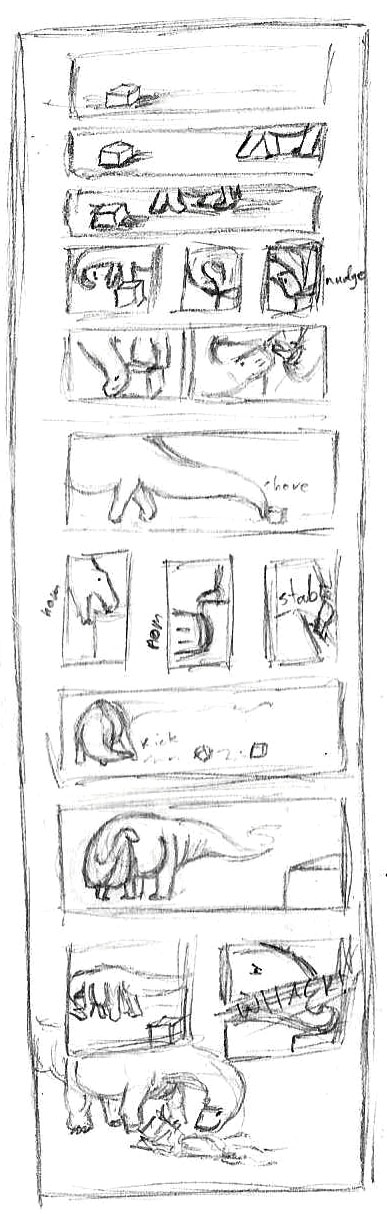
As my special treat for you, here’s a sneak peak at my “super secret project” 😉 Spoiler alert, if you can interpret my scribbles. 🙂
Coming Next Week…
The oft-proclaimed smallest dinosaur in the world is!…not as small as you might think. 🙂
First up is Ajax (hi there Ajax! Give’em a smile), because really he’s the first critter of the lot I ever drew, and he shows up in my sketch book a lot. Plus he’s just an all around friendly guy, and anyone knows a brontosaurus (ahem, Apatosaurus) when they see one. 🙂
So what’s science and what’s art? To keep this post short, I’ll cover three main points (there are always more, but we can save those for later). All drawings in these posts are quick doodles to illustrate a point, with not as much reference as I usually use, so there are plenty of inaccuracies for you to point out for me. But I do have this great toymodel replica to look at when I’m clueless as to how something looks at certain angles. 😉
Clearly I have a lot to learn when it comes to photographing these things, but everyone starts somewhere right? Hehe, and yes, that’s a toy. Papo’s latest model of Apatosaurus to be exact, inspired by Sideshow Collectibles’ Apatosaurus, which is double levels of gorgeous and ten-thousand times more expensive. 😛
1. Toothy grin, or soft smile?
For starters, let’s talk about Ajax’s smile in the picture above. There’s a lot of discussion on dinosaur lips- did they have a toothy grin like crocs, or closed lizard-type lips?
On one hand there’s the study by Ashley Morhardt (unfortunately I can’t find it, so I’m relying on 3rd party sources). She compared the skulls of prehistoric and modern animals, and looked at the clues left behind by beaks, lips, etc…and her study suggests that sauropods like Ajax had a face more like a crocodile’s than the fleshy lips of mammals.
Ajax’s teeth, like most dinosaur teeth, have a pretty healthy coating of enamel, the same stuff that coats our teeth and makes them hard. Enamel does best when it’s bathed in saliva 24/7, which is why mostly all animals that have enamel-rich teeth have mouths sealed shut by lips of some sort.
Anyway, Ajax eats whatever he can get a hold of. He does replace his teeth every once and a while (unlike our permanent set of adult teeth), but still, it takes a while to get a replacement tooth, so he needs to use each set for as long as he can.
With that in mind, I’ve decided to reconstruct Ajax and the other sauropods with closed, lizard-like lips.
It’s one of those things that we can’t know for sure, because even a mummy can’t give you a perfect picture, anymore than a raisin can tell you what a grape looks like.
2. How far can he stretch?
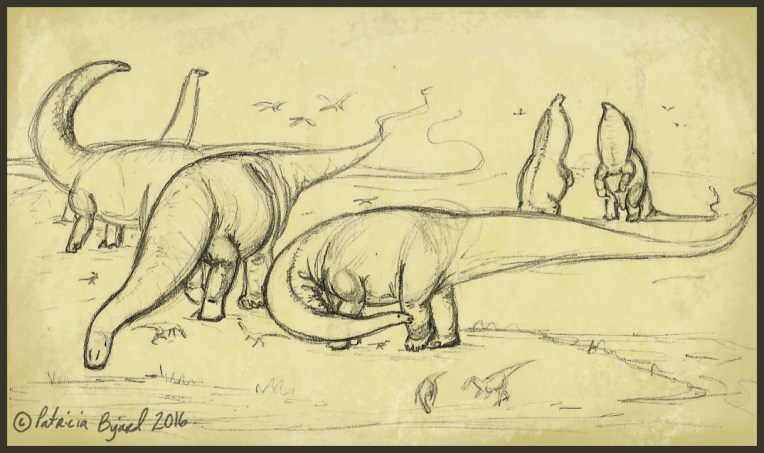
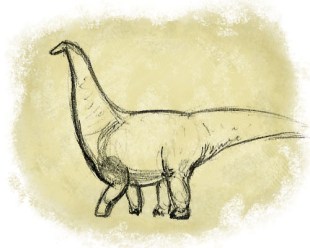
Oh boy, paleontologists have gone back and forth on this one for over a century. First thin, graceful necks like swans, then BBC’s Walking With Dinosaurs comes out and shows the fruit of research claiming that Ajax & Dippy held their necks out like suspension bridges. They held their heads and tails in almost a straight line, and were unable to lift their heads higher than their shoulders.
He’s really trying to impress you
More recent work has pointed out that if you add space for cartilage between the bones, then the necks of many sauropods had the flexibility to loop in a complete circle. The brilliant minds behind the SV-POW! team over at svpow.com (always enjoyable to read, but definitely more on the technical side) helped rekindle my love for the long-necked giants by holding their heads high again, and regain neck flexibility by taking soft tissues into account.
In short, we don’t really know. But Ajax would probably have a great deal more flexibility than Walking With Dinosaurs would have you believe. The bendiest part would be the middle of Ajax’s neck, with the ends less flexible.
I always think that animals are more capable than we usually think, so one of Ajax’s buddies has reached back to scratch at an itch on his leg. 🙂
Oh, and those two in the back with the puffy necks…that’s entirely speculative. Something weird was going on with Ajax’s neck though, that’s for sure. 😉
Ajax’s legs are like solid pillers, and all the finger bones are wrapped together to form a fleshy, padded, hoof-like structure. Only the “thumb” has a claw, which has some limited mobility depending on the species. Ajax can move his thumb claw up and down a little bit. 🙂
Scientists disagree on how much Ajax could move his wrist. So how far he has his front foot bent at the wrist is a bit speculative.
I’ve done a terrible thing and made his wrist flexible based on an elephant’s range of movement. 😛
Quick Question: Is there anything in the popular media you can think of about Ajax and other sauropods? What common misconceptions do movies like Jurassic Park and The Land Before Time give about Ajax and his cousins? 🙂 I’d love to hear your answer in the comments!
Meet Rosie. She’s a bit shy, and might need a little encouragement to come closer. A few treats should do the trick. Before you know it she’ll be perfectly content to snuggle close and put her head on your lap. 🙂
Rosie is smaller than your average dinosaur, about the size of a deer. Like a deer, she can be a bit jumpy, and she feels much better if she has friends to keep her company and watch out for troublesome, over-exuberant types like Opie. He’s far too excitable, and that makes her nervous. She’d much rather curl up under the shade of spiky cycad fronds for a little siesta.
Much safer there. And Rosie always wins at hide-and-seek. 😉
If you take the time to give her treats and coax her out of the thicket, then she’ll get to know you rather quickly. Then she’ll be your friend forever, and come running when you call. 🙂 I hope you don’t mind having a second shadow…
Making progress…
I’m working on something super top-secret at the moment. Well, not really super top-secret, since I told my family about it- but anyway, I want to mention it here too.
Since it may be a while before the picture book is finished, I want to work on a smaller, short term project so that you have something sooner.
In short, I want to create a collection of shortstories, mini-comics, illustrations, what-have-you. My question is about what topic to cover…
Pete’s adventures around the shop- Like the time Terry and her flock nabbed his lunch.
Feeding time at the shop- Walk with Pete as he shows us how he feeds Tigger at the lake, or takes care of Elmer’s stubbed toe.
Letters to Pete- Frustrated paleo pet owners send letters to Pete with their questions. What do you do when Big Al keeps tearing up the furniture?
Critter cam- So what do dinosaurs do when you’re not looking? Find out what happens if you give Dippy a giant ball.
The Paleo Pet handbook- a small book with all the basics of the care and feeding of your paleo pets.
Please let me know what looks the most interesting in the comments! Thank you for sharing a little of your time with me here on the site, you guys are awesome, and I want to do whatever I can to make your stay better than great. 🙂
Coming Next Week…
Food is the first (and just about only) thing in mind for this gentle giant. 🙂
So there’s a long and a short way to go about this. I do something really tedious and boring, and pull out the scientific papers, fossils, diagrams, anatomy jargon, and articles written by people much smarter and more knowledgeable than me in all things paleontology…
OR
I can save you the big snore (because the technical stuff is tough to read, and I like this sort of thing!) and have an excuse to draw yet more cute critters, while sneaking in a few quick fossil facts in a bite-size post or convenient picture. 🙂
Why am I doing this?
The truth is that I got a little frustrated. All the dinosaur books for kids fall into one of two categories-
Super cute story and dinosaurs, but no science. For example, “Pteradactyls” lumped in with the dinosaurs, and dinos stuck with the appearance of rubber toys from the 80s.
OR
“Educational”, but tough to read. Because after reading a list of names like Tyrannosaurus rex, Euplocephalosaurus, and Parasaurolophus 20 nights in a row, I know that book is going to put aside for “some other time”. Plus the computer graphics always look a bit unpleasant to me.
Pete’s Paleo Petshop is the best of both worlds. A cute story with illustrations based on the latest scientific research I can find. But I also want to make clear what part of the illustration is something we actually know as fact, or really just an educated guess. Speculation. A hypothesis. 🙂
So this is the start of a new series called The Art & Science of Pete’s Paleo Petshop. That’s super long though, so I’ll have to shorten it somehow. 🙂
For your convenience, I’ll keep a list of all posts in the series here on this page, and I’ll update the list with links as we go along. I’ll begin with the main cast, and we’ll see where we go from there. 🙂
Bonus Question: Any special requests? I’ll be going over these critters in no particular order, so if there’s one you really want to see first, let me know. First one to answer in the comments gets first pick! 🙂
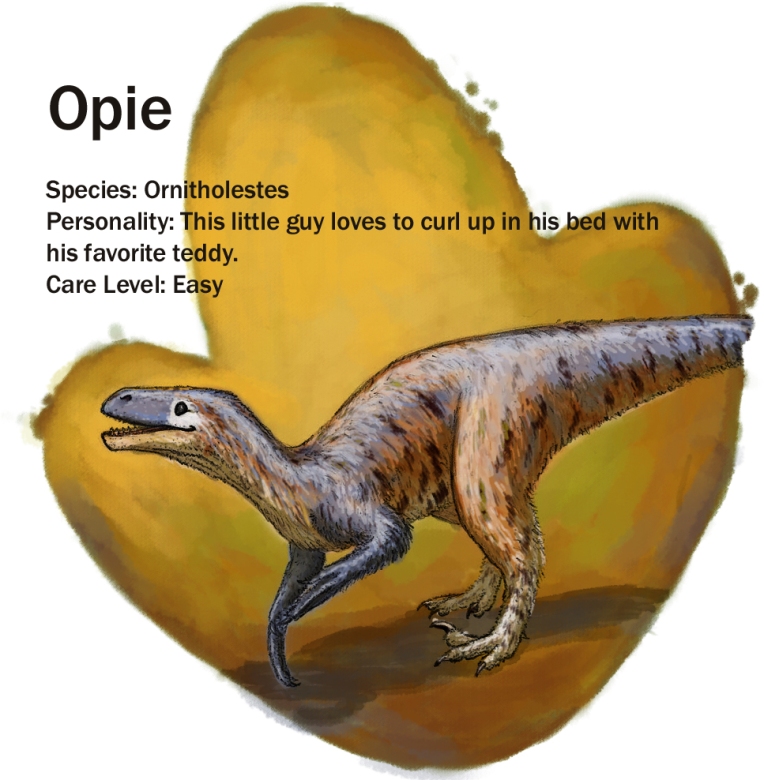
Meet Opie. He’s a happy little fella who loves to curl up in your lap, so it’s a good thing he’s about the size of a big dog!
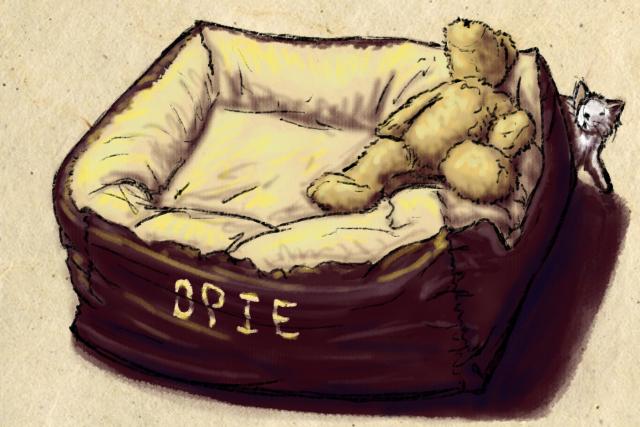
Yes, Opie seems to think he’s a big lapdog, and he loves it when you stroke his feathers. Where is he off to now? It looks like he’s going to show you his favorite toy…Opie carries Teddy around everywhere. He’s gone through quite a few “surgeries” to poke the stuffing back in after Opie nibbled on him.
Oh! That’s Miss Kitty peaking around the corner. She’s a little shy after Opie tried playing a game of snatch with her. He’s just a big softie though, and he only wants to play. He’ll get a little droopy when Miss Kitty doesn’t understand. So he’ll curl up in his bed to snuggle with Teddy, and he’ll chirp happy chirps when he snuggles. He sounds a lot like this…
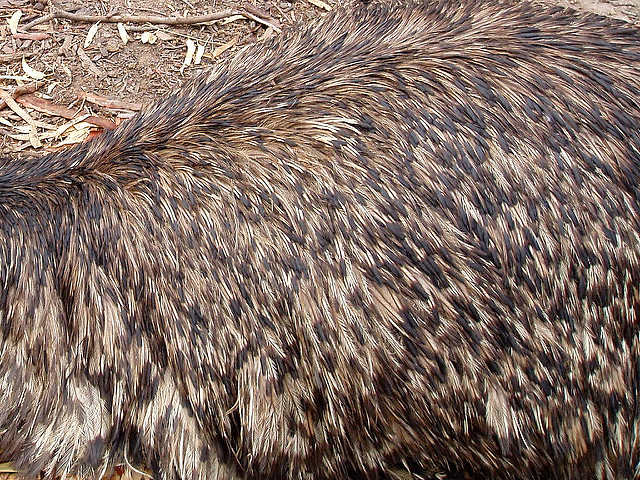
Speaking of soft and cuddly, those feathers are rather like those on an emu or kiwi. Looks a lot like fur, doesn’t it? 🙂
Emu feathers. Photo courtesy of Amanda Slater (2009)
Making progress…
My biggest discovery this week is Pinterest! Not a lot to do or say about it just yet, since I’m just in the learning phase…but let’s just say that for a website heavy on illustrations like this one, it sounds like an image-centric site like Pinterest will be a great way to spread the love. 😀
Coming Next Week…
This small plant-eater is a bit shy, but she’ll snuggle for treats. 🙂
Let’s revisit our friend Mr. B from the first post of this series on fossilization (Who’s Mr. B? Refresh your memory here). We’ve dug up his bones, put them together, figured out all the soft stuff like muscle and skin, and we’ve got a pretty good idea how he lived…but he didn’t live all by himself on a desert island, or on a blank white sheet of paper (ahem, I’m looking at you, boring sideways diagrams).
So how do we figure out about the big picture? Where does Mr. B fit in?
First let’s take a look at old Mr. B…what do we know about him?
We know he’s a Brachiosaurus.
We found it in Colorado while digging at the Morrison Formation.
He’s a very large mega-herbivore, and rare in this particular formation.
This isn’t a lot to go on, aside from the fact that Mr. B would need plenty of plants to eat and water to drink, and lots of space to roam.
Who’s in the neighborhood? It would be tough to figure out what makes a Savannah with only a giraffe to look at, so let’s take a look at some of Mr. B’s neighbors.
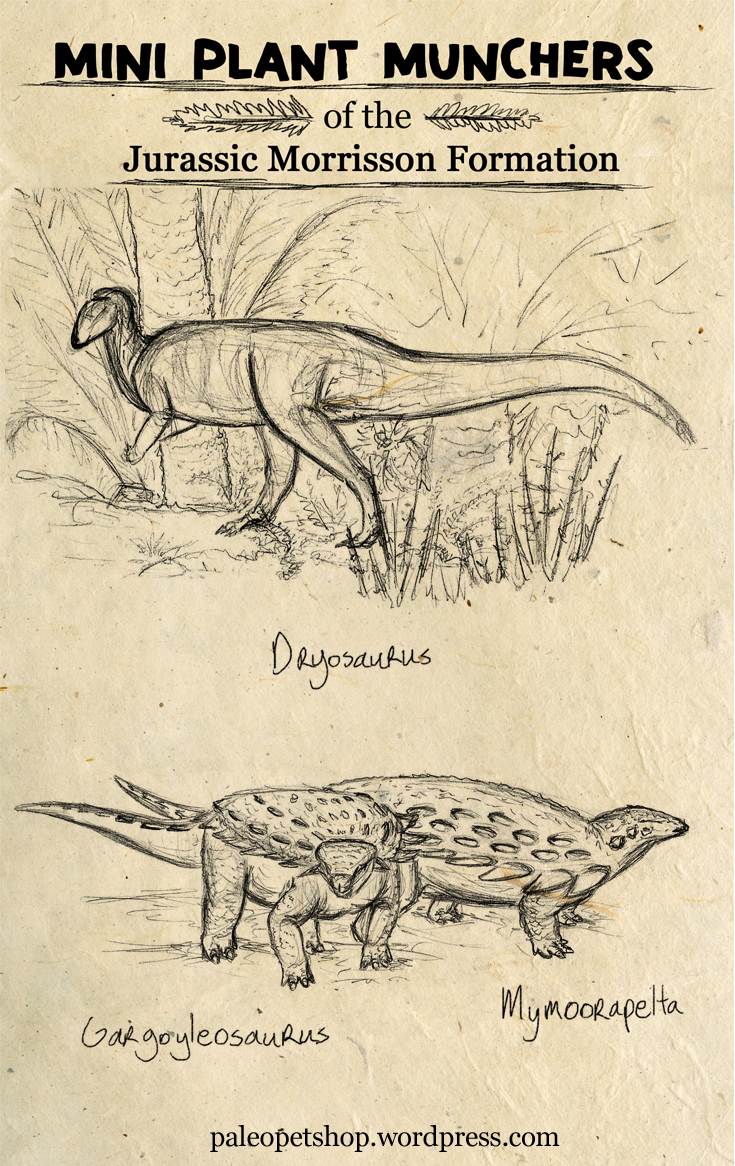
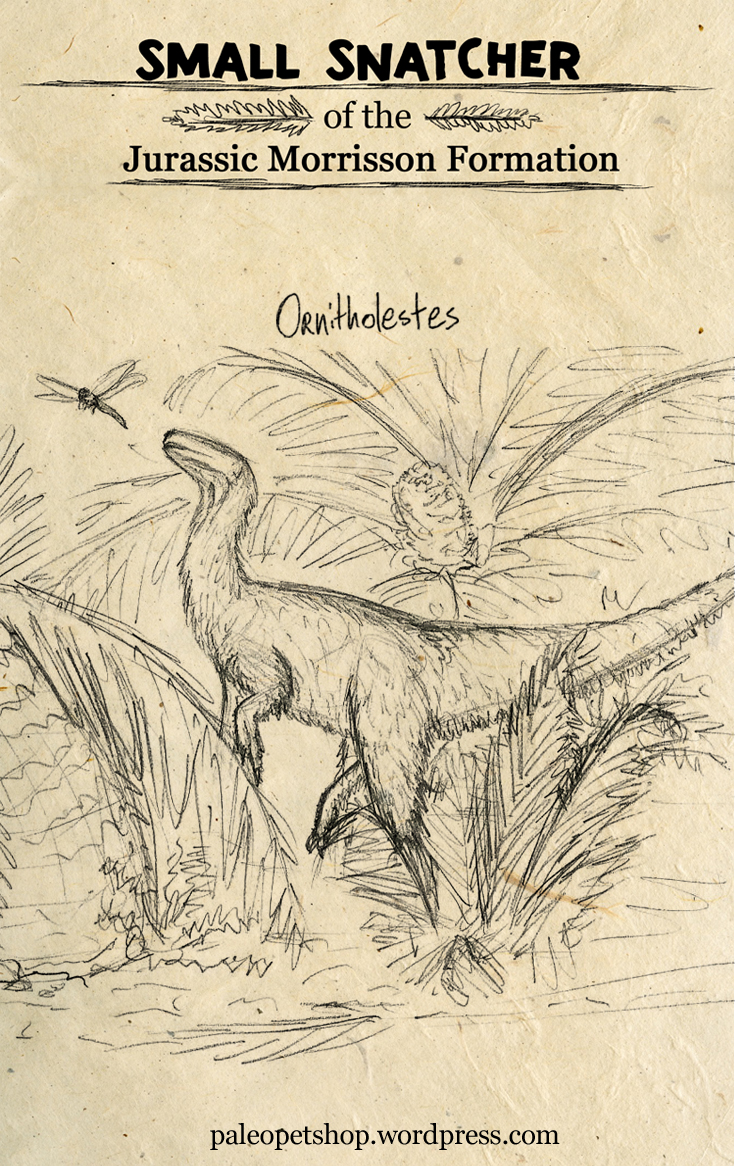
There were also all sorts of other non-dino critters, like flying pterosaurs, several small land and water-loving crocs, all sorts of insects (including termites that built 90ft-tall mounds), fish, frogs, turtles, lizards, crayfish, clams, and even a few egg-laying mammals no bigger than rats.
Now we’re getting somewhere. We know that this environment has to support several very large herbivores and carnivores, along with a very diverse population of smaller dinosaurs and other animals. We’ll have to assume that many small and delicate animals were not preserved.
What we can’t really figure out from looking at all these animals is…what where all those giant plant eaters eating?
The Green Stuff. Of course, plants are essential to any ecosystem, and in the Morrison Formation we find stuff kinda like this…
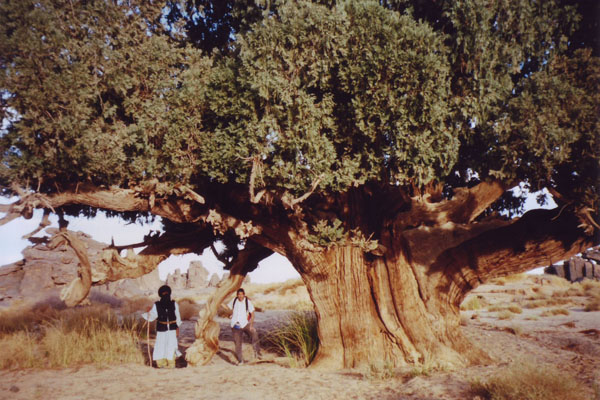
Conifers:
A giant cypress tree in the Tassili n’Ajjer National Park, at the edge of the Saharan desert. Image courtesy of archmillenium.net
A conifer tree, probably a type of juniper.
Ponderosa pine trees. These are in the middle of the desert in the southwestern states of the US.
A pinyon pine. Pine nuts would be a tasty treat for any dino I’m sure. 🙂 Images courtesy of in-the-desert.com
Ginkgoes:
A reconstruction of a Jurassic ginkgo branch. Image courtesy of Wang Chen
A modern day Ginkgo biloba tree. Wikipedia commons.
Tree Ferns:
Doesn’t it make you feel like you’ve stepped into a time machine? These tree ferns are at the Whirinaki Forest Park in New Zealand. New Zealand is just plain awesome, they should’ve stuck a couple of these in Jurassic Park…image courtesy of fotoditzi (2007)
These cycads are grown in a garden, but wild cycads tend to grow in large thickets. They depend on being close to each to reproduce.
There are many more varied shapes to cycads. these are just the most drought tolerant, but all cycads tend to do well in places that are hot and dry like Arizona.
Others prefer wetter climates. Click “cycads” above to see more varieties in this person’s garden. Images courtesy of troydonovan, on growingontheedge.net
Photo courtesy of Maurice Levin (2011)
Horsetails can live just about anywhere so long as there’s a river- even deserts.
These horsetails were photographed in the Chihuahuan Desert Gardens, Centennial Museum. Images courtesy of A. H. Harris
These images are courtesy of Aneyefortexas.wordpress.com
Some ferns don’t even look like ferns!
This one looks dead, but will freshen up into a lovely green again as soon as the rains come. You can see more beautiful pictures like these by clicking the link to desert ferns above. Images courtesy of Aneyefortexas.wordpress.com
Dirt isn’t just dirt. Sand, mud, ash, sediment at the bottom of the ocean or a lake…they all turn into different kinds of rock. So what kind of rock a fossil is buried in can tell us a lot about plants, which can then tell us a lot about the local weather.
The Morrison Formation is made of layers of mudstone, sandstone, siltstone and limestone, and is light grey, greenish gray, or red in color. Most of the fossils occur in the green siltstone beds and lower sandstones.
To translate into plain English, this means that the area was an area laced with a few rivers, and had seasons of drought and flood. Since the area was relatively flat, it would flood and turn into swamp in the wet season, but have dry Savannah during the dry season.
But there was no grass or flowering plants in the Jurassic, so what sort of plants would there be in a Mesozoic Savannah?
A typical Savannah in the present day.
Take a look at modern ecosystems. In areas that have no grass or flowering plants, what is the primary groundcover?
Let’s take another look at those desert ferns…
Dead looking and dry during the long months of drought, but give it a little water and it transforms. The grassy-looking brown fern further up does the same thing. Dead and brown when it’s dry, lush and green when it rains.
Biological what? (my thoughts when I first read that)
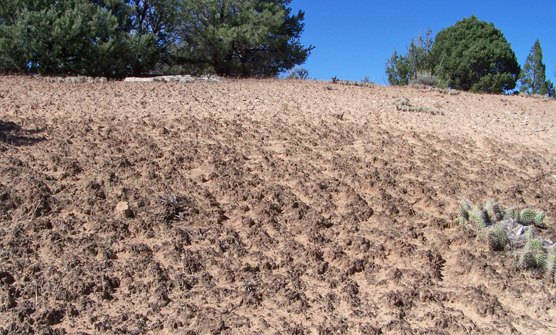
Biological soil crust, or cryptobiotic soil, is a community of bacteria, moss, and lichen that holds moisture, prevents erosion, and provides valuable nutrients for plants (and possibly dinos 😀 ). It looks all brown and crusty during the dry season, but like the ferns, turns green when it rains.
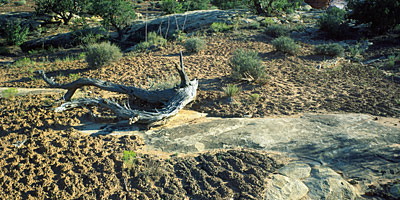
What looks like rocky soil are actually living communities of bacteria, lichens, mosses, and algae. Photo courtesy of NPS.gov
One last picture, and here we have something that is probably very similar to what the Jurassic Morrison habitat was like. Only instead of the flowering shrubs we see here, imagine many different shapes of cycad and bushy areas of dried out ferns waiting for rain…closer to the river we get horsetails, ginkgoes, and giant, more water-loving ferns and tree ferns.
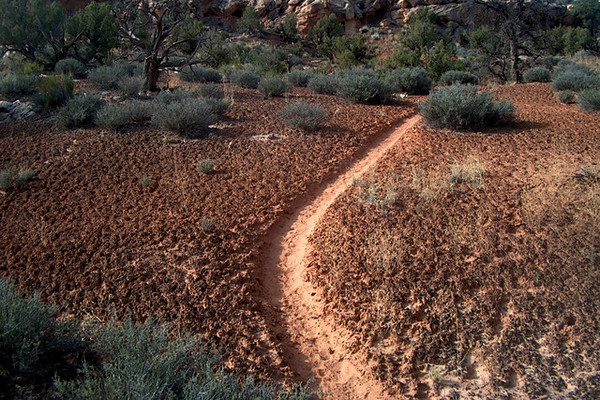
The padded feet of dinosaurs, like camels, kangaroos, and ostriches today, doesn’t break the slow-growing crust underfoot.
That trail you see cutting through the crust shows us how thick the living layer can be. The trail is the result of a mountain bike or something cutting through it, which will take hundreds of years to grow back.
Quick Question: Now that we have a more complete picture, how do you think Mr. B fits in now? My guess is as good as yours, so it’s all fun speculation. I’d love to here your answer in the comments! 🙂






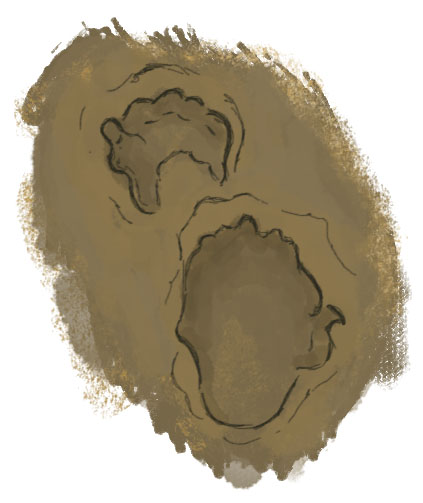 Ajax’s legs are like solid pillers, and all the finger bones are wrapped together to form a fleshy, padded, hoof-like structure. Only the “thumb” has a claw, which has some limited mobility depending on the species. Ajax can move his thumb claw up and down a little bit. 🙂
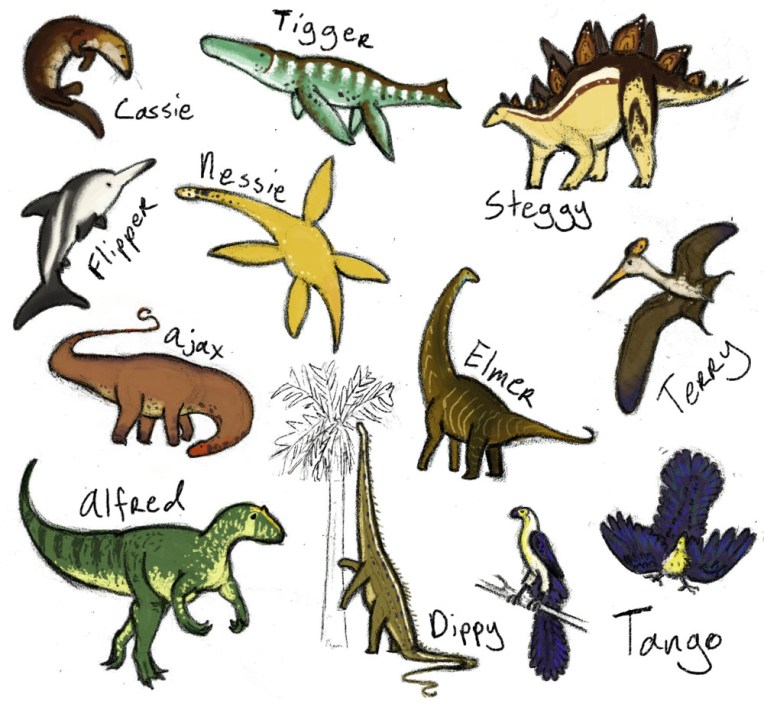




 Pete's Paleo Petshop