Critter of the Week: Pterodactylus

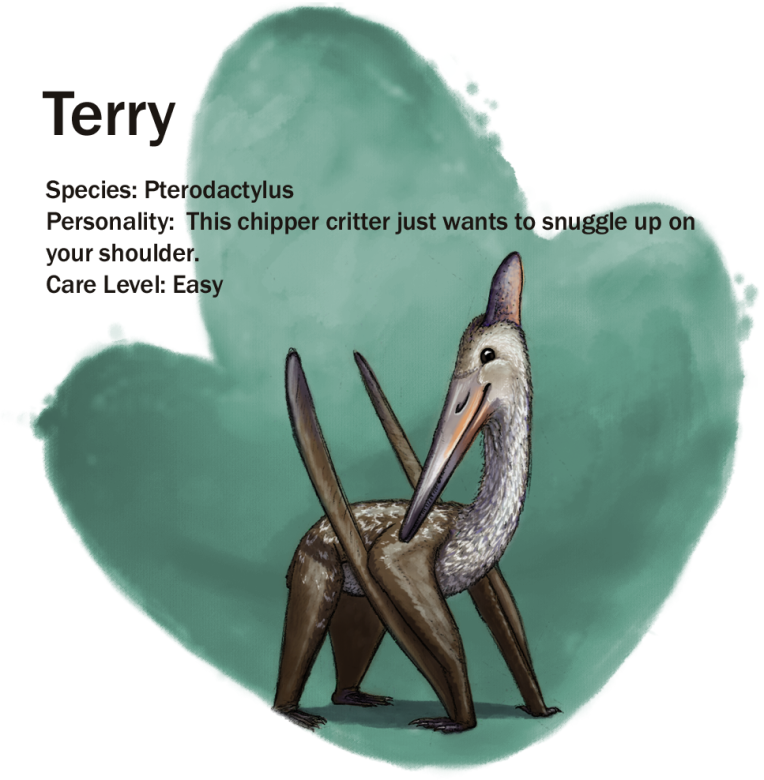
Meet Terry. He’s a chipper little guy who would love to scramble up onto your shoulder and nibble your ear (just a little nibble, it tickles).  And could he please, pretty please have a tiny bit of that sandwich?
 

Terry.png


Terry always likes a snack, especially small morsels like snails, grubs, and worms he digs up.  That sandwich looks quite tempting though, and he won’t turn his nose up at an opportunity to snatch it out of your hand, so keep an eye and a firm hold on it. 😀

He might not look it, but this little pterosaur (not dinosaur), is very good at walking and running around on the ground.  He spends a lot of his time poking his sensitive beak in the dirt for all sorts of burrowing creepy crawlies.  When he feels one, he nabs it with his tiny teeth and gulps it down.  Yum!

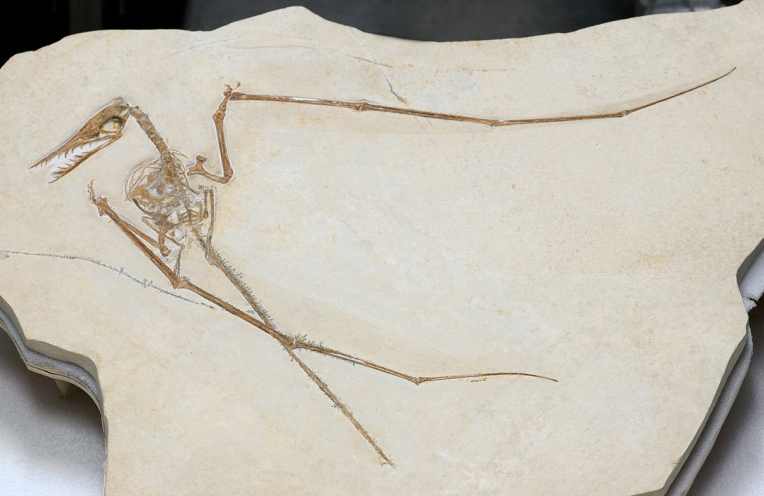
These flying reptiles have a layer of furry fuzz covering their bodies. To make a long (and possibly boring) story short, we know this covering is not fur, but we’re not 100% sure if it’s some kind of feather or not. It might be something totally new.  If the fuzzies are feathers, as some paleontologists suggest, then that says a lot for how many dinosaurs probably had feathers.  Pterosaurs aren’t dinosaurs, but they’re like 2nd cousins. 🙂

Also notice how the wings are not saggy skin.  The wings are actually super awesome (insane genius levels of cool!), and they deserve their own post, but I’ll try to give you the short version.  They’re “smart” wings with layers of muscle and inflatable air pockets, and they behave a bit like the wings on a plane.  I can tell you this for sure, they’re not anything like bird or bat wings.

Oh yes, one more thing.  The beak is speculation on my part.  I read a paleo article somewhere about the possibility of terries having beaks, so I figured I’d draw it and see how it looks.  I’ll have to do more research from more paleo experts to figure out if this is just a wild idea or actually plausible.

Just to clarify, this beak is a thin, keratinous layer over the skull, so not exactly like a bird’s beak.  Similar, but this little guy still has teeth. 🙂


Making progress…

Well, after about a month I’ve determined that trying to get a buffer down is failing.  All it takes is a little hiccup in the week, and then I’m back to working on my posts the weekend they’re due. 😛

So I’ll be trying something else to help streamline things.  Two posts  per week is a realistic number, so I can stick to that, but I think I’ll trying incorporating actual work on the picture book into my Monday posts. 🙂  That way I can make progress on the whole reason this site exists.

Critter of the Week is here to stay.  It’s too much fun!  And I like having a new critter to practice on each week. 🙂  So we’ll see what I can do for Monday.  Hehe, experiment time. 😀


Coming Next Week…

This little guy loves to curl up in his bed with his favorite teddy. 🙂

Share your guess in the comments! He’s one of the critters over on the critter page. 🙂

Time to Get Wild! (how we can guess about behavior, and how crazy it can get!)

Now we’ve put all the pieces together and figured out what they mean (sort of).  We’ve done our best to cloth the muscle and bone with fatty tissue, skin, and maybe even feathers.  Now we can really get wild.


But surely there’s no way to have any clues on behavior?  It’s all just guesswork right?

Well no, fossils can leave behind clues even for how an animal lived.  Here are a few ways we can speculate (or make an educated guess based on fossil evidence) how wild these critters could get. 🙂


Bones & Teeth             

  • Teeth can tell us a lot about what an animal ate, and the rest of the skeleton can give clues as to how it ate.  For example: the slender, notched jaw of Dilophosaurus suggests that it usually ate fast, slippery prey.
Image courtesy of Jaime A. Headden (2011).  Check out his blog to see more beautiful diagrams & illustrations, or if you want to look up more detailed info on all things paleontology. 🙂  Qilong.wordpress.com
  • It’s not fool proof though, just look at pandas and fruit bats.


  • Sometimes an animal that looks specialized in one thing is just specialized to survive during hard times. Example: seals that have teeth “specialized” for eating krill don’t only eat krill.  They eat everything they can get their teeth on, with the added bonus of pigging out on krill when they can, just because they can.


Articulated Skeletons      

  • Sometimes animals are buried suddenly and quickly.  In especially rare cases, these complete skeletons preserve “candid shots”, moments frozen in time by a collapsing sand dune, mudslide, or drifting down into a deep, cold lake.
  • Click on the pictures for more info. 🙂


Track Ways                                 

dino_09.jpg
Photo courtesy of R. T. Bird
  • There are many more tracks than bones, and they offer a unique look at prehistoric animals in action.  Here are a few things we can learn from tracks…
    • How they moved
    • How fast they moved
    • How different animals interact (like traveling herds, or pursuit of prey)
    • Swimming pterosaurs!  There are many tracks of the flying critters swimming.  Interestingly enough, the tracks only have back paw prints.
Witton 2013 swim traces.png
Image courtesy of Witton 2013


Other Trace Fossils        

Coprolite.png
Wikipedia commons


  • Fossil dino poo is even better at telling us what a dino ate than its teeth.  The only problem is figuring out who it came from (unless you have a fossil of an animal mid-poop!)
pterosaur_henderson_4090
This little Pterosaur drifted to the bottom of a very deep lake. If you follow the spine with your eyes to just below the blobby rib cage at the base of the tail, there’s a tiny shadow that looks like a cucumber shape. This critter was fossilized mid potty-break. Image courtesy of the Royal Tyrrell Museum of Palaeontology.
fig-4-2x
Here’s a closer image. The little arrows labeled cp are pointing to the coprolite, or fossil poo. 🙂 Image courtesy of Hone et al. (2015)
  • Dino burrows give great insight into the social nesting behavior of some dinos.
  • Nests, teeth marks on bones, and dino bottom prints (true story) are all great clues left behind by living prehistoric animals.  Put together, they offer a glimpse into the animal’s story.


Modern Family             

  • Since crocs are living relatives of dinosaurs, and birds are dinosaurs, then they are a great place to look for clues.  Take a closer look, and we may get a glimpse of exactly how strange, beautiful, and wonderful dinosaurs could be.
  • The croc family may look tough and mean, but here are a couple of normal behaviors that show how gentle and social they can be.


  • Here are a few funky bird dances.  Bright colors not required. 😉


Quick Question: Which was your favorite dancing bird? How do you think looking at modern animals like these can inspire our vision of prehistoric animals?  I’d love to hear from you in the comments! 🙂


Fleshing out the Bones Series:

Critter of the Week: Brachiosaurus

Meet Elmer. He’s a little shy, and likes staying in his comfort zone, but he’ll be your best giant friend if you give him some greens and a big hug.


Elmer.png

The best way to a dino’s heart is through his stomach, as they say.  Well, that’s not really the phrase, but I’m sure it’s just as true, especially when it comes to these long-necked sauropods. 🙂  I think the rough estimate is a solid cube- 5ft x 5ft – of vegetation in a single day to feed one of these guys.

Speaking of feeding longnecks…it reminds me of that scene in Jurassic Park.  The one where Dr. Grant and the kids are enjoying a few moments not running away from hungry Rexy, and they get a chance to pat the brachiosaurus (totally my inspiration for paleo pets, by the way).

If you’ve ever watched Jurassic Park, you may notice that Elmer’s head looks a little strange…that’s because the longneck in Jurassic Park is an African cousin of this guy (and until recently the critter with more complete fossils).  There’s a few differences between the two even a novice dino enthusiast like me can easily recognize…

  • Completely different head.  The African cousin (Giraffatitan) has a head like the one in Jurassic Park.  The American Brachiosaurus (Elmer here) has a much gentler slope to his forehead, and longer snout.
  • Body shape is different. The African Giraffatitan has a shorter torso and overall more stocky build.  While Elmer the Brachiosaurus has a longer body, and generally is a bit more slender.  Not skinny, just not as stocky as his African cousin.
  • They live on entirely different continents.  The Atlantic ocean was already forming in the Jurassic period, so Brachiosaurus and Giraffatitan were separated by a lot of water. 🙂  That leads to the same sort of thing that makes a mountain lion (cougar, puma, etc…) in the Americas different from a lion in Africa.


Also on the subject of greenery, I tried experimenting with something different this time.  All these critter profiles are an experiment in style really, as I practice how I want to illustrate the pictures in the book.

This time I really focused on making my shadows dark and my highlights light.  It sounds obvious and hard to mess up, I know, but you’d be surprised how hard it is!  Especially working with color, it gets really easy to let the color do all the work, and not see how dull and gray everything is.   So I changed the whole picture to grayscale, so I could see how it looked in black, white, and gray tones.

It all looked about the same shade of gray.  Not good.  I like it much better now after I added more light and shadow. 🙂 So I’ll do that test from now on.

Another experiment is the vague hint of background.  I don’t generally paint backgrounds, so this is me dipping my toes in the river to see how cold the water is.  I like to ease my way into things.  Baby steps. 😀

Do you like the profile pictures better this way, or are they better with simple painted color?  Let me know in the comments! 🙂


Making progress…

I’m having fun experimenting with new artsy techniques.  As an artist, it’s always a joy and a challenge to improve my work.  Plus it’s an important bonus that I can give you something better and better each time you stop by. 🙂

On a related sidenote, I think I’m getting into the swing of these little profile pictures.  I think I’m getting a little faster at it, or at least not as many starts-&-stops as before. 🙂


Coming Next Week…

Look up to see this critter, before he nabs that sandwich out of your hand! 🙂

Share your guess in the comments! She’s one of the critters over on the critter page. 🙂

Let’s Put Some Skin on That (how much we know, and don’t know, about the soft stuff)

Now here’s where things get a little muddy.  Bones are easy.  They’re hard, relatively common, and all bones that look about the same are going to have similar functions.  Back-boned critters all kinda have the same basic pattern.  Same with muscle.  The only squishy thing with muscle is determining how much is where, then you can figure out the basic shape on top of the bones.


But what about skin?  We’re pretty good at figuring out how a dinosaur works on the inside, but what did they look like on the outside?

Here is where a little mud or volcanic ash comes in handy.

When an animal is buried in soft, fine-grained sediment, then the critter’s skin, scales, fur, or feathers leave an impression.  Just like stamping into soft clay.  With more refined techniques in recovering fossils in the field (or prepping them at the museum), paleontologists are finding more “skin stamps” than ever before.


Corythosaurus casuarius skeleton, by Barnum Brown, 1916.

A hadrosaur mummy.  Keep in mind that the animal was most likely dead and already decomposing when it was buried.  We can’t know for sure if it had more fat under the skin than showed here or not.  Notice how thick and muscular the tail base is. 🙂

Photo not mine.  If you know who needs credit, please let me know. 🙂

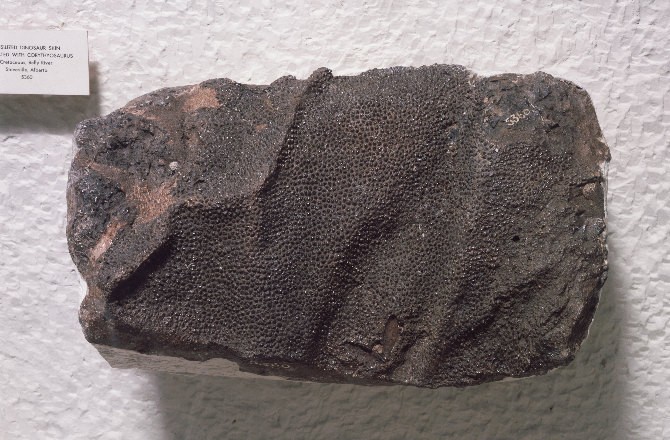
Corythosaurus skin.

Bell, 2012

More hadrosaur skin impressions.  The impressions that look like a honeycomb are actually impressions of what’s underneath the bumps.  Reminds me of bubble wrap. 😛

040813-nws-skin003.JPG
Photo courtesy of Black Hills Institute of Geological Research

Triceratops skin impression.  No one knows if those larger osteoderms would look just as they do here, or if larger quills or spikes where attached.  Speaking of quills…

File:Psittacosaurus mongoliensis.jpg
wikipedia commons

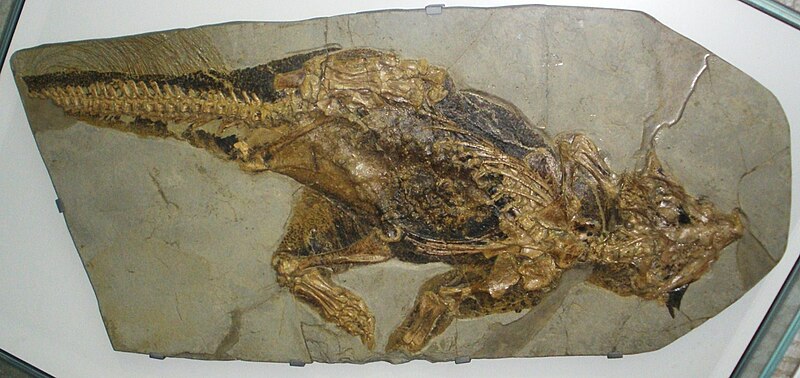
A beautiful fossil of Psittacosaurus (distant, small cousin of Triceratops) at the Senckenberg Museum of Frankfurt.  We can’t be sure about color, but you can see the pattern of darker and lighter scales.  Notice how much muscle this critter has, and those quills!  A one-of-a-kind find.  Remember my post a couple weeks back about how hard it is for an animal to be fossilized?  How much more amazing that we have something like this?

Here’s a closer look at those quills…

high resolution images of Psittacosaurus tail quills, from the paper studying the specimen

The general consensus is that these quills are a feather-like integument. Here’s what we don’t know…

  • If all species of Psittacosaurus had them (there’s 18, all very different from each other), and if they did, how much & where.
  • If any other ceratopsians had them.  Psittacosaurus was part of a line that died out, so it’s rather unlikely that Triceratops & co. had them.


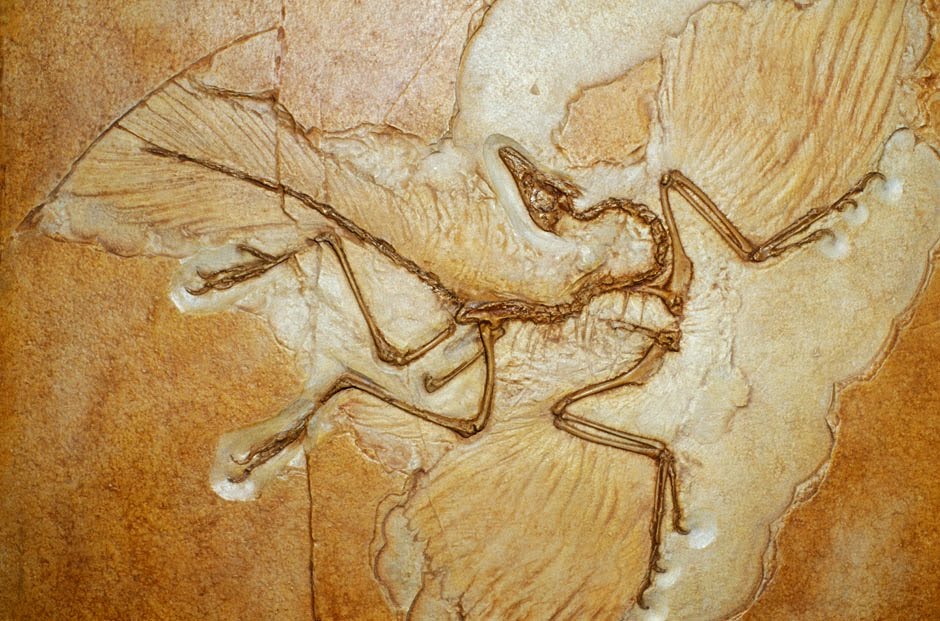
Now that we’re on the subject of feathers…just look at this exquisite fossil of archaeopteryx. 🙂 It never gets old…takes my breath away every time I see it.

Photo not mine.  If you know who needs credit, please let me know. 🙂

Archaeopteryx used to be famous for being the “first bird”, now we know that just about every smallish dinosaur (and even some big ones) where wearing similar outfits.  Yes, most carnivorous dinosaurs are known to have feathers, it’s just a question of what kind, and how much. 🙂

12386.ngsversion.1422035753869.adapt.470.1
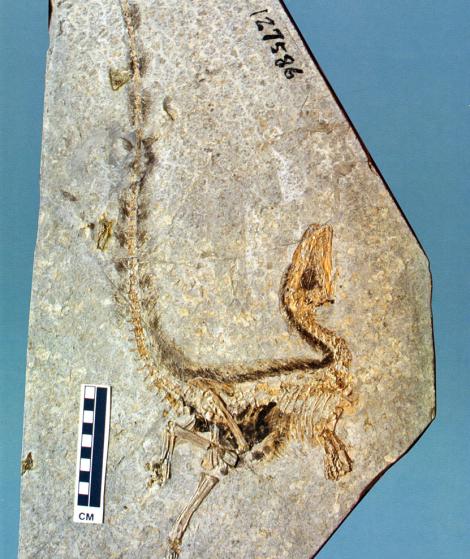
Photo courtesy of Institute of Fossil Paleontology and Paleoanthropology, Beijing

I know that looks like fur, but those are fluffy feathers all over this little sinosauropteryx.  Notice the bands of light and dark color on its tail.

Here are some more birdy feathers on a larger dinosaur.

This is Zhenyu- Zhenya- Zen- Oh forget it.  Let’s just say she’s a cousin of those infamous raptors from Jurassic Park.  She’s about five feet long, so closer to the real turkey-sized Velociraptor.  Fully feathered.  Just look at those glorious wings!

Photo courtesy of Stephen Brusatte

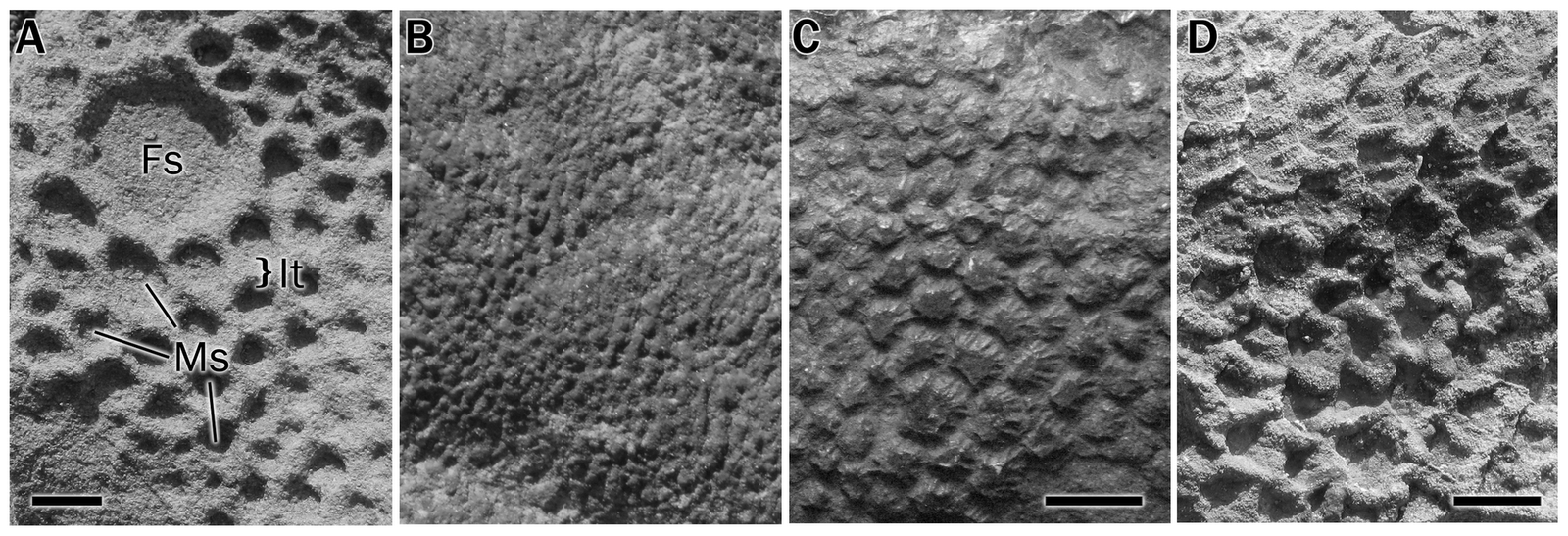
Here’s a close up of those feathers.  Notice the full wing in photo D below.  You can clearly see primary, secondary, and covert feathers, just like what you’d see on a modern bird wing.

But wait, it gets better. 😀

Not quite as pretty, but look at figures A, B, and C below.  The bumps that those arrows are pointing to are called quill knobs, and figure D shows us what that means. 😀

Keep in mind that this fossil came from a critter called Dakotaraptor.  This guy was every bit as big as the ones in Jurassic Park.  And it has wings.

Image from paper studying Dakotaraptor.

A prettier reconstruction of Dakotaraptor’s wing.

Photo courtesy to Robert DePalma.

These and other fossils from even larger dinosaurs such as yutyrannus (T-rex’s Chinese cousin) that also preserve feathers, can give us clues for exactly how diverse and widespread feathers are in the dinosaur family tree.


The flying reptiles called pterosaurs, for example.

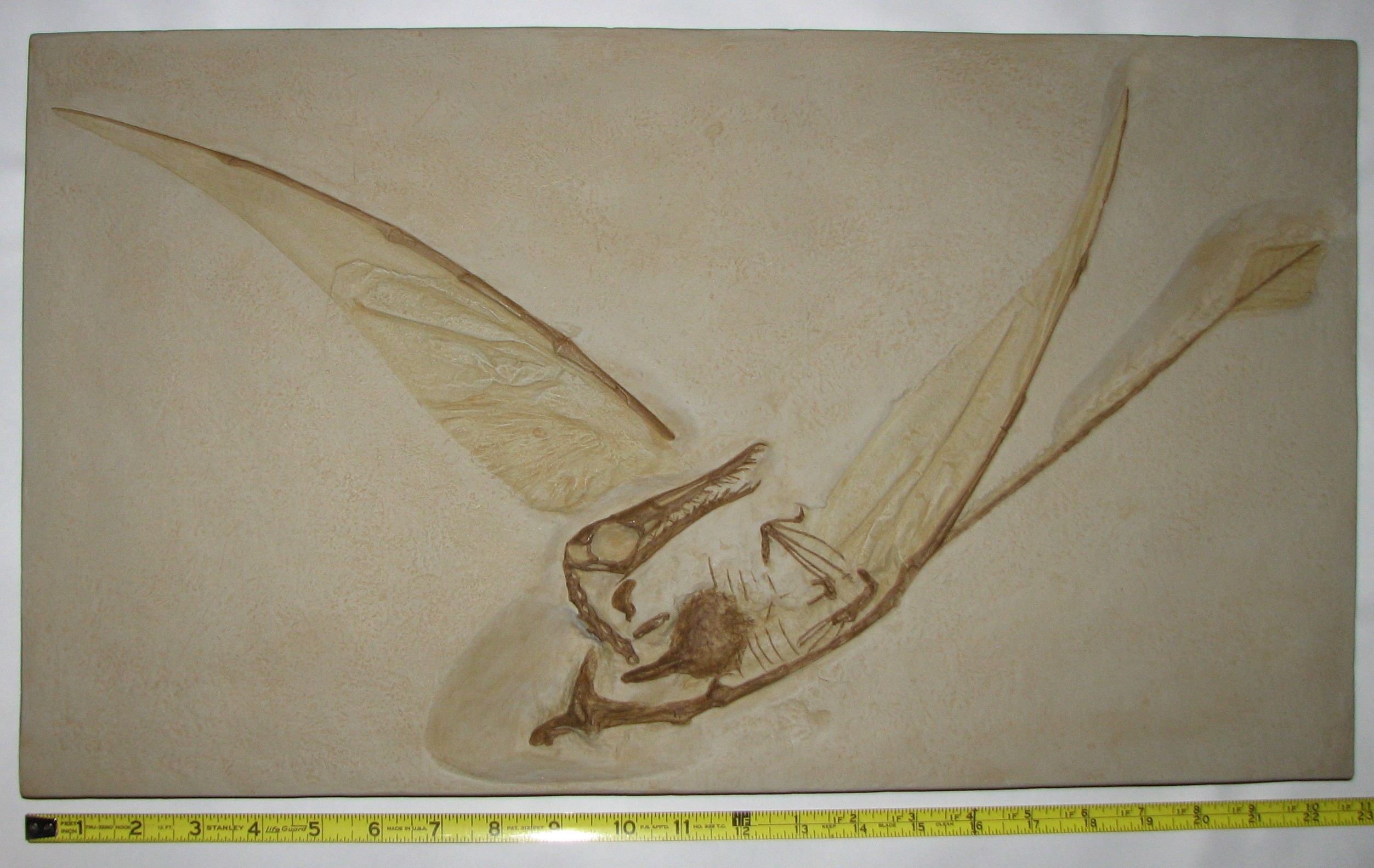
Picture not mine, if you know who needs credit, please let me know.

With fossils like these we can learn about the structure of the wing, and that these animals also had a fur-like coat of feathery fuzz covering their bodies.  No scaly or naked skin here.


So there is a lot we do know, but still so much left in the dark.  With bones, muscles, and a few hints of soft tissue, next time we’ll be heading off into uncharted waters.


Quick Question: These fossils are all amazing, but there is still so much we don’t know.  Take a quick look at the lion and tiger above, and then look at the skulls below.  Can you tell which one is which?  Leave your answer in the comments, I’d love to hear from you! 🙂


Fleshing out the Bones Series:

Critter of the Week: Camptosaurus

Meet Copper & Daisy. These gentle giants are always happy to meet new friends.  They love being part of the group.

copperndaisy update.png


Copper is a strapping young bull, and never leaves the side of his lovely lady.  He’s very much the gentleman with her, and any friend who joins the herd.  Just keep a close eye on your pockets if you have treats!

You can’t hear him, since it’s a picture of course, but Copper is chirping to Daisy.  He’s found a good patch of something tasty, and he’s telling her to follow him.  Many dinos could probably make a lot of noise without ever opening their mouths, like the gurgly hum Copper is making here.  But you can see his lovely red throat all blown up like a bullfrog. 🙂

I imagine him sounding a lot like this…


Making progress…

I’ve got a tiny buffer going, yay!  It’s taking a little more determination and stick-to-it-iveness (I’m sure I’ve heard that term used before) than I’m used to, but you’ll be seeing this post a week after I write it. 😀

You have to celebrate the tiny wins as much as the big ones, y’know. 🙂

Baby steps will still get you up the stairs. It just takes a lot of concentration, looking back to see how far you’ve come, and looking up to the top to keep moving forward.

A little lesson I learned from watching my little Sammysaurus crawl up the steps, learn to walk, and all the many challenges of being one year old. 🙂

And why is a buffer good for you?  It means I can focus more time on the actual book!  As a full-time mom, I have to manage my time carefully, so any way I can help streamline the blog here makes sure I have time for the book. 🙂


Coming Next Week…

A shy giant who just wants some greens and a big hug. 🙂

Share your guess in the comments! He’s one of the critters over on the critter page. 🙂

Here’s the Easy Part (figuring out muscle and other fun anatomy)

They say the dead tell no tales…Obviously whoever coined that phrase never studied the bones of prehistoric animals, because the fossils of dead critters sure say a lot.  Dry bones all kinda look the same, but take a closer look and you can see the clues left behind.


Last Monday, we went through a basic rundown on how paleontologists can figure out how to put the bones together.  How they take the bits and pieces they find in the field and build up the skeletons you see in museums.  Now before we move on to the soft stuff I just want to make one thing clear.

Unless it’s something totally new, most dinosaurs don’t have as much guesswork as I implied in my post.

Take Allosaurus, for example.  Tons of bones, from many different animals, gives us a good overall picture of the species and its growth cycle.  So for many dinosaurs, the difference from one skeleton to another is pretty small for the average enthusiast like myself.  And honestly, the skeletons of lions and tigers are almost identical.  We wouldn’t have a clue how obviously different they are without everything on top of the bones.

But I’m getting ahead of myself now.  We’ll come back to the lion and tiger example next Monday. 🙂

So what can bones tell us about an animal?

  • A skull can tell us about how the animal sensed the world around it.  The size and shape of its brain, how good its sense of smell, if it had binocular vision like we do…all that good stuff.
  • Teeth and special adaptations in the skull can give us clues to diet and wacky feeding habits.  Take a quick look at woodpecker skulls and you’ll see what I mean. 🙂
  • The shape of the joints, and points of muscle attachment, can show us how the animal might’ve moved.  It also gives us a basic silhouette to work with.
  • Bumps on the forearm, called “quill knobs”, show where large feathers where attached.  As well as other marks of soft tissue like where crests might attach.


These are just a few things bones can tell us, and how can we know this?

Take a close look the next time you eat a chicken drumstick or turkey leg.  The bone is not perfectly smooth, and it has a very specific shape.  There are ridges, bumps, little divets on one side…these are all marks where the muscles and tendons attached.

The chicken drumstick is actually a great example, because the bones of birds and crocodilians can be a sort of Rosetta Stone for translating dino bones.  Birds and crocs are the closest living relatives of dinosaurs, and birds are now classified as a group within dinosauria.

Long story short, the bones of living relatives like birds and crocs are a good starting point for figuring out dinosaur anatomy.  Not perfect, since crocs aren’t dinos, and modern birds fit into a specific niche inside the huge and diverse group of animals we call dinosaurs.  But crocs and birds can help fill in a few places that we would otherwise be clueless about.

  • How much muscle?  Crocs and birds have a different structure to their muscles than mammals.
  • So we know the shape and size of the critter’s brain, but what does that mean?  Crocs and birds today can give us clues.
  • Other soft bits like organs, and how dinos metabolisms worked…looking at birds and crocs can help figure out mysteries in the bones, like how dinosaurs got so big.

But now we’re heading into squishier territory than even muscles.  Bones are pretty solid (for the most part).  Muscles and soft tissue directly attached to the bone is just a matter of translating the markings correctly…but next Monday we’ll dip our toes into the mud and find out how much we know, or don’t know, about the soft outsides.


skull-1170772_640

Quick Question: Take a moment to notice all the little bumps, ridges, and dimples in this skull.  Notice that triangular dip at the back of the lower jaw, and the high ridges that make that triangle shape.  Powerful muscles to close the jaw attach here and go through that “loop”, where they attach to the back of the neck and head. This is one powerful critter!  Can you guess what it is?  

Hint: those teeth will tell you it’s not a dinosaur or reptile. 😉 I’d love to hear your answer in the comments! 🙂

Fleshing out the Bones Series:

Critter of the Week: Pliosaurus

Meet Tigger. This big guy is always ready to flash a big, toothy smile, especially at mealtime.


Tigger plio.png

Tigger sure has a big appetite.  He’ll eat anything that fits in that giant mouth of his.  Don’t mind the teeth though, because he’s just a big softie.

Speaking of teeth, I’ve made a few changes to his smile.  I’d originally chosen Liopleurodon, the marine predator famous in Walking With Dinosaurs, as the critter for Tigger.  But I decided to change it to Pliosaurus for a few reasons.

  1. Pliosaurus is the pliosaur!  It was the original critter discovered that gave the whole group its name
  2. Pliosaurus doesn’t seem to be as well represented as Liopleurodon, probably because of Walking With Dinosaurs.  
  3. Pliosaurus is easier to spell and say than Liopleurodon.  I have to sound out that name in my head every time I write it. 😛 Kids are awesome at saying long dino names like a boss, but come on, that one is just plain hard unless you’ve heard it. *cough*Walking With Dinosaurs*cough*

What’s the difference between this picture and the last one?

I’m glad you asked, because here’s where I get to geek out on you. 😀  But first, a quick disclaimer.

I don’t pretend to be an expert, because I’m not.  I’m just a hardworking mom doing my best to make a scientifically accurate picture book based on prehistoric animals.  I’m just sharing what I learn in the process, so if you happen to be an expert, please let me know if I’ve got something wrong! I’d be happy to hear from someone more experienced. 🙂

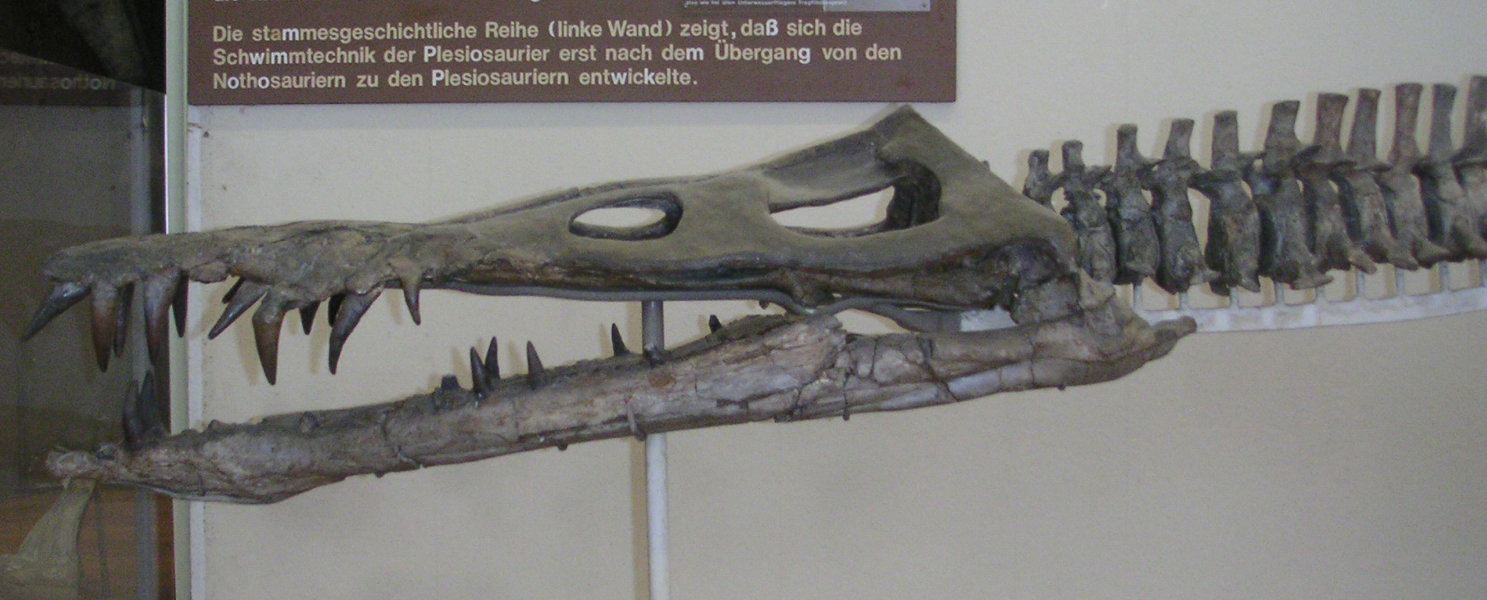
Liopleurodon skull. Picture was found on Pleasiosauria.com, where credit is given to Markus Felix Bühler

Now, Top left picture is the original sketch, which is based on liopleurodon.  Compared to the bottom picture of the skull, now I see where I got the teeth wrong a bit.  Shows what happens when you use a toy for reference. A very well sculpted Wild Safari model, but still a toy. 🙂

Comparing both skull and sketch to the top right and middle pictures, you can see a few big differences.  You can really go into technical detail, but the basics are…

  • the slope of the forehead
  • the shape of the mandible, the bottom jaw.
  • the size and arrangement of the teeth.

So a casual glance looks like I didn’t change much, but a closer look shows a much different animal. 🙂


Making progress…

I just want to say thank you for stopping by to chit chat with me on my little corner of internet. 🙂

It truly is humbling (and awesome!) to know that I get visitors all the way from Spain and Indonesia.  I have no idea who came from where of course, so there’s no way I’d ever know where you live unless you wanted to share your address with me.  It’s just cool to see the little map and which countries are colored in. 😀  Isn’t technology amazing?

Thank you for taking the time to read.  Life is busy and time is irreplaceable, so I hope I’ve done what I can to make your stay enjoyable.

If there’s anything I can do to make things better around here, then I’d love to hear from you!  I know there isn’t a lot on the site so far, but what do you like best?  Why do you like it?  I’d love to hear your answer in the comments. 🙂 


Coming Next Week…

Two thrown in for the price of one this time around.  This pair are always happy to meet new friends. 🙂

Share your guess in the comments! They’ll be a couple of the critters over on the critter page. 🙂

The World’s Toughest Jigsaw Puzzle

A six-year-old walks down the hall, eyes wide as he stares open mouthed at the skeletons towering high above him.  Dagger teeth, gleaming claws, curving necks and long, sweeping tails…It’s almost surreal how the bones are suspended in the air, as if the skin around them was just invisible.

Of course, now I know about the armature of steel.  How each bone has it’s own pocket to nestle in.  If one bone needs cleaning or repairs, then there’s no need to take down the whole skeleton.  But how do we know what the skeletons looked like?

In the last post, we talked about how unlikely it is to find a complete skeleton, or even a mostly complete skeleton.  If you haven’t read it yet, then check it out, because it’s pretty amazing what happens between dead dinosaur and museum. 🙂

But kid’s books and movies always show the whole dinosaur under some random hill.  It’s gotten downright ridiculous, so that Bob the Builder and his team can dig into a hill, find a complete skeleton of a brontosaurus “standing” in the dirt, and then simply leave it there to be the entrance to their dinosaur themed amusement park.

Convenient.

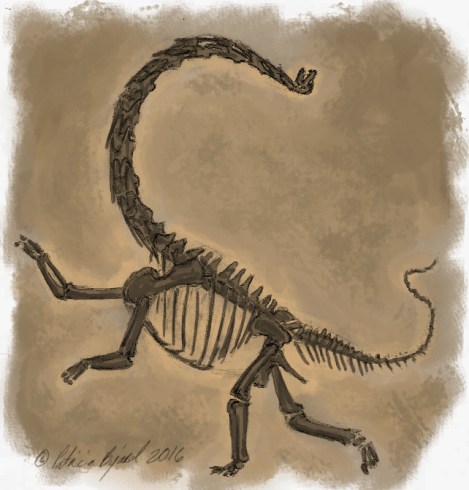
articulated brachiosaur color copy.png
Every paleontologist’s dream.  Please excuse the ugly sloppiness.  I was practicing speed. 🙂

Truth is, building the complete skeleton is only the first part of figuring out just what these critters looked like.

It’s like the world’s toughest jigsaw puzzle, with a few minor complications…

  • No box with the picture to get a clue on what you’re building
  • No idea how many pieces there are supposed to be, just that there should be at least oh, 2,000 or so…right?  Just how many bones does your average dino have anyway?
  • After a summer spent combing the hills, maybe this is what you end up with…

fossil bits color.png

So what do you do?

Luckily, bones can tell you a lot, especially teeth.  An expert can tell you these are sauropod bones.  Even better, an expert can tell you these belong in the family brachiosauridae .


Now here comes the fun part…putting the puzzle together.

You look at all the other fossils in the family.  Maybe there are more of the same “genus”, brachiosaurus.  Maybe these bones are enough to tell which species of brachiosaurus you’re looking at, and you can look at those for reference.  And so on and so forth until you and your colleagues have determined what a complete skeleton of your brachiosaur might look like.

Of course, the whole process is a long, drawn out, very complicated business.  This is just my humble rundown. 🙂

Long story short- except in very few cases where paleontologists discover an articulated skeleton, like the lovely dilophosaurus here- then most skeletal reconstructions have at least a few missing parts, which are then filled in by educated guesses based on closely related animals.

wikipedia commons.

Now that you have all the pieces, how do they fit together?

Knowing where all the pieces go relies on reference to other skeletons, research, and a great deal of know-how on the bones themselves.

Bones can tell us a lot, because the soft and squishy bits that hold them together leave scars.  Knowing how to interpret these scars is where dry bones get interesting, because this is the beginning of figuring out how the animal looked in life.

Next post we’ll talk about muscles, tendons, and all the soft stuff under the skin that we don’t usually see in the museum.

Quick Question: Did you like to see fossil exhibits as a kid?  What impressed you the most about them?  I’d love to hear your answer in the comments! 🙂


Fleshing out the Bones Series:

Critter of the Week: Dilophosaurus

Meet Picasso.  This quiet softie loves spending time with his special person.  Snuggling under the tree to hear a good story?  That sounds like a lovely way to spend a warm afternoon. 🙂

picasso

Picasso looks very happy to see you, and he wonders very much if you like his red crest.  He’s very proud of it, you see, and he’s been strutting around the field like a very large rooster.

He marches up and down the fence line with his chest puffed out and his tail high, standing as tall as he can.  Anytime any of the ladies give notice he crows like a peacock, and shows off those lovely blue feathers on his arms.  It looks like he’s going to give the lady a big hug. 🙂

Oh yes, feathers!  Now we don’t for sure if this critter had feathers or not, and the whole subject of feathered dinos deserves it’s own series of posts, But there’s a definite possibility. 🙂

I’ve given Picasso a coat of feathers similar in texture to an emu’s, which gives him the furry look.  His fingers and feet are feathered too, like a snowy owl, but they have pads on them for walking and grabbing.

If you’ve watched a lot of Jurassic Park, take note that Picasso has awesome grabby hands that are good for hugs.  Not dangly zombie bunny arms.  What good are those for? 😛


Making progress…

I made some changes to the about page. 🙂 Check it out!

I think this one does a much better job explaining what the whole site is about.  Much more clear. 🙂 Of course, if there’s something I’m missing or is not as clear as I might think it is, then I’d love to hear your feedback. 🙂
Goal for next week.  Really work on getting a buffer.  I have a tiny buffer, but it’d be great to work on getting a month’s worth.  This means I can breathe a little easier (because being prepared is awesome), and I can focus a little more time on the picture book!

It’s also great to have a buffer when the week doesn’t work so smoothly.  Can’t always count on nap time working in my favor, and there’s been more than a few posts written in a rush before the deadline.  I know there are a few “mom-preneurs” out there who wake up at 5 am to get stuff done, but I don’t work that way.

My 20 minute power nap is essential to the quality of my posts (and the sanity of everyone within a 5 mile radius of me)!

Coming Next Week…

This big guy is always ready to flash a big, toothy smile, especially at mealtime.

Share your guess in the comments! He’ll be one of the critters over on the critter page. 🙂