Meet Rosie. She’s a bit shy, and might need a little encouragement to come closer. A few treats should do the trick. Before you know it she’ll be perfectly content to snuggle close and put her head on your lap. 🙂


While Alfred gets the ball, I can share this lovely disclaimer. Que elevator music…
I do the best I can with research, but I definitely don’t claim to be an expert. I try my best to keep up to date, and all my illustrations reflect this. (thank you internets, and to all hard-working paleo-nerds who are kind enough to make your papers open source!) 😀
That said, all the drawings in the A&S post series are quick doodles to illustrate a point, with not as much reference as I usually use, so there are plenty of inaccuracies for you to point out for me. 😉
Thank you disclaimer, you can go bother someone else now. 😛 Elevator music fades out…Oh and here comes Alfred! Looks like he wants more…
There we go, good boy Alfred!
Now Alfred here is an Allosaurus. He’s young, so only about 12 feet long so far, but he’ll grow to be a lot bigger. Not as big as his wild cousins though, a few of them could be as big as T-rex! (very few, gotta be old to get that big, and most dinos have a live fast, die young policy)
1. On Scaly Skin vs. Feathers
So you see Alfred here has these lovely bright yellow and forest green scales, the colors of youth. (They’ll mellow out a bit when he gets older, like monitor lizards do)
Also like a monitor lizard, you’ll notice that most of Alfred’s scales are quite small, with a rather pebbly texture. They get a bit larger and thicker on his back, which is good since adult Allosaurus tend to get into quite a lot of tussles with each other. But most of his scales have that nice cobblestone look to them.
Like this guy, remember him from last week’s post on feathers and scales?

Short answer as to why Alfred has scales…there’s a young Allosaurus with preserved scales somewhere on it’s body. (Unfortunately the report didn’t say where)
Long answer was so long I made a post out of it…To Feather or Not to Feather Your Dinosaur, That is the Question. (The komodo dragon above was laying around in that post. So was this gal, she’s a monitor lizard. 🙂 )

2. Getting Comfy…

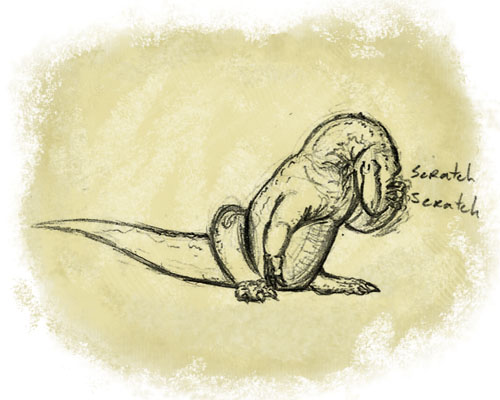
Looks like Alfred’s all worn out from chasing after that giant, cheesy bacon-ball. He hasn’t quite grown into his adult silhouette yet. He’s still young enough to think he can chase after stuff, but he’s starting to get to an age where it’s getting hard to make those quick turns.
When he fills out his more barrel-chested adult figure, he’ll be spending quite a bit of his leisure hours (think energy-efficient) laying around. Since his body is a bit taller than it’s wide (more lanky cat than double-wide gator), it’s more relaxing to be lounging on his side.
Of course, that doesn’t mean he can’t do other things to relax, even things that may surprise us (ever seen a large horse roll? It’s hilarious 😀 ).

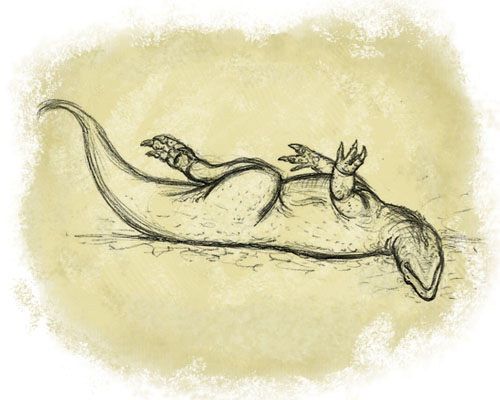
Oh, and here’s that horse… 😀 I can totally picture some “duckbill” dino doing this.
3. Where are His Teeth?!
I hear ya, I wondered the same thing when I looked up pictures of Komodo Dragons and monitor lizards. But wait, what does that have anything to do with it?
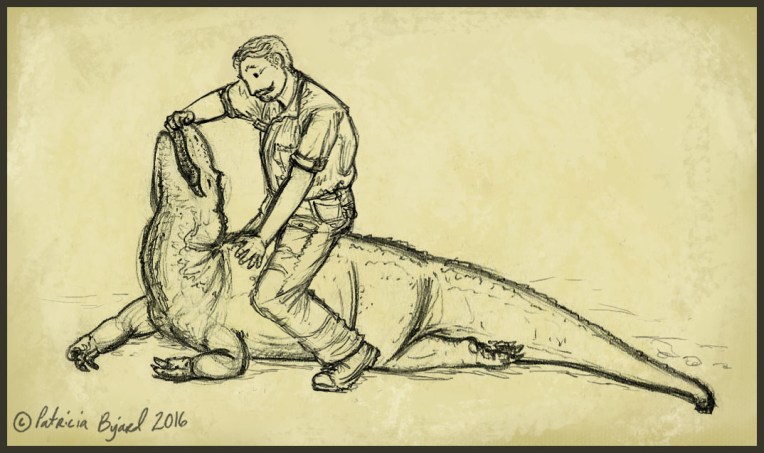
Pete will help us out here. I know Alfred looks a little awkward, but he’s actually quite comfy. Ah- I’ll let Pete tell you the rest…
“Thank you. Yes, Alfred is quite at ease here. I’m not heavy to him at all, and he weighs at least a good 300 pounds at this age. So he doesn’t mind a bit.
I’m tilting his head back very gently- show us your teeth there Alfred, that’s it, nice and easy.
See this is the biggest difference between a domestic Allosaurus like Alfred here and a wild one. Look how completely relaxed he is. He’s not fighting me at all, and even his eyes are closed, look at that. (Alfred makes a gurgly, kinda purring sound in his throat)
Anyhow, I’m holding onto his lips here so I keep my fingers out of his mouth. My fingers can look a bit like treats, so I’ll be sure to keep them right at the edge here, at the gums.
All this, the lips, the gums, the saliva- it all keeps his teeth nice and moist. Dinosaurs have a healthy coat of enamel on their teeth, same as your teeth, and the key to healthy teeth is to keep them moist. Even better if you can give your teeth a constant bath of saliva.
Yes, drool is essential to healthy teeth!
Now Alfred will lose his teeth and grow new ones, just like crocodiles and alligators do, but if you look closely at these teeth-they’re serrated. They’re like steak knives- not like the cone-like teeth of crocodiles.
Thank you Alfred, you’ve been quite patient. Here’s some jerky.
But crocodiles don’t need serrated teeth. They’re eating different things, they have a different habitat, and different diet, they’re eating in a completely different way. Alfred has teeth like a bone saw.
Ever cut a roast turkey with an electric knife? That’s what Alfred’s teeth are doing when he eats, so they need to stay sharp, and they need to be strong in his mouth. So the gums hold his teeth, and his lips keep them nice and moist so they stay strong and don’t get brittle.”
Thank you Pete, and Alfred. Just for comparison, here is a crocodile monitor lizard.

My first thought, “Where are the teeth?!” Then I noticed those sharp white triangular things inside the lip. Also interesting is that it looks like there are pockets for the bottom teeth to slip into. 🙂 Here’s the skull of the same animal…
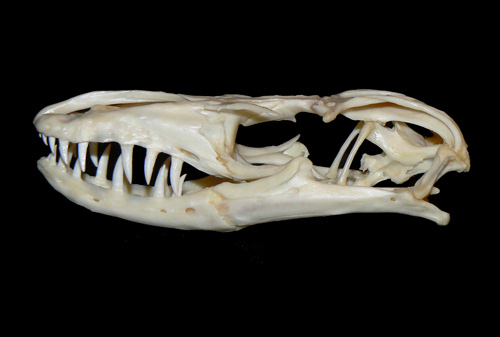
They look quite different from the other picture don’t they? Almost, shall I say, dinosauresqe? Take a look at an Allosaurus skull. 😀

The one and only skull I could find that doesn’t have its teeth halfway falling out of their sockets (it happens when the dead critter decays). Jason has many more pictures of the Allosaurus mounts at the American Museum of Natural History, and I’d highly recommend you check out his blog post. You’ll also discover all my errors and where I need to fix Alfred. 😀
Quick Question: Help me find what I need to fix! If you wouldn’t mind checking out this blog post on Allosaurus, you’ll get to see some great pictures of excellent mounts, and you’ll see what I have to correct in my illustrations of Alfred.
I’d love to hear from you in the comments! I’ll be posting a comment on how many I find, and let’s see if we come up with the same ones or more. 😀
P.S.- You can always hop over the the A&S page to pick out who you want to see next! 🙂
If I have a clear image of what I’m headed for, then it may be easier to keep heading that direction. 🙂
I would like it very much indeedy if I could have a bit of feedback. Doesn’t have to be much, just enough to help me steer in the right direction. 🙂
First though, a quick (and brief!) rundown of what’s needed in a picture book cover.
There’s more to designing a book cover, but those are the basics. So I have a couple of questions for you…
With those questions in mind then, here is the sketch.
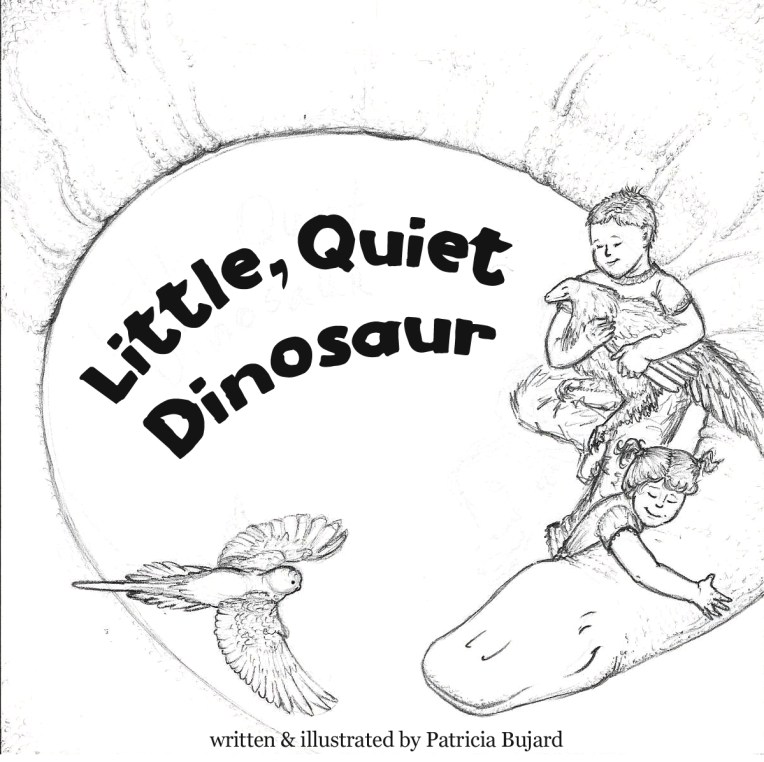
And here is the colored version as I have it now. It’s only colored as much as necessary to get an idea of style and general look. It doesn’t have fine details yet.
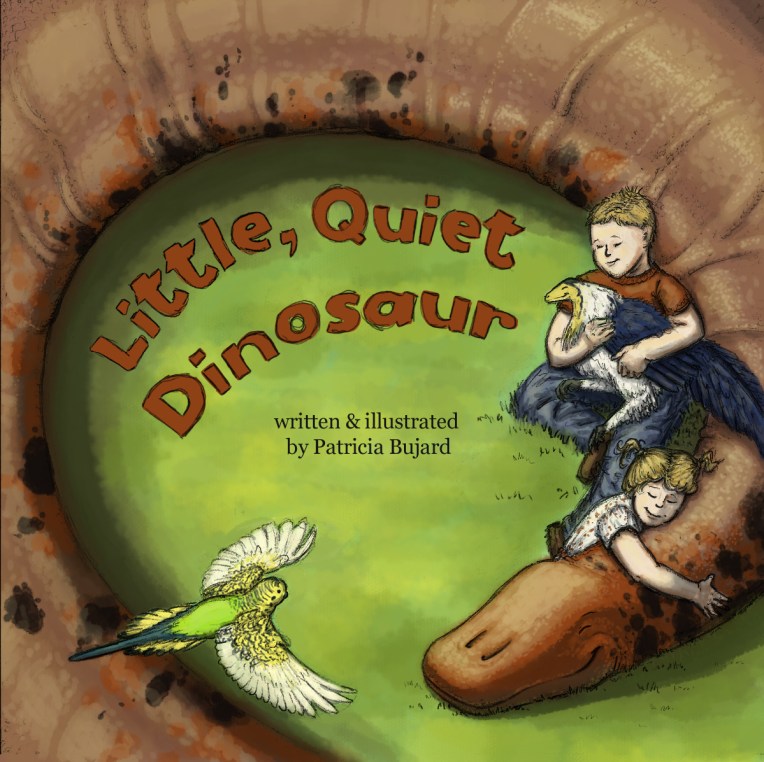
Thank you for swinging by my little corner of the internet, and thank you for taking the time to chat with me today. 🙂 I think it’s pretty awesome that indie publishing is an option, and that you can be a part of this.
Here are those questions again, and it would be most helpful if you could answer the questions for each image above. Whichever ones work best for each picture. 🙂
Thank you again for taking the time to help me give you something better. 🙂 I love to read your answers in the comments! 😀

1. Soft or hard-shelled turtle?
Steggy’s a bit smaller than the average wild stegosaurus, but she’s still quite a bit taller than we are. If you reach up on your tip-toes you might be able to touch the biggest of her plates, the one right above her hips there.
There’s been some speculation in recent years on if these plates were hard and covered in keratin- like a turtle’s shell or cow’s horn- or if the plates were soft and covered in scales or skin.
I did a bit of digging (research wise), and came across this lovely gem of information written by Darren Naish. He cites a paper provided by Christiansen & Tschopp (2010), who reported a continuous sheath-like covering on one of the plates they referred to another spiketail known as Hesperosaurus.

So there you have it. Hesperosaurus is a very close cousin of Stegosaurus, so in the realm of phylogenetic bracketing that makes it more likely that Steggy had a smooth, hard sheath of horn on her plates and spikes.
2. Armed to the teeth.

The same Hesperosaurus described had another very rare insight on spiketails- fossil skin. As you can see on Steggy here, most of her body is covered in small, non-overlapping scales, called tubercles. They look a bit like pave stones don’t they? Now look up here, a bit higher up on her side. Interesting isn’t it?

Steggy has some pretty tough scales. These large oval scales are called osteoderms, just like the large, hard scales on the backs of crocodiles. They’re covered in keratin, like our fingernails, and they do a pretty good job as armor. I’m sure Alfred‘s wild relatives had a tough time munching on wild stegosaurus. 🙂
3. She might not be the sharpest rock, but she’s one tough cookie.

Steggy might have a brain the same size as a dog’s, but she’s not nearly as dumb as movies and the media would have you think. (I’m looking at you Spike, in The Land Before Time). I think most encounters would not have ended up like the stego in Disney’s Fantasia (which is totally what inspired my love for them in the first place 🙂 )
With all that armor, and tons of fossil evidence with some serious dino damage on Alfred‘s wild relatives, it looks to me that spiketails had an attitude to match their prickly array of spikes and plates.
Because of that, I’ve given Steggy a bright warning pattern. Someone told me it reminded her of a skunk, and that’s exactly what I’m going for. Steggy’s color is something that says “stay away!”
Good thing Steggy is a calm and peaceful pet then, a domesticated spiketail. Domestic spiketails have a tendency to be nervous, and spook easily (like horses), but Pete works with her a lot, and hardly anything bothers Steggy now. (horses can be trained like this too)
Just for fun, here’s my reasoning on why Steggy may not be as dumb as you think. A quick check on Youtube brings up plenty of smart tortoises. Yep, after discovering that it couldn’t fit through the pet door, this one figured out how to open a sliding glass door.
Quick Question: Animals do all sorts of crazy things we wouldn’t expect. Do you have a story about an animal or pet that did something unexpected? I’d love to hear your answer in the comments!
P.S.- You can always hop over the the A&S page to pick out who you want to see next! 🙂

So what’s science and what’s art? To keep this post short, I’ll cover three main points (there are always more, but we can save those for later). All drawings in these posts are quick doodles to illustrate a point, with not as much reference as I usually use, so there are plenty of inaccuracies for you to point out for me. But I do have this great toy model replica to look at when I’m clueless as to how something looks at certain angles. 😉

1. Toothy grin, or soft smile?
For starters, let’s talk about Ajax’s smile in the picture above. There’s a lot of discussion on dinosaur lips- did they have a toothy grin like crocs, or closed lizard-type lips?
On one hand there’s the study by Ashley Morhardt (unfortunately I can’t find it, so I’m relying on 3rd party sources). She compared the skulls of prehistoric and modern animals, and looked at the clues left behind by beaks, lips, etc…and her study suggests that sauropods like Ajax had a face more like a crocodile’s than the fleshy lips of mammals.
But…
This article by Duane Nash on the giant canine teeth of saber-tooth tigers (smilodon & relatives) gives some food for thought. The blog post has all sorts of cool info of what makes a tusk vs. a tooth. 🙂
Ajax’s teeth, like most dinosaur teeth, have a pretty healthy coating of enamel, the same stuff that coats our teeth and makes them hard. Enamel does best when it’s bathed in saliva 24/7, which is why mostly all animals that have enamel-rich teeth have mouths sealed shut by lips of some sort.
Anyway, Ajax eats whatever he can get a hold of. He does replace his teeth every once and a while (unlike our permanent set of adult teeth), but still, it takes a while to get a replacement tooth, so he needs to use each set for as long as he can.
With that in mind, I’ve decided to reconstruct Ajax and the other sauropods with closed, lizard-like lips.
It’s one of those things that we can’t know for sure, because even a mummy can’t give you a perfect picture, anymore than a raisin can tell you what a grape looks like.
2. How far can he stretch?
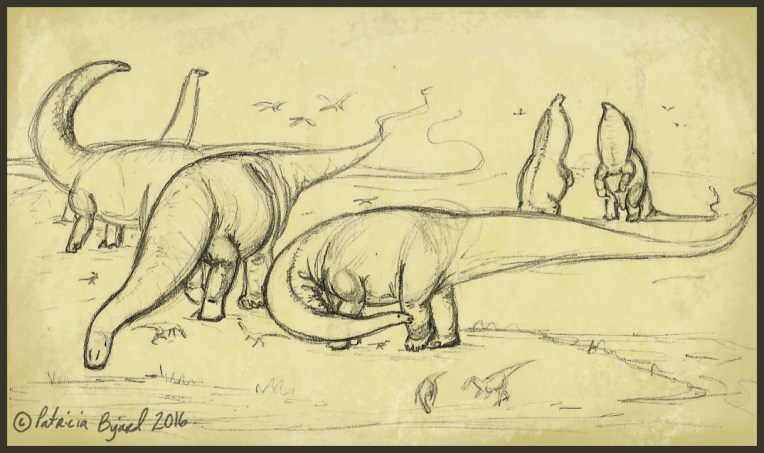
Oh boy, paleontologists have gone back and forth on this one for over a century. First thin, graceful necks like swans, then BBC’s Walking With Dinosaurs comes out and shows the fruit of research claiming that Ajax & Dippy held their necks out like suspension bridges. They held their heads and tails in almost a straight line, and were unable to lift their heads higher than their shoulders.

More recent work has pointed out that if you add space for cartilage between the bones, then the necks of many sauropods had the flexibility to loop in a complete circle. The brilliant minds behind the SV-POW! team over at svpow.com (always enjoyable to read, but definitely more on the technical side) helped rekindle my love for the long-necked giants by holding their heads high again, and regain neck flexibility by taking soft tissues into account.
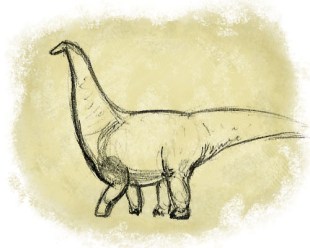
In short, we don’t really know. But Ajax would probably have a great deal more flexibility than Walking With Dinosaurs would have you believe. The bendiest part would be the middle of Ajax’s neck, with the ends less flexible.
I always think that animals are more capable than we usually think, so one of Ajax’s buddies has reached back to scratch at an itch on his leg. 🙂
Oh, and those two in the back with the puffy necks…that’s entirely speculative. Something weird was going on with Ajax’s neck though, that’s for sure. 😉
3. I think we need some bigger horseshoes…

Feet, especially the front feet, are usually drawn very, very wrong when it comes Ajax and his relatives. Many artists will slap elephant feet on them and call it a day. But take a look at one of Ajax’s tracks…
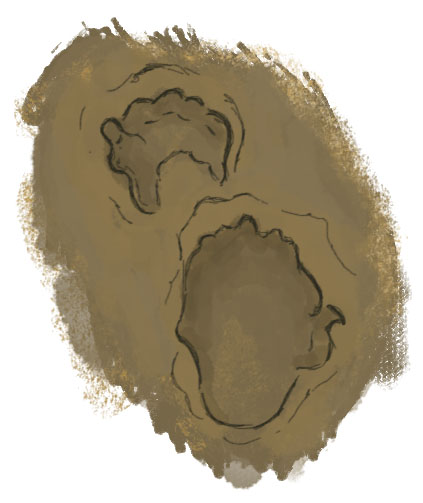 Ajax’s legs are like solid pillers, and all the finger bones are wrapped together to form a fleshy, padded, hoof-like structure. Only the “thumb” has a claw, which has some limited mobility depending on the species. Ajax can move his thumb claw up and down a little bit. 🙂
Scientists disagree on how much Ajax could move his wrist. So how far he has his front foot bent at the wrist is a bit speculative.
I’ve done a terrible thing and made his wrist flexible based on an elephant’s range of movement. 😛
Quick Question: Is there anything in the popular media you can think of about Ajax and other sauropods? What common misconceptions do movies like Jurassic Park and The Land Before Time give about Ajax and his cousins? 🙂 I’d love to hear your answer in the comments!
P.S.- You can always hop over the the A&S page to pick out who you want to see next! 🙂
OR
I can save you the big snore (because the technical stuff is tough to read, and I like this sort of thing!) and have an excuse to draw yet more cute critters, while sneaking in a few quick fossil facts in a bite-size post or convenient picture. 🙂
Why am I doing this?
The truth is that I got a little frustrated. All the dinosaur books for kids fall into one of two categories-
Super cute story and dinosaurs, but no science. For example, “Pteradactyls” lumped in with the dinosaurs, and dinos stuck with the appearance of rubber toys from the 80s.
OR
“Educational”, but tough to read. Because after reading a list of names like Tyrannosaurus rex, Euplocephalosaurus, and Parasaurolophus 20 nights in a row, I know that book is going to put aside for “some other time”. Plus the computer graphics always look a bit unpleasant to me.
Pete’s Paleo Petshop is the best of both worlds. A cute story with illustrations based on the latest scientific research I can find. But I also want to make clear what part of the illustration is something we actually know as fact, or really just an educated guess. Speculation. A hypothesis. 🙂
So this is the start of a new series called The Art & Science of Pete’s Paleo Petshop. That’s super long though, so I’ll have to shorten it somehow. 🙂
For your convenience, I’ll keep a list of all posts in the series here on this page, and I’ll update the list with links as we go along. I’ll begin with the main cast, and we’ll see where we go from there. 🙂
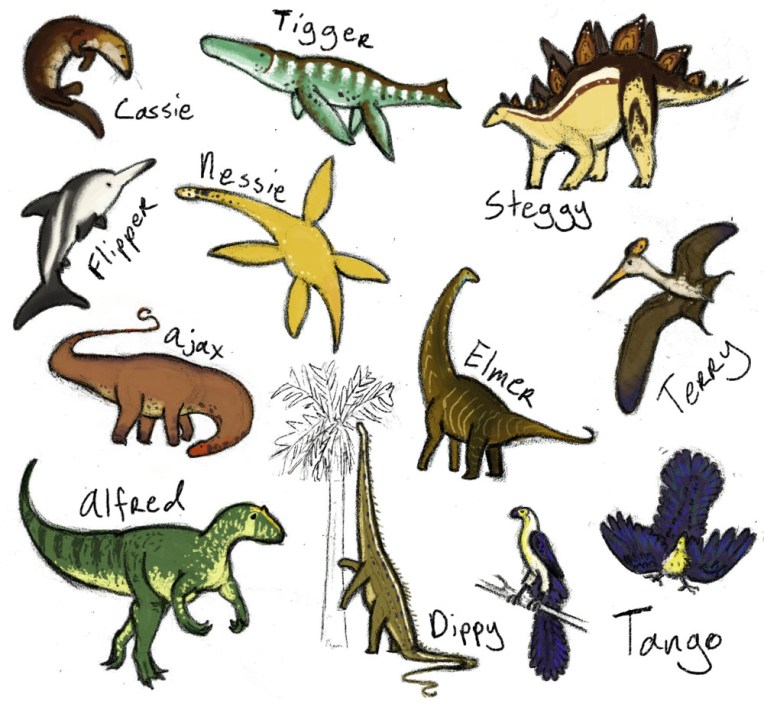
Main Cast:
Bonus Question: Any special requests? I’ll be going over these critters in no particular order, so if there’s one you really want to see first, let me know. First one to answer in the comments gets first pick! 🙂

I really love my country, and everything the founding fathers worked so hard to cultivate in the early years. So here we have some American dinosaurs to help us celebrate.
From left to right…
That’s all for now! Thank you for dropping by, and I hope your day is fun and safe. 🙂
Now here we have a few thumbnails. Thumbnails are small, quick sketches that are used to give the artist an idea for the composition of an image. In this case, thumbnails are useful for getting an idea for the layout of the illustrations. Which characters to use, where words might go, how the picture will help the words tell the story…it all starts gelling together in the thumbnail. Keeping thumbnails small helps force you to leave out detail, which helps to focus on the basic shapes.


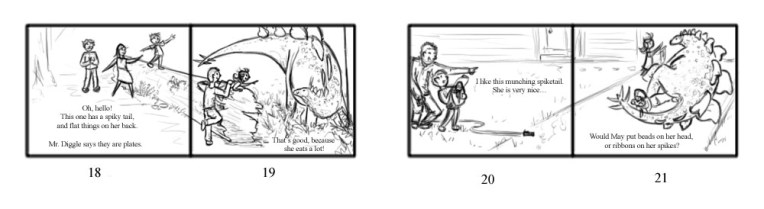
Once I figured out which thumbnail I liked best I made it larger and cleaned it up a little. These drawings are mostly to figure out exactly what I need to find references for.

For example. I looked at a couple of pictures of flying birds to help me with Tango and his buddy on the left here (learn more about him here). It’s not known if these dinosaurs could actually fly or just glide, so this is speculation on my part. Short, broad wings are great for maneuvering thick forest, and you don’t need a lot of muscle for short bursts of flight. 🙂
In this case, I needed pictures to get ideas for poses! And for Terry and her friends on the right…well I needed a few reference pictures to have a clue what I was drawing. These critters are tough if you don’t draw the classic “silhouette from above/below” pose. 😛
Which makes a great example of what happens in the sketch stage.
In the thumbnail, I had one pterosaur (teh-roh-saw-r) flying past the corner of the page. An overhead flying view is so overdone I decided to have them perch on the branch instead. I also changed the species to pterodactylus (teh-roh-dak-tih-lus) since they worked out better for what I needed. Bonus that these guys are the poster children of the pterosaur group. 🙂

Here we have three famous giants of the Jurassic.
I’ve been doing lots of research on the necks for these guys, so that awesome snakey neck is not random. And yes, it is an awesome python neck (though this is about the limit of its bendiness.)
Also, can I just say how awesome it is to use a toy as a reference? Yes, you heard me. I went out and got a few toys (as accurate as possible) and I’m using those for pose reference. I don’t have the dippy, but for that one I got pictures of the toy online. 😛

Here we have Steggy the Stegosaurus (steg-oh-saw-rus). Original name, I know 😛
I used a toy I have for reference here too, but this one isn’t the best model, so I’ll be doing research to make sure I correct those inaccuracies.
I hope you’ve enjoyed this sneak preview! I’m starting to get an idea of what things will actually look like, and that’s pretty exciting after it’s been stuck in my head for so long! The words need a lot of work (they kinda suck at the moment), but the gist of the story is there.
I’ll never be fooled into thinking a picture book is easy again! 😀
Now my question for you is…Do you have any questions? Anything you want to know about what happens behind the scenes? Let me know in the comments! I’d love to hear from you! 🙂

Now let’s take a look at the other photo. Here we have a portrait of another lion. This one lays on a rock, at peace. He looks off towards the sunset, and the warm light of late afternoon highlights his soft mane. What’s your take on this one? How do you feel about this calm lion vs. The snarling one?

Images and art have power to shape how we think and feel about things. Imagine you’ve never seen a real lion before, and the only thing you know about lions is that snarling picture above. Now let’s bring a real lion into the picture. Just for fun. What happens? How do you react?
Yeah, it’s not gonna be pretty. I’d like to think I wouldn’t make a big deal out of it either, but that’s just wishful thinking. 😛
Now think about how much power art has to shape our image of animals gone for centuries. Ask anyone, and chances are that when you say dinosaur, many people think Jurassic Park. Now I love the original Jurassic Park. It fueled my interest in dinosaurs! But those things- sorry to break it to you, if you didn’t know- are not dinosaurs. Those are monsters.
No matter how many times Chris Pratt says “These animals.”
Dinosaurs are so often written off as a “kid” thing. An interest that’s only a phase kids have, like unicorns and dragons. I’ve gotta be honest though. I don’t really blame anyone who says dinosaurs don’t matter. I so often see bad computer models of some random predator with blood dripping from its claws. Toys that claim “museum quality” portray the same predators with mouth wide open, teeth gleaming as they roar to the universe.
Even in museums, the skeletons and painted reconstructions are usually in the same style. The predator (usually T-rex or something big and scary) has one three-toed foot over the throat of some hapless victim as it roars in triumph. Or is seconds away from making the death strike.
Put that way, what makes dinosaurs any different from dragons and other fantasy critters? (well, aside from the whole fire-breathing magic thing)
It’s so easy to emphasize a predator’s size and power. Sharp teeth, scaly skin, stomping feet…all great bits to exaggerate into something totally unreal. Just look at all the hoaky B-rated monster movies on sharks, crocs, snakes, spiders…you name it! Same principle.
We don’t need monster sharks, crocs, or dinosaurs. That only breeds misunderstanding and fear for the animal itself.
If all we see is this…

Then how does that shape how we think about gators? This big guy looks mean and scary, and then all those stories of alligator attacks in the everglades come to mind.
If we see more of this…

Then this mama gator and her hitchhiking baby all of a sudden look almost endearing. They look normal, and we can see them for the animals they are, vs. the potential killer monster in the toothy picture above.
Now how can we use this in our art?
Should we draw a predatory dinosaur with mouth open wide, teeth glistening, every skull opening visible as it roars at its helpless victim? Or perhaps we can illustrate the predator resting in the shade of a tree, maybe watching a herd of herbivores in the distance.
Of course, I’m not dictating what you should draw. But not every moment is a life & death struggle, and animals get bored too. They do things that surprise us, and pictures like this show little snapshots in the everyday lives of these animals. (lol, didn’t realize I did that until after I said it 😀 )
Art has power, and the public’s view of dinosaurs is slowly changing to keep up with the science. Dinosaurs aren’t dumb lugs doomed for extinction anymore, or bloodthirsty killing machines. Now they are as normal, wonderful, and beautiful as today’s birds.
Just take a look at the beautiful birdiness of Emily Willoughby’s art, and the crazy normal, everydayness John Conway portrays in his art. (I don’t get anything for saying this. I just love their work!)
We can highlight the wonders of today by illustrating the wonders of the past. How cool is that? 😀
So here’s my question to you. What do you like to see in paleoart? Do you think it has the power to shape how we see prehistoric animals? I’d love to hear from you in the comments!
 Pete's Paleo Petshop