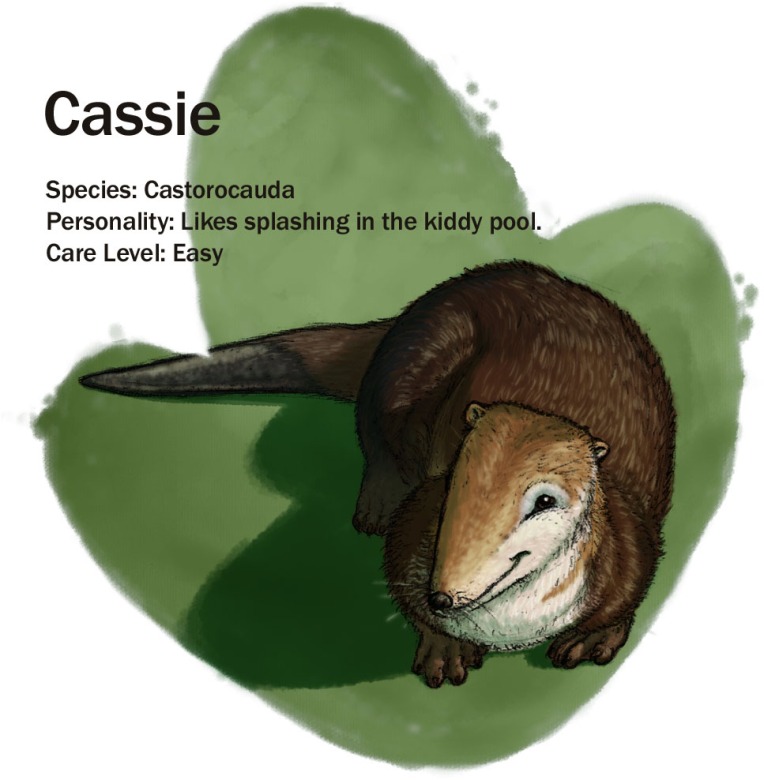
Meet Cassie. All she wants in life is to get her feet wet, and perhaps a fish or two. Yes, she would really like fish. Do you have some?
Pretty please with cherries on top?
Can’t fool her, she knows I brought some of those little dried fishy treats. Look at that face, she might even snuggle for some.
But please don’t Cassie. Down girl. Thank you. I don’t really want to smell like river mud at the moment.
Have a treat!
I’m sure you must be wondering what she is…
She is a small mammal from the middle of the Jurassic China, just a bit smaller than a modern platypus. She has a lot in common with platypus, such as a love for water, strong digging paws, a thick fur pelt, and probably even laid eggs like a platypus (though there’s no way to know for sure).
But she’s not actually related to platypus, beavers, or any modern mammal. She is from an extinct group of mammals called docodonta.
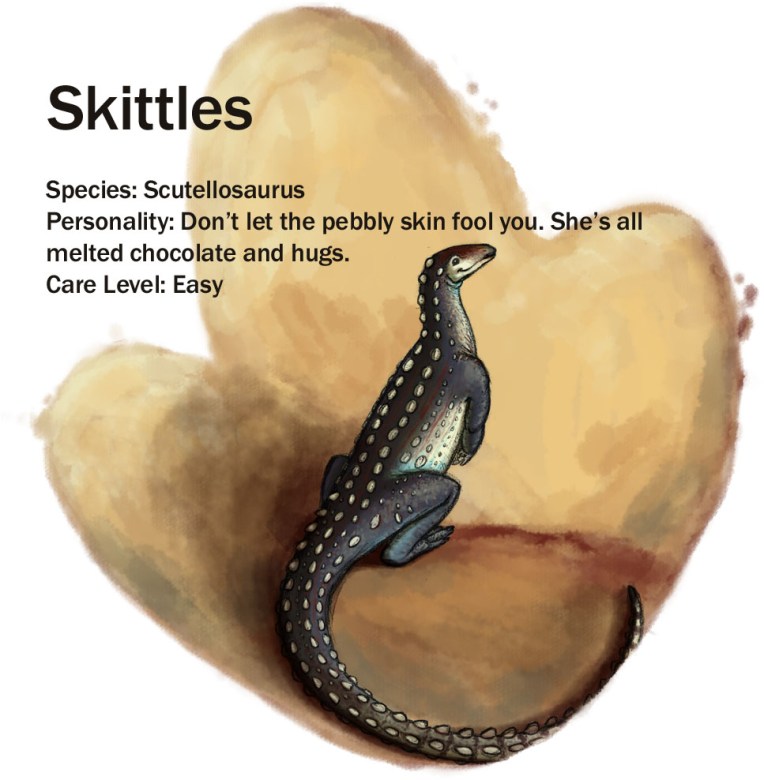
Meet Skittles. She might be all hard and pebbly on the outside, but on the inside she wants nothing more than a nice warm hug. Scratch just a little in between those rocky scutes, and she’ll roll on her back so you can rub her smooth, soft belly scales.
Skittles is happy to see you! She wonders if you would please, pretty please, give her a treat. Can you resist those puppy-dog eyes?
She may be about the size of a golden retriever, but believe it or not, Skittles here is the great-great-great-great-grandmother of Stegosaurus!
It’s hard to imagine how long a time span the Jurassic period covers, but we can get a few hints when we see that a little critter like this had enough time to change and diversify into animals like the spike-tailed Stegosaurus, or the armored, club-tailed Ankylosaurus.
The Jurassic period started at the end of the Triassic period (big extinction event there, to separate the two), and lasted 56.3 million years until the beginning of the Cretaceous.
56.3 million years. Think about that. Humans have been around for about 2 million. Between us and the latest dinosaurs like T-rex? About 65 million years.
So that means Dinosaurs had their “golden age” in the Jurassic for almost as long as the nearest T-rex is to us. Pretty mindboggling.
And that’s not even thinking about the Triassic and Cretaceous periods yet…
Dinosaurs have been around for a looong time (especially if you count birds living today!).
Skittles is just happy to have a few moments to cuddle. 🙂 Completely oblivious to how long dinosaurs have been around. Or that she’s related to Steggy. 😛
Meet Maya. She’s a sweet little fuzzball who loves nothing more than to curl up in your pocket. At least during the day. When the sun goes down, that’s when the party starts!
Wait a second…what’s a squirrel doing in a dinosaur book? Well I’m glad you asked. So far, her kind is the first mammal discovered that nourishes her babies in utero with a placenta. A placental mammal. This is unique from marsupials like kangaroos, or egg laying monotremes like platypus. 🙂
My little girl keeps calling Maya a squirrel (she’s 2 🙂 ), but she’s a bit more like a tree shrew. Little Maya has sharp little teeth that are great for just about anything she can get her paws on, but bugs are her favorite. That slender nose helps her sniff them out in the dark. She has long arms and sharp claws that make her completely at home in the tree tops.
When you’re the size of a squirrel it’s good to be out of reach of giant dinosaurs!
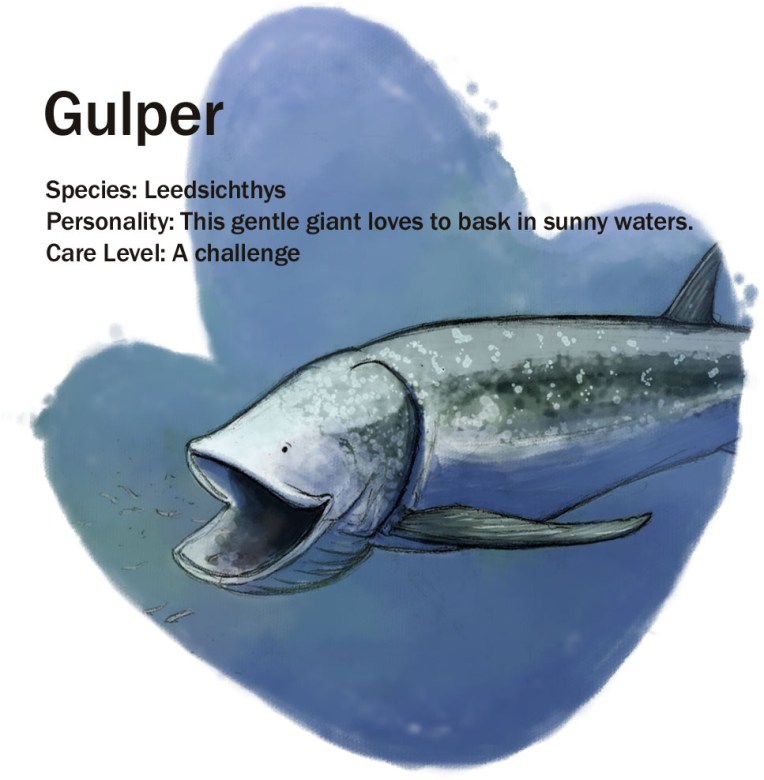
Meet Gulper. He’s the biggest, most easy-going fish in the sea. All he wants in life is to drift through nice sunny waters. He’d love it if you joined him for a swim, and you’re welcome to hitch a ride on his fin. 🙂
Gulper has a giant mouth, but don’t worry, all he eats are tiny sea critters called plankton- just like whales. 🙂 Continue reading →
Meet Terry. She’s a chipper little flyer who would love to scramble up onto your shoulder and nibble your ear (just a little nibble, it tickles). And could she please, pretty please have a tiny bit of that sandwich?
Terry always likes a snack, especially small morsels like snails, grubs, and worms she digs up. That sandwich looks quite tempting though, and she won’t turn her nose up at an opportunity to snatch it out of your hand, so keep an eye and a firm hold on it. 😀
She might not look it, but this little pterosaur (not dinosaur), is very good at walking and running around on the ground. She spends a lot of her time poking her sensitive snout in the dirt for all sorts of burrowing creepy crawlies. When she feels one, she nabs it with her tiny teeth and gulps it down. Yum! Continue reading →
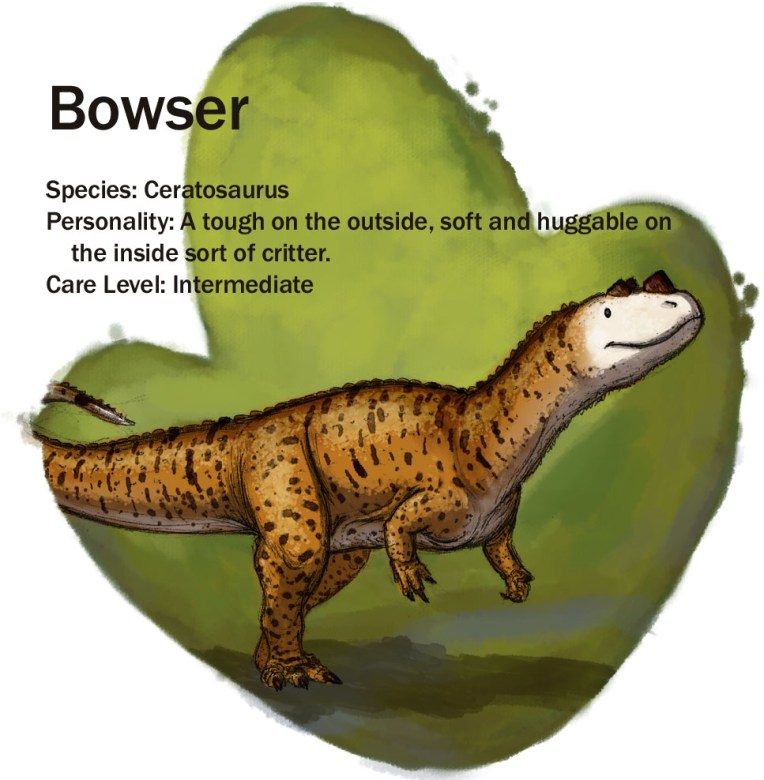
Meet Bowser. Those horns may look intimidating, and his toothy grin can be downright fearsome. But you know what they say about books and their covers… 😉
There we go, he smells it! See these nice big strips of jerky? He’ll love it. I brought some for you too if you want to give him a special treat.
See him cock his head off to the side a little? Bowser can see a little bit in front of his nose, but he has trouble seeing very much past those bony ridges in front of his eyes. He still has better binocular vision than his cousin Alfred though!
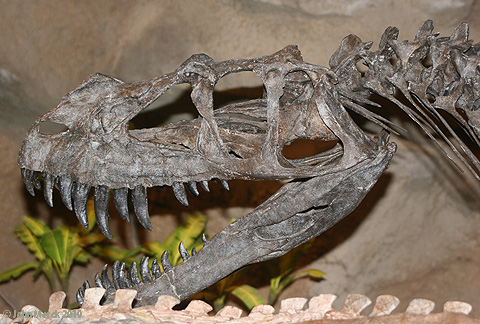
Here you go, just take a strip of jerky with these tongs, and we’ll get to see the size of Bowser’s chompers. Bowser’s teeth are some of the longest for a dinosaur his size.
Yep, hold the tongs just like that, so we keep our fingers out of the way. There we go! Good boy Bowser! Listen to him grunt. 😀
Oh he wants more. Ok big guy! Wow, look at the size of those teeth! Personally, I’m glad he usually keeps his mouth shut…
The teeth on this mount may be extra long, because teeth tend to slip out of the socket when there’s no soft tissue to hold them in, but they’re still super long! This is a younger individual, so the horns aren’t as big as Bowser’s. Photo courtesy and copyright of Dr. John Meck. Obtained from qilong.wordpress.com
Bowser always reminds me of a pit bull. Kinda short (compared to Alfred), thick muscle, big head…he’s the pit bull of Jurassic predators. He’s buff, he’s tough, and he’ll stop at nothing to protect his special person.
He has an unfortunate reputation for being aggressive and nasty, but animals are only as bad as their owners train them to be.
Give them a good home and healthy training- you’ll have a loyal friend that is sweet and adoring.
Well, I’m not sure how adoring Bowser can be…he’s not exactly the sharpest tack. But Pete’s trained him well, and he never shows his teeth except when he’s chomping down on a meal.
That’s a good boy Bowser, here’s another piece of jerky for ya. 🙂
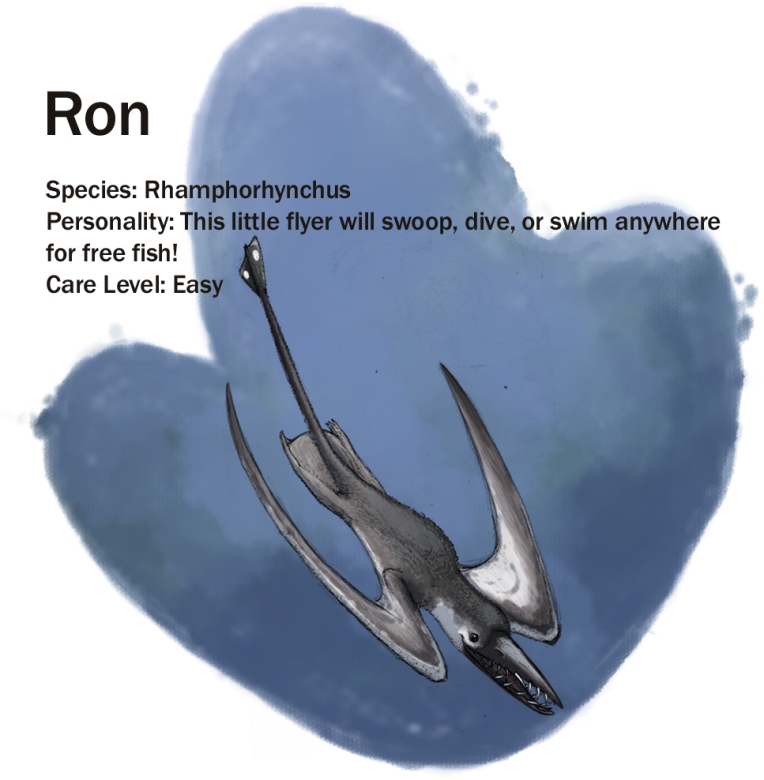
Meet Ron. He’s the flying ace. He’ll swoop from the sky, dive into the water, and swim anywhere for a shiny fish. 🙂
Rrr- just how do you pronounce that? I wasn’t 100% sure on that myself, so I looked it up on Youtube…
There, mystery solved. 🙂 I wonder if there’s one for all the really hard paleo-critter names out there. I may have to include something like this from now on until I figure out a better system.
Oh, and before you ask, yes, there is evidence that pterosaurs can swim. 🙂 Ron here seems to spend most of his time in water, which might be why we have so many perfect fossils of this little guy. 🙂
He’s fast though. It took a whole bucket of fish to entice him to come over for a quick chat.
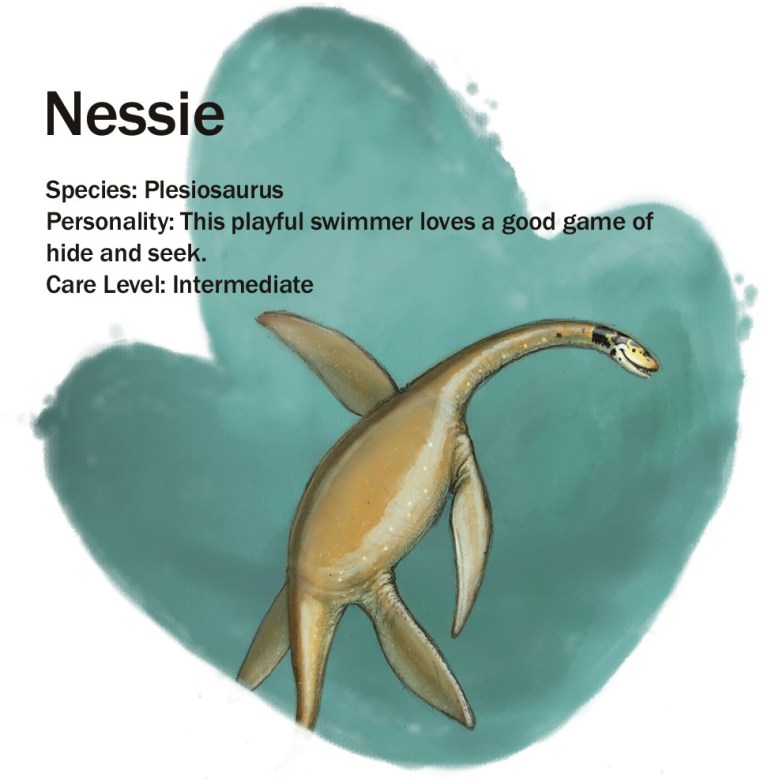
Meet Nessie. This curious undersea critter is always looking for an opportunity to nab a treat. You’ll never see her coming! Her favorite game is hide-&-seek. 🙂
Look at that smile, I think she wants you to chase her!
Nessie loves a good game of hide & seek. She’ll find a good spot in the sand, bury herself with those powerful flippers, and wait until an unsuspecting fish or squid comes by…
Snap! Up comes her head, and the squid is lunch before it knows what’s happening.
Other times Nessie likes to be the seeker instead, and come up to a school of squid. It’s hard to tell exactly how close she is…the squid are easily tricked into thinking that she’s further away than she really is, so that long neck of hers can dart in for a quick bite.
Her neck is actually quite stiff, more like a fishing pole for extra leverage than the swan-like curviness you usually see on the Loch Ness monster. But Nessie can put that leverage to good use.
There were more squid and squid-relatives than fish in Jurassic oceans, and one of those relatives are ammonites. If you’ve never heard of an ammonite (am-oh-night) before, then you can think of them as squid with snail shells.
The big difference (aside from not being related to snails)… Continue reading →
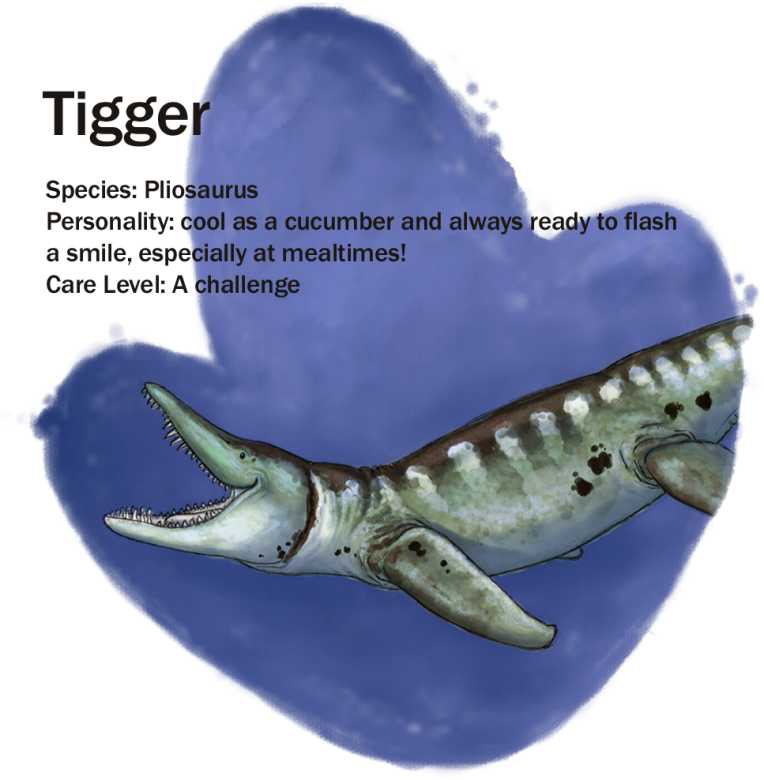
Meet Tigger. This big guy is always ready to flash a big, toothy smile, especially at mealtime.
Look at that giant, toothy grin. He’s sure happy to see you! He’s looking for a treat or two (or ten), so that’s what this stinky bucket of slimy deliciousness is for. Tigger has a huge appetite, and he’ll eat anything that fits in that giant mouth of his. Even dinosaurs if one of them decides to go for a swim. (you heard right, dinos can swim, we have tracks to prove it)
Now when I say dinosaurs, I don’t mean swimming critters like Tigger. If you want the nitty gritty on what a dinosaur is or isn’t, you can quiz yourself on “Which One is the Dinosaur?”. 🙂 But even though Tigger wouldn’t mind a dino snack on occasion, it wasn’t usually on the menu, since he has plenty of turtles, squid, ammonites (think squid with a snail shell), fish, and marine reptiles to chomp on.
I say marine reptiles, because that’s what this big guy is. Tigger isn’t a dinosaur at all, but a pliosaur. In fact, his species, Pliosaurus, named his whole group!
The other marine reptiles swimming around here are ichthyosaurs and plesiosaurs. My little girl calls them “icky-saurs” and “pleasy-saurs”. 😛


 Pete's Paleo Petshop