Meet Maya. She’s a sweet little fuzzball who loves nothing more than to curl up in your pocket. At least during the day. When the sun goes down, that’s when the party starts!
Wait a second…what’s a squirrel doing in a dinosaur book? Well I’m glad you asked. So far, her kind is the first mammal discovered that nourishes her babies in utero with a placenta. A placental mammal. This is unique from marsupials like kangaroos, or egg laying monotremes like platypus. 🙂
My little girl keeps calling Maya a squirrel (she’s 2 🙂 ), but she’s a bit more like a tree shrew. Little Maya has sharp little teeth that are great for just about anything she can get her paws on, but bugs are her favorite. That slender nose helps her sniff them out in the dark. She has long arms and sharp claws that make her completely at home in the tree tops.
When you’re the size of a squirrel it’s good to be out of reach of giant dinosaurs!
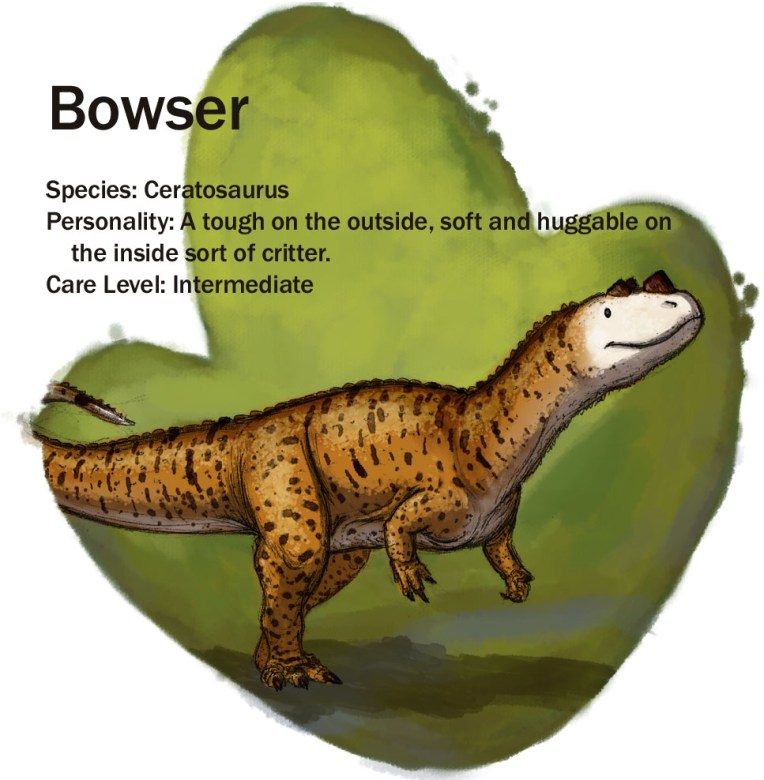
Meet Bowser. Those horns may look intimidating, and his toothy grin can be downright fearsome. But you know what they say about books and their covers… 😉
There we go, he smells it! See these nice big strips of jerky? He’ll love it. I brought some for you too if you want to give him a special treat.
See him cock his head off to the side a little? Bowser can see a little bit in front of his nose, but he has trouble seeing very much past those bony ridges in front of his eyes. He still has better binocular vision than his cousin Alfred though!
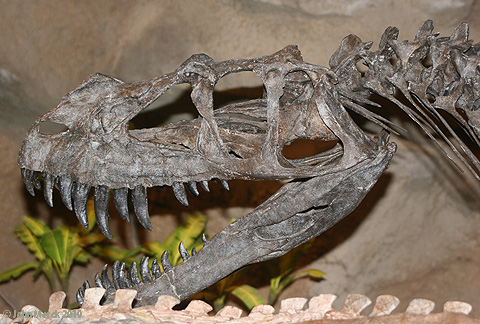
Here you go, just take a strip of jerky with these tongs, and we’ll get to see the size of Bowser’s chompers. Bowser’s teeth are some of the longest for a dinosaur his size.
Yep, hold the tongs just like that, so we keep our fingers out of the way. There we go! Good boy Bowser! Listen to him grunt. 😀
Oh he wants more. Ok big guy! Wow, look at the size of those teeth! Personally, I’m glad he usually keeps his mouth shut…
The teeth on this mount may be extra long, because teeth tend to slip out of the socket when there’s no soft tissue to hold them in, but they’re still super long! This is a younger individual, so the horns aren’t as big as Bowser’s. Photo courtesy and copyright of Dr. John Meck. Obtained from qilong.wordpress.com
Bowser always reminds me of a pit bull. Kinda short (compared to Alfred), thick muscle, big head…he’s the pit bull of Jurassic predators. He’s buff, he’s tough, and he’ll stop at nothing to protect his special person.
He has an unfortunate reputation for being aggressive and nasty, but animals are only as bad as their owners train them to be.
Give them a good home and healthy training- you’ll have a loyal friend that is sweet and adoring.
Well, I’m not sure how adoring Bowser can be…he’s not exactly the sharpest tack. But Pete’s trained him well, and he never shows his teeth except when he’s chomping down on a meal.
That’s a good boy Bowser, here’s another piece of jerky for ya. 🙂
Meet Picasso. This quiet softie loves spending time with his special person. Snuggling under the tree to hear a good story? That sounds like a lovely way to spend a warm afternoon. 🙂
Picasso looks very happy to see you, and he wonders very much if you like his red crest. He’s very proud of it, you see, and he’s been strutting around the field like a very large rooster.
He marches up and down the fence line with his chest puffed out and his neck arched like a stallion. He watches over his patch of yard like the duke of the land, and if something doesn’t look quite right, he’ll stand as tall as he can and show off those blue feathers- just so you know he has things under control.
Oh yes, feathers! Now we don’t know for sure if this critter had feathers or not, and the whole subject of feathered dinos deserves it’s own series of posts, but there’s a definite possibility. 🙂
I’ve given Picasso a coat of feathers similar in texture to an emu’s, which gives him the furry look. His fingers and feet are feathered too, like a snowy owl, but they have pads on them for walking and grabbing.
If you’ve watched a lot of Jurassic Park, take note that Picasso has awesome grabby hands that are good for hugs. Not dangly zombie bunny arms. What good are those for? 😛
Making progress…
Happy New Year! I hope you’ve been having a good holiday season.
I have big plans for the new year…Here’s a basic list, kinda in the order I want to accomplish it.
officially set up Mailchimp so that I can launch Pete’s Postcards from the Shop.
Finish Dippy vs. Ball so I can publish my first book (ever.)
Earn my first 99 cents from said book. 😀
Prep Dippy vs. Ball to make a print version available.
Create more Critter Cam episodes until I have enough for the anthology, which will also be available in print.
And…
Publish “Little, Quiet Dinosaur” (working title) by my birthday this year! We’ll see how realistic a goal that is later, but I’ll try my best to have it at least finished (if not ready to publish on Amazon).
I have a strategy in mind, to make sure this happens. Once Dippy vs. Ball is published, I’ll then work on an illustration for the picture book.
With an illustration complete, I’ll prep Dippy vs. Ball so that it can be available in print as well.
Then another illustration for the picture book…then I’ll start a second Critter Cam episode…you get the picture. 🙂
This way I hope to have more books out there (and therefore more easily seen, so future readers know I exist) while still making progress on the picture book. 🙂
P.S. – In case you didn’t notice, Picasso got an update!
He looks more like most of the other critters now, style-wise
He’s more balanced over his hips now, and doesn’t look like he’s about to fall on his face
His head crest is shorter, and more like the latest skeletal drawings
His body is leaner, since I gave his feathers a slightly shorter, more fur like look.
Here’s the older picture for comparison. 🙂
Coming Next Week…
This big guy is always ready to flash a big, toothy smile, especially at mealtime.
Meet Copper & Daisy. These gentle giants are always happy to meet new friends. They love being part of the group.
Copper is a strapping young bull, and never leaves the side of his lovely lady. He’s very much the gentleman with her, and any friend who joins the herd. Just keep a close eye on your pockets if you have treats!
You can’t hear him, since it’s a picture of course, but Copper is chirping to Daisy. He’s found a good patch of something tasty, and he’s telling her to follow him. Many dinos could probably make a lot of noise without ever opening their mouths, like the gurgly hum Copper is making here. But you can see his lovely red throat all blown up like a bullfrog. 🙂
I imagine him sounding a lot like this…
Making progress…
I’m making progress like a ninja tortoise on my little project. If you want to see what that looks like, here’s a surprisingly fast tortoise I found on Youtube. 😛 (I love how everyone in the clip makes such a huge deal on how fast this tortoise is)
So here’s what I’ve got…
line work for the comic is complete. (though it needs a couple of updates, I found a paper describing the soft spines on Dippy’s back, and I’ve been drawing them wrong.)
first page color nearly complete.
thumbnails for front and back cover, and a few other pages are done, so I just need to finish the line work there.
Here’s a quick look at the first page. I’m going for a simpler style that’s animation friendly later on, so aside from a few tweaks on the background, this is just about done. Do you prefer the simpler, more suggestive backgrounds, or a little more detail?
Personally, I’m thinking of very minimal background, similar to the Wall-e and Big Hero 6 shorts. 🙂 Those short clips have pretty much no background, but the little scene at the bottom of the page is closest to what I’m going for. Very minimal.
Here’s a look at the Wall-e and Baymax clips, so you see what I mean.
What do you think? I would love your feedback! 😀 Just leave a quick word or two (or three) in the comments. 🙂
Coming Next Week…
This little dino is a bit shy, but she’ll come out of the bushes for a sweet hug and a small treat. 🙂
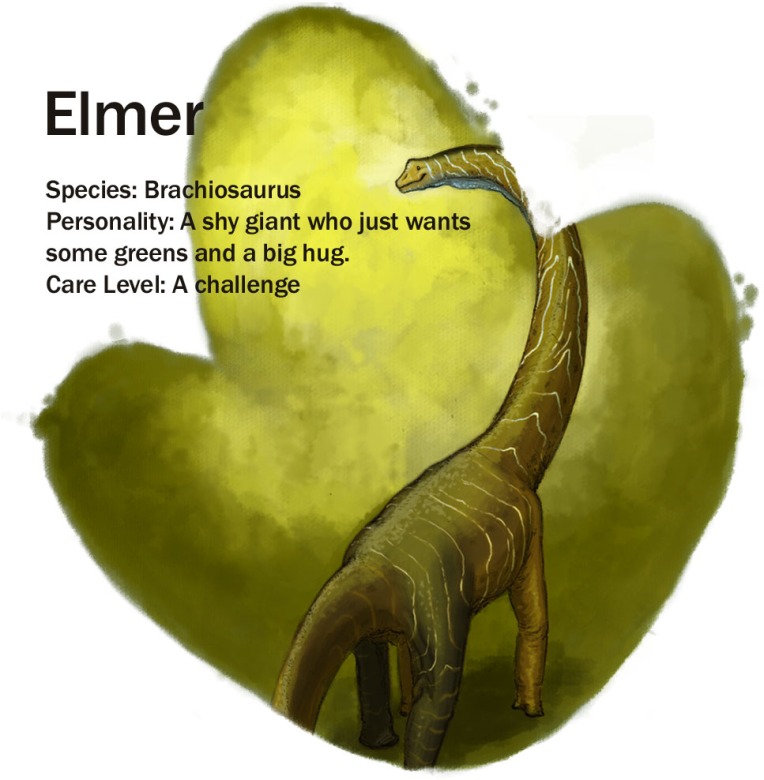
Meet Elmer. He’s a little shy, and likes staying in his comfort zone, but he’ll be your best giant friend if you give him some greens and a big hug.
The best way to a dino’s heart is through his stomach, as they say. Well, that’s not really the phrase, but I’m sure it’s just as true, especially when it comes to these long-necked sauropods. 🙂 I think the rough estimate is a solid cube- 5ft x 5ft – of vegetation in a single day to feed one of these guys.
Oh, there’s Elmer, browsing on a few of the trees that grow here in the pasture. You’d think you’d see him right away, he’s so big. But his striped pattern is surprisingly good camouflage in that grove of tall conifers.
What’s he looking at…? Oh, here comes Pete on the Kabota. He’ll be joining us here on the platform to feed Elmer. If you lean over the railing a bit and look down, see that row of big boxes kinda spaced along the wall? That’s where the big bunches of conifer branches and ferns will go. They’re in the big shed behind us, the one to the left of the stairs we came up.
And here comes Elmer. My goodness, he’s fast. It looks like he’s moving slow, but with those long legs he sure covers ground quickly! And so quiet…You’d think there’d be the big stomping footsteps you hear in Jurassic Park.
Hey there Elmer! We have a friend to see you today. 🙂
I just can’t get over how big he is! What are we, 30 feet up? 40?
It’s hard to grasp how big these guys really are until you’re right next to them. Come to think of it, that’s the way it is with most animals.
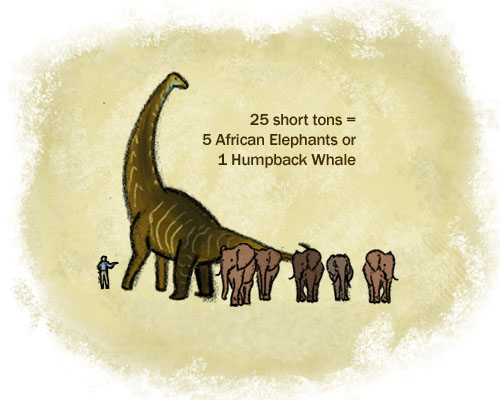
To think that Elmer is as heavy as 5 elephants. Five! And not just any elephant. 5 bull African elephants, which are about as big as it gets when it comes to land animals walking around today.
Here’s a video that helps put that into perspective…
So five of those guys is about as heavy as the average humpback whale. Yes, Elmer here is every bit as big as a whale, and he’s not even the biggest sauropod out there!
Oh, hi Pete, we have a visitor today!
There you are, friend, a nice bunch of ferns you can give Elmer. Just grab it at the end here, and make sure your fingers are in a nice, tight fist.
That’s it.
Elmer’s teeth are like pruning shears, so we don’t want to lose any fingers today by mistake.
I think he likes you!
Making progress…
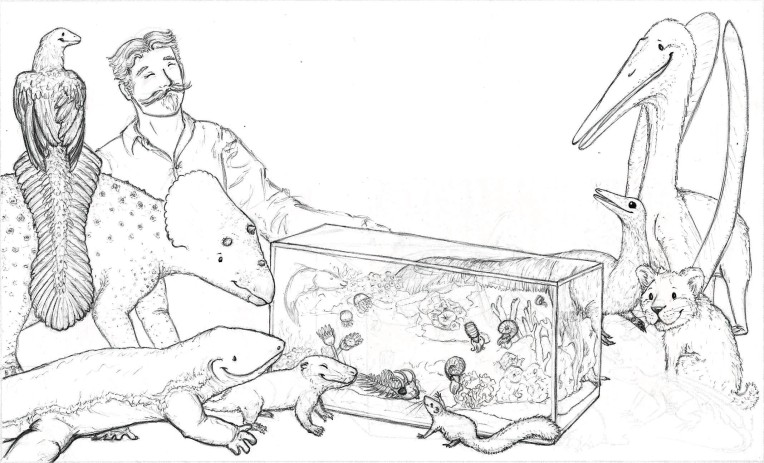
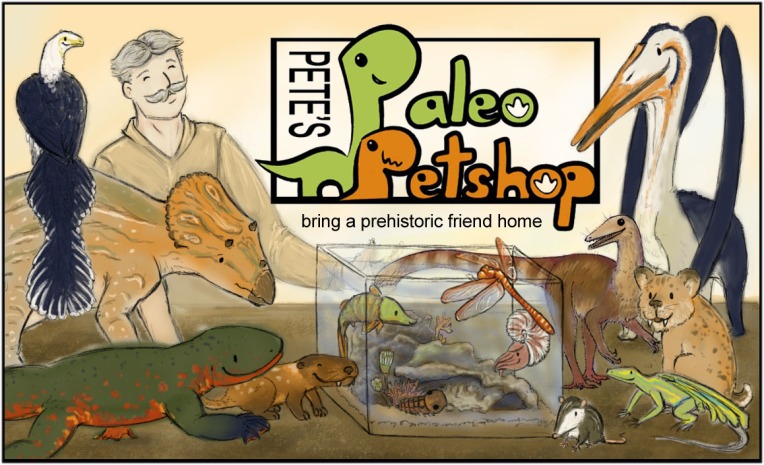
I’ve been working on actually finishing the homepage image for a bit now, and I thought I would share my progress so far.
It’s an important part of the site, since it’s the first thing you see, and it’s the “front window” of Pete’s Paleo Petshop.
But it’s also a test.
A test for style, to make sure I’m happy with it, and it’ll have the feel I’m going for.
A test to see how long it takes me to complete a full illustration. (so far two weeks, but that’s in between the margins of everything else)
And a test to make sure you like what you see as well. After all, this may be an ambitious idea and project, but the long-term goal is to earn a passive income in a way that doesn’t take time from my family.
So here is two weeks of sporadic sketching between posts, child herding, and making sure the house doesn’t fall apart. 😛 (I exaggerate, but truly, being a stay-at-home mom takes quite a bit more work than a lot of people think 🙂 )
Compared to the current homepage…You’ll notice the little saber-tooth cub lost his fangs. They’re just hidden behind extra large lips. Turns out only tusks are exposed, so all saber-tooth cats should have their teeth nicely sheathed. 🙂
I did look at reference pictures, but research was kept to a minimum since most of these animals are not in the Jurassic period. I’ll update the picture as I get to the appropriate periods, which may take a while. 😛
Coming Next Week…
I hope you don’t mind getting wet, because this swimming critter loves to splash! 🙂
When it comes to prehistoric critters, it can be real easy to point at any large, scaly beast and call it a dinosaur. But there are a lot of prehistoric critters that were not dinosaurs, even during their heyday. In fact, dinosaurs are only a small fraction of the animals that walked around during the “Age of Reptiles”.
Unfortunately, sometimes even “educational” books and movies will lump in the other critters in the same group as the dinosaurs. So how can you tell which is which?
Let’s have some fun with a little quiz. Can you tell me which critters are the dinosaurs, and which ones aren’t?
First off, a handy dandy dino checklist.
Dinosaur hips make for straight, sturdy legs under their bodies, just like mammals. Unlike other reptiles that walk with legs splayed out, dinos tend to walk with one foot in front of the other, just like we do.
Dinosaurs all lived in the Mesozoic period up to the present day. Birds, of course, can be seen outside your kitchen window. All other dinosaurs, or non-avian (not-bird) dinosaurs, appeared in the Triassic, reigned all through the Jurassic, and met their end at the Cretaceous.
All Dinosaurs share the same latest common ancestor- the great-great-great-grandaddy of Iguanodon and Megalosaurus. Iguanodon is a giant, spike-thumbed plant-eater from Cretaceous England. Megalosaurus is a meat-eating distant cousin of T-rex, from Jurassic England.
Fun Fact on that last one:
Sir Richard Owen coined the name Dinosauria based on Megalosaurus, Iguanodon, and Hylaeosaurus (a plant-eater built like an armored tank, but without the club-tail of more popular armored dinos. Cretaceous England).
All three of these critters can still be seen today at the Crystal Palace in London, where sculptures were built based on the latest scientific knowledge of the 19th century. It’s in a sad state compared to the grandeur of its golden years, but it’s still on my bucket list. 😀
Dinosauria is often translated from the Greek as “Terrible Lizard”, but it can also translate to “Fearfully Great Reptile”. Owen seems to have named the creatures based on their awesome size and how majestic they must’ve looked in life. Not on their “terrible” teeth, spikes, and claws.
Now that you know the features that make a dinosaur, let’s get started! 😀 I’ll leave the answers for the very end, so that you can test yourself.
First up, Bowser the Ceratosaurus! He’s big, and lived in Jurassic North America. He has a nice beefy tail with the muscle power to move his legs forward, one foot in front of the other.
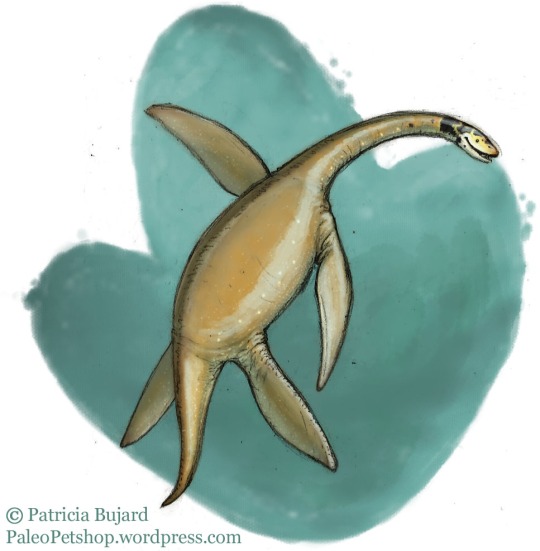
Look who’s come out of hiding…Nessie the Plesiosaurus! Those flippers are great for gliding through shallow Jurassic seas or paddling in murky rivers. You’ll find her swimming around in Jurassic England.
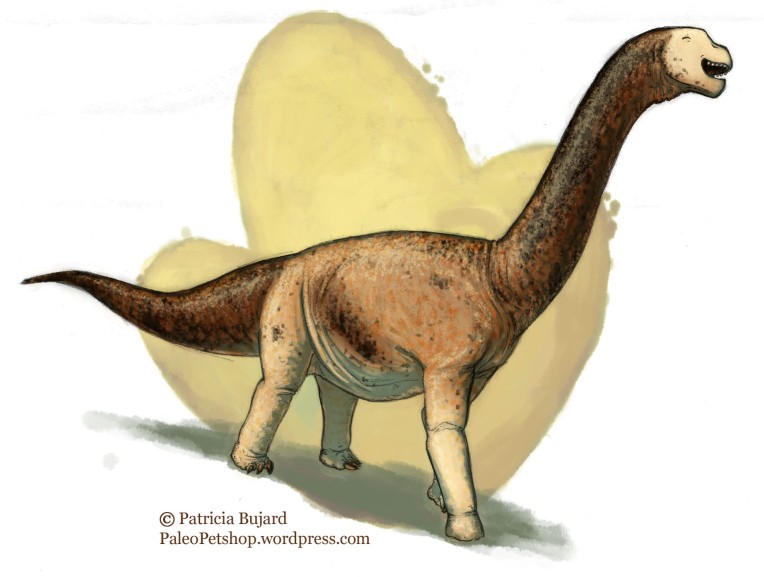
Here comes Bella the Camarasaurus! She’s a big girl, and proud of it, but she has no problem moving all that weight around. Her legs are like pillars, strong and sturdy under her body. You can find her in Jurassic North America.
Why hello there, Dan the Dimetrodon is here for a special visit. He came by all the way from Permian North America, an earlier time than the Triassic period.
Twig the Compsognathus is a little guy, only as big as a turkey, but that just means he’s extra fast. He runs like a roadrunner, and easily snatches up splay-legged lizards. You can find him in Jurassic Germany.
(quick note: there are rumors of scale patches on the legs and tail for this little guy, but I haven’t been able to find the papers describing them. So I’ve given him feathers based on a close cousin.)
Flipper the Ichthyosaurus comes in with a splash! But what is he? You can find him cruising Asian and European waters during the Triassic and Jurassic periods.
Tango the Archaeopteryx loves to sing and dance, and no lizard can dance like Tango can! He’s got the finesse of a duck and the enthusiasm of a parakeet. You can find him and his fancy feathers in Jurassic Germany.
Here comes Tigger the Pliosaurus with a big grin. An apex predator in the water, this big guy would’ve made the Jurassic seas around Europe and South America a dangerous place to be.
Are those…Turkeys? Why yes, yes they are. They’re showing off their festive plumage by strutting with one foot in front of the other. You probably see one at your dinner table on occasion.
Ron the Rhamphorynchus has dropped by to see you. Those teeth look a bit vicious, but he’s just an excitable fuzzball really. You can find him soaring through the Jurassic skies in Germany.
Think you got them all? Let’s check and see!
Bowser the Ceratosaurus is a dinosaur! He stands upright with his legs under his body, he’s a theropod (who were the theropod dinosaurs?), and he lived during the Jurassic period- the middle of the Mesozoic era.
Nessie the Plesiosaurusis not a dinosaur! She lived at the same time as many dinosaurs, and she’s big and scaly, so I can understand why she’s often thrown into the pile. She’s a marine reptile called a plesiosaur, and she’s actually the first discovered, so she got to name the whole group!
Bella the Camarasaurus is a dinosaur! She stands tall and straight on legs like pillars, and she lived in about the same time and place as Bowser.
Dan the Dimetrodon is not a dinosaur! Dan is quite a few million years too early, with the biggest mass extinction in Earth’s history between him and dinosaurs. But if you don’t know what time he’s from, then you can see that his legs are sticking out like a croc, instead of underneath his body. But he’s not a croc either. He’s a synapsid. Mostly that’s a fancy term about the skull. I’ll get to that when I’m working on the Permian period. 😀 That said, I totally get why people would think it’s a dinosaur. I mean, it’s everywhere! It’s even on my kids’ favorite oatmeal, y’know the one with the hatching dinosaur eggs?
Twig the Compsognathus is a dinosaur! Size doesn’t matter when it comes to dinos. This little guy has his feet under him, lives in the Jurassic, and he’s a tiny cousin of Megalosaurus. Not so sure about the feathers? I talked about feathers on dinosaurs in a post not too long ago…
Flipper the Ichthyosaurus is not a dinosaur! He’s also not a fish, dolphin, or prehistoric whale. He’s a marine reptile called an Ichthyosaur, and he was the first of his kind discovered, so he got to be the namesake of his group. Since the name translates to “fish lizard” or “fish reptile”, then there’s no surprise when people call him one. The reason he looks like a dolphin is because the fishy/dolphin/shark body plan is so perfect. For an animal that is born, lives, and dies in water, then his body shape is perfect.
Fun fact: Plesiosaurus was given that name because her kind is “nearer to dinosaurs” than Ichthyosaurs like Flipper.
Tango the Archaeopteryxis a dinosaur! Few deny the birdiness of this critter. Where some people get confused is the dinosaurness of birds…but this little guy is a lovely mix of both. But now you’re getting to know the drill. Feet underneath the body and supporting his weight. Jurassic period, “golden age” of dinos…etcetera, etcetera… 🙂
Tigger the Pliosaurus is not a dinosaur! It’s starting to look like there are no swimming dinosaurs. There are always exceptions to the rule of course *cough*Spinosaurus*cough*, but in general, you don’t really see dinosaurs getting specialized for a life in water. Tigger is another that gets to name his own group. The Pliosaurs. They were marine reptiles that thrived in the Jurassic and into the Cretaceous, but died out alongside the dinosaurs.
A Turkey is a dinosaur! Yes, when you sit down for that turkey sandwich, or prepare for that Thanksgiving feast, you are about to eat a dinosaur. All birds are members of the theropod group (take a look at Bowser up there). Want more info? I’ve got a post on birds over here.
Ron the Rhamphorynchus is not a dinosaur! Like the marine reptiles, his kind lived at the same time, and so are always being tossed onto the same pile. Ron is a Pterosaur, a flying reptile that is actually in the same family tree as crocs and dinosaurs, but not so close that he’s mixed in with the dinosaurs. Pterosaurs were usually pretty good at walking, but they didn’t have the same hip as dinos.
How did you do? If you didn’t do very well, don’t feel too bad. There’s a lot of misinformation out there, even from sources that are supposed to be educational. And really, it’s a lot easier just to call them all dinosaurs, instead of having to remember all the different names for the different groups. 🙂
Quick Question: What’s your biggest source of info about dinosaurs? Jurassic Park? The news? Dino obsessed friend or kid? Your own research? I’d love to hear from you in the comments! 😀
Hello there! Alfred is super excited to see you, and look at how curious he is. Do you own a cat or dog? Because he seems to think you smell good. (stay back Alfred, be nice). Here we go, I’ve got a nice ball of cheese and bacon here. He’ll love it. Here Alfred, go get it!
While Alfred gets the ball, I can share this lovely disclaimer. Que elevator music…
I do the best I can with research, but I definitely don’t claim to be an expert. I try my best to keep up to date, and all my illustrations reflect this. (thank you internets, and to all hard-working paleo-nerds who are kind enough to make your papers open source!) 😀
That said, all the drawings in the A&S post series are quick doodles to illustrate a point, with not as much reference as I usually use, so there are plenty of inaccuracies for you to point out for me. 😉
Thank you disclaimer, you can go bother someone else now. 😛 Elevator music fades out…Oh and here comes Alfred! Looks like he wants more…
There we go, good boy Alfred!
Now Alfred here is an Allosaurus. He’s young, so only about 12 feet long so far, but he’ll grow to be a lot bigger. Not as big as his wild cousins though, a few of them could be as big as T-rex! (very few, gotta be old to get that big, and most dinos have a live fast, die young policy)
1. On Scaly Skin vs. Feathers
So you see Alfred here has these lovely bright yellow and forest green scales, the colors of youth. (They’ll mellow out a bit when he gets older, like monitor lizards do)
Also like a monitor lizard, you’ll notice that most of Alfred’s scales are quite small, with a rather pebbly texture. They get a bit larger and thicker on his back, which is good since adult Allosaurus tend to get into quite a lot of tussles with each other. But most of his scales have that nice cobblestone look to them.
Short answer as to why Alfred has scales…there’s a young Allosaurus with preserved scales somewhere on it’s body. (Unfortunately the report didn’t say where)
Looks like Alfred’s all worn out from chasing after that giant, cheesy bacon-ball. He hasn’t quite grown into his adult silhouette yet. He’s still young enough to think he can chase after stuff, but he’s starting to get to an age where it’s getting hard to make those quick turns.
When he fills out his more barrel-chested adult figure, he’ll be spending quite a bit of his leisure hours (think energy-efficient) laying around. Since his body is a bit taller than it’s wide (more lanky cat than double-wide gator), it’s more relaxing to be lounging on his side.
Of course, that doesn’t mean he can’t do other things to relax, even things that may surprise us (ever seen a large horse roll? It’s hilarious 😀 ).
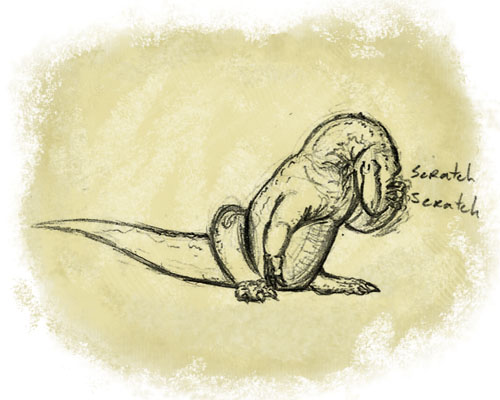
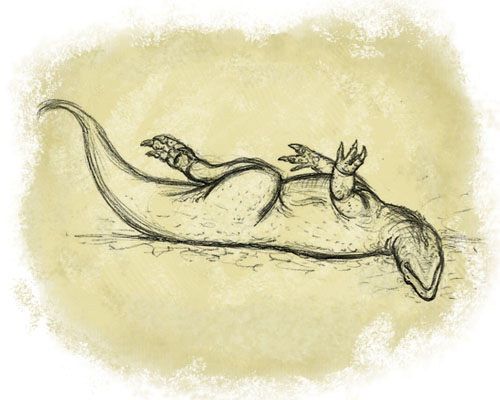
Sit!Down!Good boy! Roll Over!
Oh, and here’s that horse… 😀 I can totally picture some “duckbill” dino doing this.
3. Where are His Teeth?!
Clearly I need more practice drawing people. Thank you for volunteering Pete. 🙂
I hear ya, I wondered the same thing when I looked up pictures of Komodo Dragons and monitor lizards. But wait, what does that have anything to do with it?
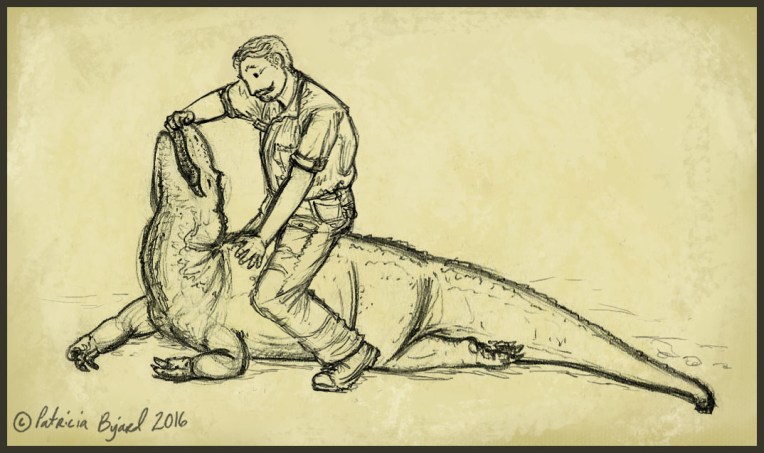
Pete will help us out here. I know Alfred looks a little awkward, but he’s actually quite comfy. Ah- I’ll let Pete tell you the rest…
“Thank you. Yes, Alfred is quite at ease here. I’m not heavy to him at all, and he weighs at least a good 300 pounds at this age. So he doesn’t mind a bit.
I’m tilting his head back very gently- show us your teeth there Alfred, that’s it, nice and easy.
See this is the biggest difference between a domestic Allosaurus like Alfred here and a wild one. Look how completely relaxed he is. He’s not fighting me at all, and even his eyes are closed, look at that. (Alfred makes a gurgly, kinda purring sound in his throat)
Anyhow, I’m holding onto his lips here so I keep my fingers out of his mouth. My fingers can look a bit like treats, so I’ll be sure to keep them right at the edge here, at the gums.
All this, the lips, the gums, the saliva- it all keeps his teeth nice and moist. Dinosaurs have a healthy coat of enamel on their teeth, same as your teeth, and the key to healthy teeth is to keep them moist. Even better if you can give your teeth a constant bath of saliva.
Yes, drool is essential to healthy teeth!
Now Alfred will lose his teeth and grow new ones, just like crocodiles and alligators do, but if you look closely at these teeth-they’re serrated. They’re like steak knives- not like the cone-like teeth of crocodiles.
Thank you Alfred, you’ve been quite patient. Here’s some jerky.
But crocodiles don’t need serrated teeth. They’re eating different things, they have a different habitat, and different diet, they’re eating in a completely different way. Alfred has teeth like a bone saw.
Ever cut a roast turkey with an electric knife? That’s what Alfred’s teeth are doing when he eats, so they need to stay sharp, and they need to be strong in his mouth. So the gums hold his teeth, and his lips keep them nice and moist so they stay strong and don’t get brittle.”
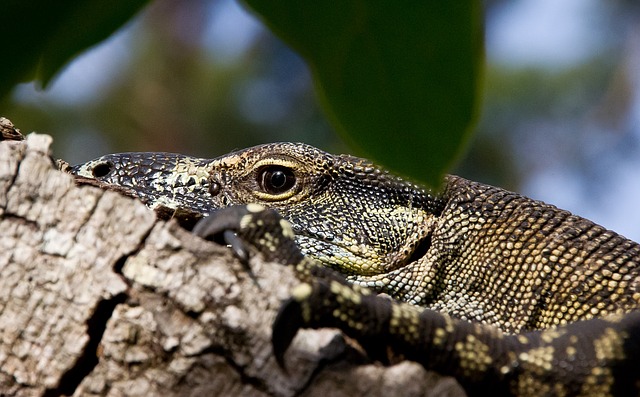
Thank you Pete, and Alfred. Just for comparison, here is a crocodile monitor lizard.
Looks friendly doesn’t he? Image not my own, but I couldn’t find who to credit. If you know who I should credit, please let me know. 🙂
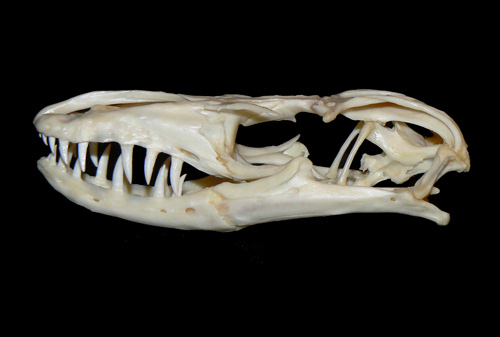
My first thought, “Where are the teeth?!” Then I noticed those sharp white triangular things inside the lip. Also interesting is that it looks like there are pockets for the bottom teeth to slip into. 🙂 Here’s the skull of the same animal…
Image not mine. If you know who I should credit, I’d love to give credit where credit is due. Thank you. 🙂
They look quite different from the other picture don’t they? Almost, shall I say, dinosauresqe? Take a look at an Allosaurus skull. 😀
Image copyright to Jason R. Abdale.
The one and only skull I could find that doesn’t have its teeth halfway falling out of their sockets (it happens when the dead critter decays). Jason has many more pictures of the Allosaurus mounts at the American Museum of Natural History, and I’d highly recommend you check out his blog post. You’ll also discover all my errors and where I need to fix Alfred. 😀
Quick Question: Help me find what I need to fix! If you wouldn’t mind checking out this blog post on Allosaurus, you’ll get to see some great pictures of excellent mounts, and you’ll see what I have to correct in my illustrations of Alfred.
I’d love to hear from you in the comments! I’ll be posting a comment on how many I find, and let’s see if we come up with the same ones or more. 😀
Meet Dippy! A giant with a heart of gold, life is never boring when this big guy is around. Nothing is out of reach! He’ll stick his nose into everything until every mystery is solved.
Looks like he’s found a very, very big ball to play with. That ball is pretty much indestructible, and something that comes in handy when you have curious giants like Dippy around. He loves food just as much as your average sauropod, but Dippy is…how shall I say? Easily distracted. 😛
Dippy here loves investigating anything new. He’s not the sharpest rock around, but when you’re this big, brains aren’t a requirement. I wonder what he plans to do with that ball? Pete found his old one flattened out in the pasture a couple weeks ago, so we’ll see how long this one lasts.
What’s that you say? An accident? Oh no, I’m sure the ball was squished on purpose. These guys have an amazing sense of touch. Dippy doesn’t like stepping on certain things, and he’s very careful where he puts his feet (elephants are like this too).
Dippy seems to like the smooth bounciness. But who doesn’t like to play every now and again? 🙂
To get an idea on how big the ball is, check out the super-sized balls these horses are playing with. 😉
And it looks like I can purchase a domain name (like PaleoPetshop.com instead of PaleoPetshop.wordpress.com) and be able to forward emails from the site for less than $100! So that’s awesome. 😀
With that in mind, I’m working on the next step- finishing the first collection of mini-comics for an eBook. This eBook will be available for 99 cents, but you can purchase a physical copy for a few more bucks.
Once this collection is finished, then I’ll purchase the domain name and you’ll get to download and print those free collectible Critter Cards I showed you a couple weeks back. 😀
Here’s Dippy, since he’s the Critter of the Week. 🙂
Just a friendly reminder. If you’re seeing this in your email right now, it would be awesome if you’d click on the post title. That will take you to the actual page, which helps the Paleo Petshop get noticed by Google, which is a good thing if you like what you read and want to share it with others. 🙂 Thank you so much for being here with me. I truly appreciate it when we can chat a little together.
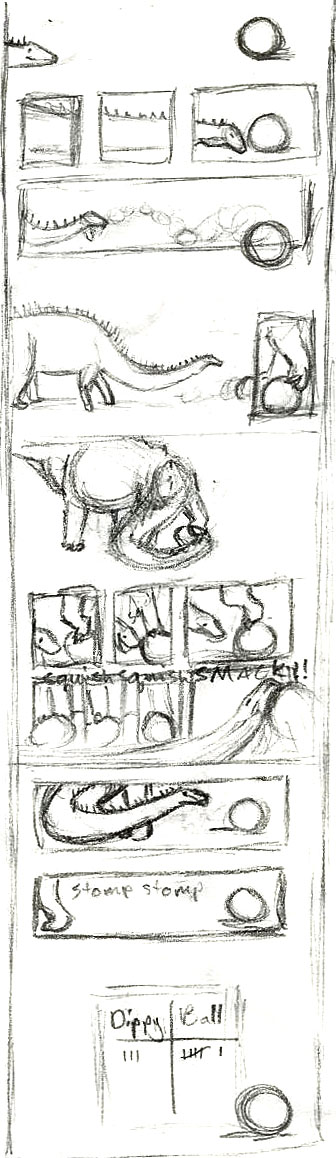
If you don’t mind spoilers, here’s a preview for one of the comics- Dippy vs. Ball.
Coming Next Week…
A real sweetie who’ll tolerate just about anything, even dress up. Just be careful not to spook her.
Every time I turn a corner, there’s a new feathered dinosaur to join the line up of “enfluffened” critters. T-rex, Velociraptor, Gallimimus…iconic dinosaurs from movies like Jurassic Park have bonified proof of some sort of floof covering their bodies. Even the plant eaters are getting floofy with critters like Hypsolophodon and Kulindadromeous.
Don’t get me wrong, I love feathery dinosaurs, and I’m a pretty big fan of a huge, fluffy, grizzly-hawk T-rex (that’s just epic 😀 ).
But sometimes artists can take this idea a little too far. “Woolly” Arctic ceratopsians (“three-horns” & cousins), and spike-tailed stegosaurus with porcupine quills is going a bit far on the speculation even for me.
There’s a fine line between reasonable speculation, and downright fantasy.
But let’s pause for just a moment. I know that a lot of paleoart is speculative, a way of illustrating hypotheses proposed by paleontologists, but there’s also a surprising amount of stuff we do know.
What I mean to say is…
The stuff you see in paleoart is not some wild guess, and just because the critters are long dead doesn’t mean anything goes. I’ve described the process of reconstructing prehistoric critters in my blog post series, Fleshing Out the Bones. You can click this link to read more on that if you’re interested.
So how do you decide if you’ll give your dinosaur feathers or scales?
“Butterfly!” Silly Alfred is just going to get worn out. He’s about the size of the young Allosaurus described below. About 12 feet long from nose to tail-tip.
Let’s take Allosaurus and my illustrations of Alfred as an example. How do I know if he should be covered in feathers or scales?
Based on the fossil, the young Allosaurus had small scales about 2-3 mm in diameter. So tiny, pebble-like, non-overlapping scales, rather like the sort you see on gila monsters and monitor lizards.
“Yo, ‘sup?”
But What if I didn’t Have Fossil Evidence?And for some, a patch of skin in one part of the body is not enough. Afterall, in some dinosaurs you get quite the mixture of feathers and scales. Compsognathus, for example, has close relatives with evidence of “full floof”, but the critter itself has scale impressions on its tail and legs.
Step 2: Look at Their Relatives.
Like we just did with Compsognathus up there, we can look at close relatives in the same family to figure out the scale/feather thing. In the case of the compy, the possibilities can get even more confusing, but let’s go back to Alfred.
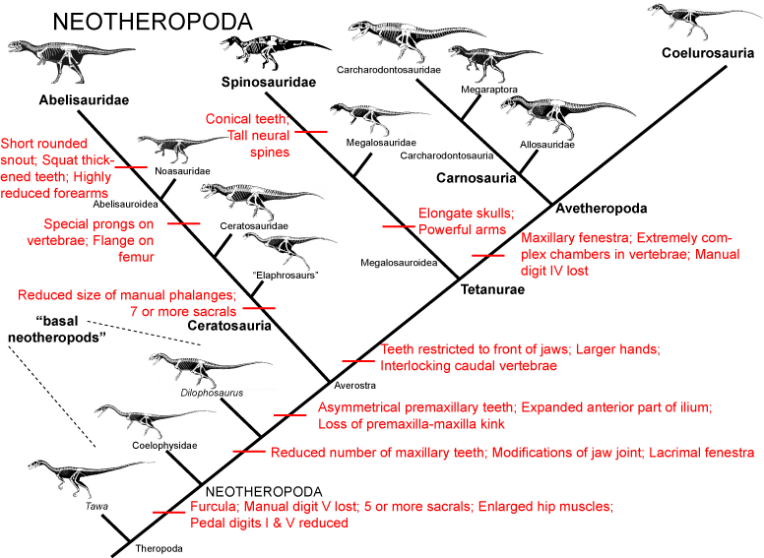
If you go back to last week’s post on Theropods, you’ll see that Allosaurus is in the family Carnosauria. One rather infamous member of this group is Concavenator. It has what looks like quill knobs on its arms, which in modern birds are small bumps on the bone where ligaments for flight feathers attach.
The “quill nobs” of Concavenator are a subject of much discussion. Duane Nash has a particularly interesting interpretation over at his blog, Antediluvian Salad. I’m not a fan of how monstrous he illustrated the poor critter, since I tend to see the beauty even in Earth’s homeliest of creatures, but the article is a very interesting read, and I’d recommend you check it out. 🙂
Step 3: Where is it in the Family Tree?
Pterosaurs are about as closely related to dinosaurs as alligators and crocodiles are. Neither are dinosaurs, but they’re all in a much larger group called Archosauria.
Because of this relationship, it’s a pretty big deal if the fuzzy pycnofibers on pterosaurs are the same as the fur-like fluff on certain dinosaurs (like Compsognathus & cousins).
Why? Because it’s much simpler to assume that the great-grandmother of dinosaurs & pterosaurs had the fuzzy feathery fluff.
Much more complicated to assume that dinosaurs & pterosaurs developed the same fuzzy feathery fluff each on their own.
What’s easier? Learning with a friend from a teacher, or each of you studying on your own? Not exactly the same, I know, but I think you get my drift. 🙂
With this in mind, let’s see where Alfred is on the family tree, and how far away he is from the main branch or outlying branches.
Image not my own. Cladogram copyright to Tom Holtz. Sourced from the University of Maryland Department of Geology website.
Alfred is on the branch labeled Carnosauria. This is quite a ways away from the base of the branch, with many critters in between that are known to be scaly. So feathers from that direction are very unlikely.
Once proof of scales appears we don’t see any real evidence of feathers until we get to the branch labeled Coelurosauria.
Final Verdict: Allosaurus is More Likely to Have Scales, Based on Current Knowledge.
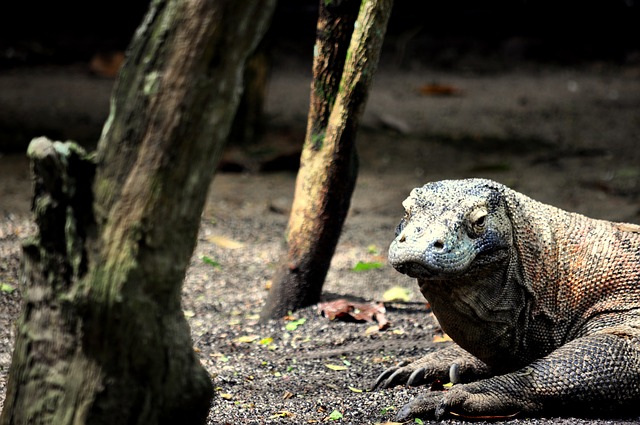
So what would that look like? The scales are small and non-overlapping in our sample, so let’s look at Komodo Dragons and Monitor lizards. 😀
“Nothin’ better than a warm rock on a sunny day…Zzzz” – Komodo Dragon“Hey. Nice day ain’ it?” – Komodo Dragon.“Hi! You wouldn’t have a snack handy would’ya?” – Monitor Lizard
Bonus Question: With this research, I think Alfred could use a bit of a makeover! What would you prefer to see?
A much needed nap after chasing that butterfly
Curious Alfred is curious
Is that the dinner bell?
Playtime!
Which scenario should I use to revamp his profile picture? I’d love to hear your answer in the comments! 🙂




 Why hello there, Dan the Dimetrodon is here for a special visit. He came by all the way from Permian North America, an earlier time than the Triassic period.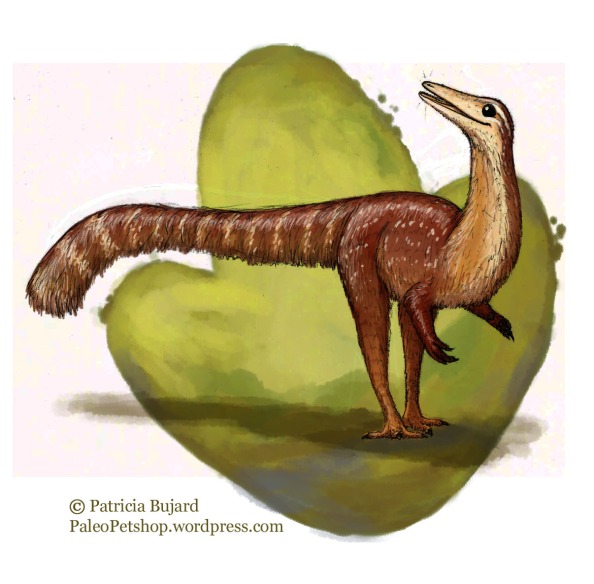







 Pete's Paleo Petshop