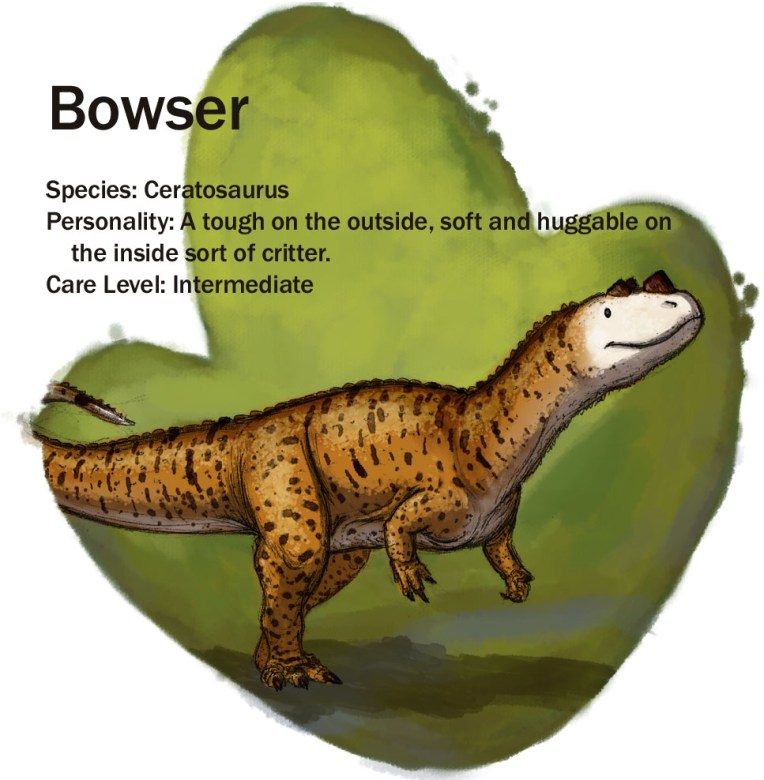
Meet Bowser. Those horns may look intimidating, and his toothy grin can be downright fearsome. But you know what they say about books and their covers… 😉
Bowser is the pit bull of Jurassic predators. He’s buff, he’s tough, and he’ll stop at nothing to protect his special person.
He also has an unfortunate reputation.
Pit bulls are only as bad as their owners. Give them a good home and training- you’ll have a loyal friend that is sweet and adoring.
Bowser is very much the same.
Pete has trained this big guy ever since he was a hatchling, and he never shows his teeth except when chomping down on a meal.
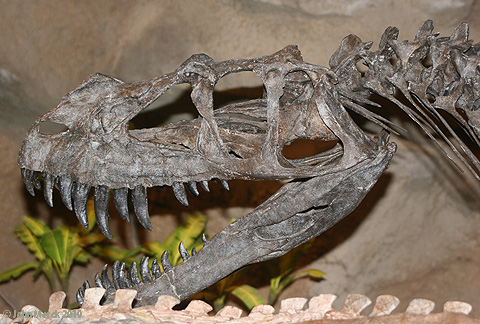
Personally, I’m kinda glad he usually keeps his mouth shut, because take a look at those chompers!
The teeth on this mount may be extra long, because teeth tend to slip out of the socket when there’s no soft tissue to hold them in, but they’re still super long! This is a younger individual, so the horns aren’t as big as Bowser’s. Photo courtesy and copyright of Dr. John Meck. Obtained from qilong.wordpress.com
Making progress…
Yay! Two more trading cards complete. 😀
I’m really liking the idea of printable character cards.
If I asked you, “What is a bird?” What would you say? For most of us (at least for me) the first things that come to mind are feathers, a beak, and usually flight. Oh yes, and lays eggs. If you look out your window, go on a hike, or visit the zoo, it’s easy to recognize birds for what they are.
But what if we went back in time a few million years? It may be harder to pick out the bird from the…not bird, than you think.
Let’s say you’re picking your way through the thick undergrowth of a pine grove. You hear twittering from a branch above you, and you look up to see the tiny singer. It looks like a bird, it acts like a bird, but when it opens its beak to sing you notice tiny teeth.
Is it a bird?
Let’s try another one. Another place, another time.
You look up when you hear the sound of flapping wings above you. At first glance it looks like a bird, but then you notice those long tail feathers are not just feathers. Instead of a long train like a parrot or peacock, this fan is supported by a long tail. A closer look and you notice that this bird has claws on its wings, and a beakless snout with tiny teeth.
Is it a bird?
Let’s take a look at one more.
In another place, another time, we peak through the branches to look out into a clearing. Pecking at the undergrowth is something that looks a bit like an ostrich, or maybe an emu. Shaggy feathers, a toothless beak, and feather-duster wings all look like a big, flightless bird. But no bird has a long tail like that. That tail looks like it belongs on a lizard, if only it wasn’t covered in feathers.
Is it a bird?
At first glance, all three look very much like birds.
The first is an early bird called Sulcavis, which lived around the same time as T-rex, in China.
The second is Archaeopteryx. More dinosaur than bird, and from a much earlier time in Germany. It’s often reported as the first bird, but there are earlier cousins that are more bird than dinosaur.
The third is Gallimimus. If you’ve ever seen the original Jurassic park, these are the featherless “ostrich dinosaurs” that stampede around the heroes. Fossils now tell us that these dinosaurs would look very much like emus and ostriches with tails. 🙂
So how do we know which is which? We can’t define it based on feathers, eggs, or flight. In fact, paleontologists argue quite a bit on exactly what makes something a bird or a dinosaur.
The best answer I have on this insanely complicated subject (because let’s face it, I’m no expert. I’m just a couch enthusiast 😛 )…
All birds, past and present, are dinosaurs. But not all dinosaurs are birds. 😉
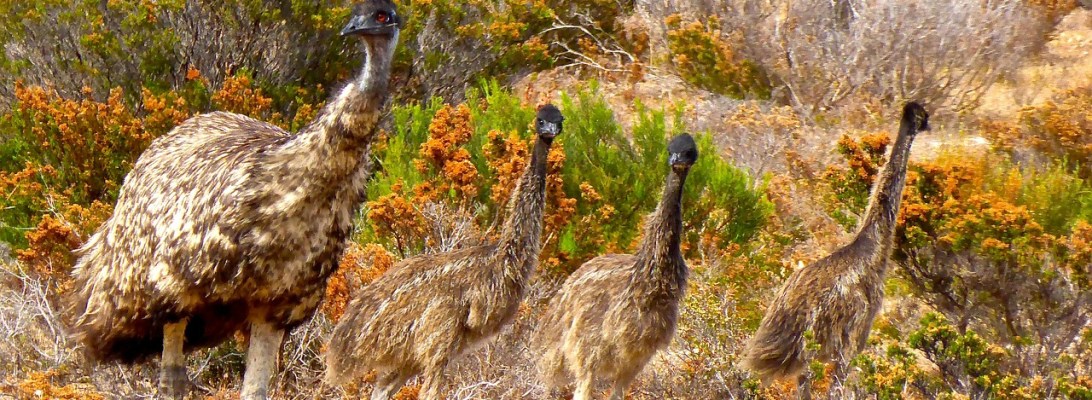
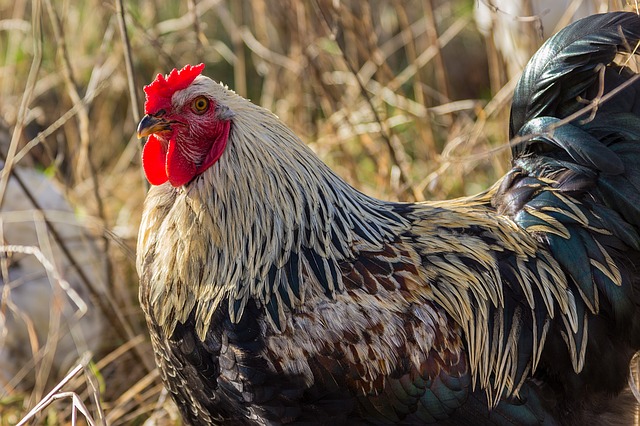
Even this handsome guy. I love the thought of dinosaurs running around my yard and giving me eggs.
Quick Question: What do you think about the relationship of birds and dinosaurs? The discovery of more and more dinosaurs with feathers has turned into a rather hot topic, with passionate feelings on both sides.
Me? I think our entire natural world (and our place in it) is amazing beyond words, so I’m cool with anything the latest research has to dish out. Birds jumping on the dinosaur wagon just adds a whole new dimension of awesome. 😀
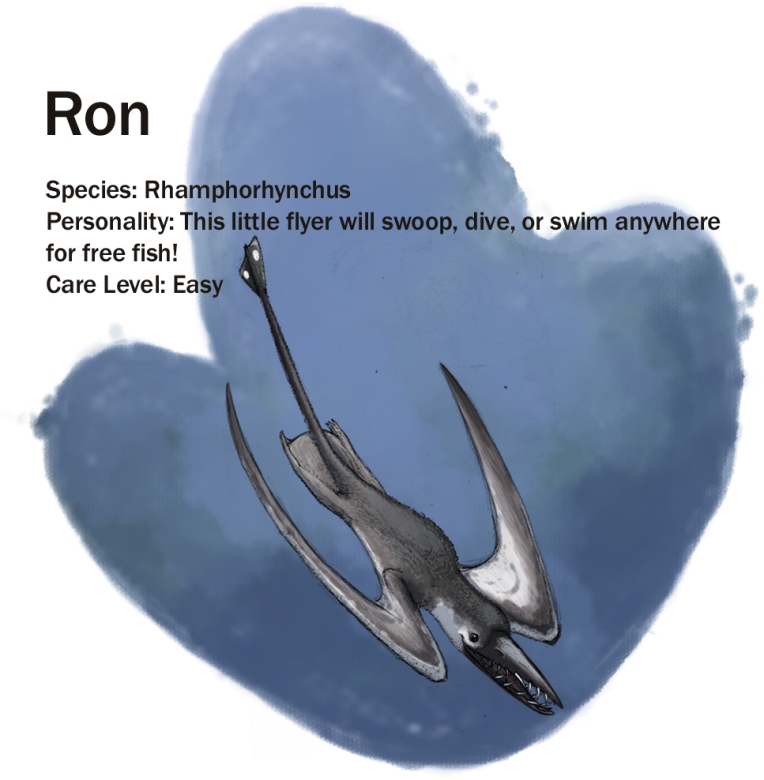
Meet Ron. He’s the flying ace. He’ll swoop from the sky, dive into the water, and swim anywhere for a shiny fish. 🙂
Rrr- just how do you pronounce that? I wasn’t 100% sure on that myself, so I looked it up on Youtube…
There, mystery solved. 🙂 I wonder if there’s one for all the really hard paleo-critter names out there. I may have to include something like this from now on until I figure out a better system.
Oh, and before you ask, yes, there is evidence that pterosaurs can swim. 🙂 Ron here seems to spend most of his time in water, which might be why we have so many perfect fossils of this little guy. 🙂
He’s fast though. It took a whole bucket of fish to entice him to come over for a quick chat.
The big reveal for what I’ve been working on lately (aside from the book of course)…drumroll please…
Little character trading cards!
I’ll be making sets of six. Dinosaurs first, then a set of other prehistoric critters. I’d love to have a fancy set made at some point, but this way I can make them available for free.
Yes! Free printables! I’ve got to admit, I must say I’m quite pleased with the two I’ve made so far. 😀
To add to the fun, here’s a chart of the (currently) planned critters. I’ll color them in as I complete each card. 🙂
Coming Next Week…
He looks tough, but once you get to know him he’s loyal to the core…and more of a softie really. 🙂
When you think of an animal with wings, you usually think of something that can fly right? Bird is one of the first things that pops in my head, and when most of us think of birds, we usually think of birds that fly.
But not all birds fly. Of course, out of all the birds that can’t fly, what’s the first thing that comes to mind. Penguin? Ostrich? Kiwi?
“I believe I can flyyyy!”
Then there’s another category (wait, there’s more?).
Those are the birds that don’t usually fly, the sort of bird that we’re always a bit surprised to hear can actually fly.
Like turkeys. 🙂
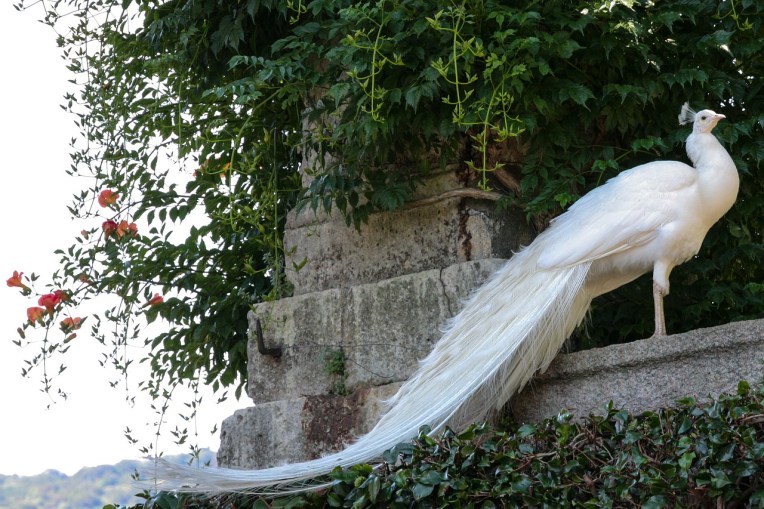
Or peacocks.
Glorious peacock in full formal attire looks down from his high tower and scoffs at human ignorance. He, not able to fly? Preposterous.
So how does this apply to prehistoric critters? Well, there are times when paleontologists aren’t so sure if a bird or other feathered dinosaur could fly. And then there are the times when paleontologists are so sure something could not fly, but then later on down the road new evidence shows up that it might…
So how can you tell for sure?
This is where the guessing game gets fun. We take a look at all the evidence we have, look at modern animals to get more insight on certain relevant details, and then propose our best hypothesis.
Next week, we’ll take a look at one of these discombobulating critters. Until then, enjoy the adorkable awkwardness of a hoatzin clambering about (a lovely bird of the South American Amazon). Landings don’t look like their strong point. 😛
Quick Question: What’s the first bird you think of when I say “bird”? I’ve got kiwis and penguins on the brain since I’ve written this post, but I do love the little songbirds that sing around our yard. I’d love to hear from you in the comments!
Oh, and if you’re seeing this in your inbox (and like what you see), please click on the post’s title. That would mean a lot to me, and help others find the site more easily. Thank you! 🙂
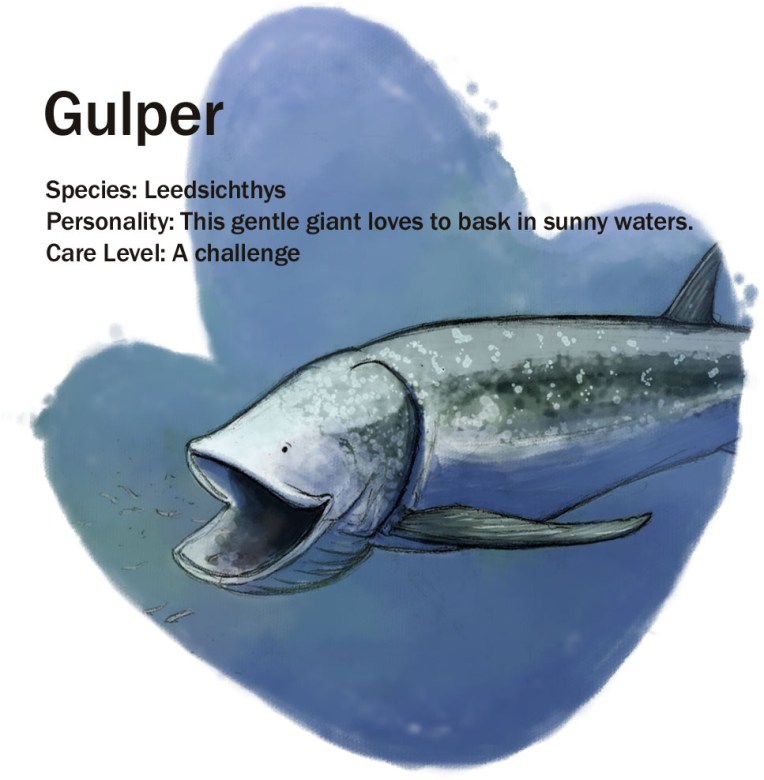
Meet Gulper. He’s the biggest, most easy-going fish in the sea. All he wants in life is to drift through nice sunny waters. He’d love it if you joined him for a swim, and you’re welcome to hitch a ride on his fin. 🙂
Gulper has a giant mouth, but don’t worry, all he eats are tiny sea critters called plankton- just like whales. 🙂
Also like whales, this guy is enormous! Here’s a short video of a whale shark and diver, just to give you a hint on how big they are.
As big as the shark is, Gulper is even bigger. 😀
Probably not much bigger, and most reports you’ll find are greatly exaggerated. But hey- whale shark size is still huge, and anything bigger than that is just about mind blowing!
Just for fun, here’s another clip. This one is from the TV show River Monsters. I’m not a fan of the way he talks about these fish as monsters- Gulper is pretty laid back- but it’s still interesting. Keep in mind the length of the fish is probably exaggerated in the clip. 🙂
Making progress…
This week was better for staying on track. 🙂
I rather like having the A&S posts every two weeks, with a shorter sort of preview post in between. It gives me more time to research on the chosen critter. Good research makes sure the critters are accurate to science, but also lets me know what I can speculate on the details.
So you can look forward to more youtube videos and possibly links to other awesome posts. 🙂
Coming Next Week…
He’s a flying ace! He’ll swoop, dive, and swim anywhere for a shiny fish. 🙂
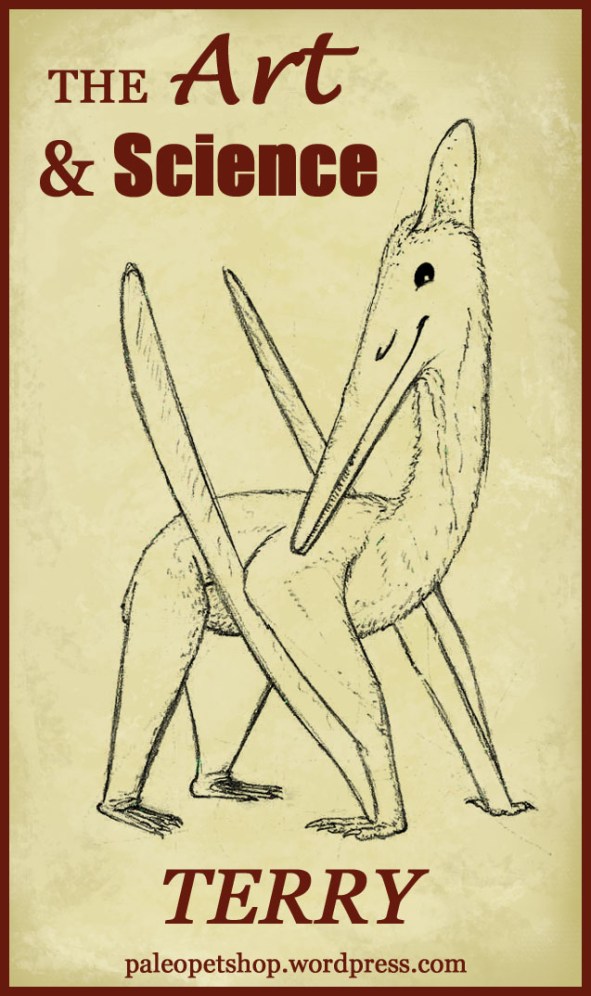
Hi there! Terry is here with us today, a rather odd looking critter isn’t she? If I asked you to tell me what she is, what would your answer be? Flying dinosaur? Terradactyl? Pterosaur?
If you said Pterosaur then clearly you’ve done your homework. If not, don’t feel bad (I’m not pointing fingers), because the sad fact is that most books, movies, toys, and pretty much anything to do with dinosaurs always lump Terry and her many relatives into the same pile.
Terry is a Pterosaur (Don’t mind the P there, it’s confusingly silent), a group of flying reptiles closely related to dinosaurs. To be specific, her wild cousins are Pterodactylus kochi. Pterodactylus is thepterosaur, where we get the name for the whole group. So now you know she’s special. 😀
1. Is that…fur?
Terry, like all pterosaurs, is covered in a fuzzy layer of pycnofibers. They’re made of the same keratinous proteins as our hair and fingernails. But they appear to be hollow inside, which makes them much more like feathers than fur.
I say “appear to be”, because not everyone agrees. Most of the fossils are a bit squashed, and even the 3d fossils can be hard to tell if what fills the space inside was part of the living animal or just more of the fossil (or a part of decomposition after the critter died, but before it fossilized).
Terry and her many relatives are related to dinosaurs in the same way that crocs are related to dinosaurs (They are all Archosaurs). A bit like a great aunt.
Since many dinosaurs are known to have feathers of various kinds, it would be pretty significant if pterosaur pycnofibers are determined to be feathers as well.
How significant? More fluffy dinosaurs! It’s possible that the earliest dinosaurs had a coat of fur-like feathers. 🙂
2. Hard Beak or Fuzzy Snout?
Terry & Ron are both pterosaurs, but look very different from each other. Fuzzy snout vs. hard beak. The difference in texture of fluffy pycnofibers is my own speculation. We don’t really know what these might’ve looked like in life.
Now I’m not quite sure where I first heard of the idea of hard-beaked pterosaurs…I think I remember Petrie from The Land Before Time had a beak. Come to think of it, I guess there are plenty of interpretations with beaky pterosaurs, but I’m not sure how many are based on fossil evidence.
Terry’s friend on the left is a Rhamphorynchus (that’s a mouthful, sorry, let’s call him…Ron). Some illustrate Ron and his wild relatives with just the toothless tip of his snout with a beak, but I’ve based mine off of Mark Witton’s lovely illustration.
Honestly, it’s hard to imagine those crazy teeth with any kind of soft tissue, and that seems to be the argument for a hard beak over the bone.
3. The original pole vaulting masters
Pterosaurs had powerful wings, but their legs weren’t really strong enough to jump up to fly like birds. So does that mean they’re helpless on the ground?
Not at all, look at Terry scamper around!
Pterosaurs were Earth’s first pole vaulting masters. Their powerful wing-arms were strong enough to push their bodies (even the biggest ones) up into the air. Mark Witton proposes that even the largest, giraffe-sized pterosaurs could lift off from the ground. Many could probably take off from the water!
Helpless? I think, not. 🙂 Here’s a quick video so you can see it in action. 🙂
How is it possible?
Unlike birds, pterosaurs have most of their muscle dedicated to their wings. Birds need enough muscle in their legs to jump up before flapping, while pterosaurs pole vault into the air with the same power they use for flying.
So no need to jump off a cliff or wait for warm updrafts of air. 🙂
Quick Question: Ah, the nostalgia of so many movies and documentaries…I must say I still rather like the leathery, cliff-clinging bats in Fantasia (so many great retro-saurs in that one). Are there any pterosaurs from books or movies that have colored how you see these animals? 🙂 I’d love to hear your answer in the comments!
Meet Bella. She’s big, she’s loud, and she’s really happy to see you! She’s happy to see anyone really, except Alfred, but can you blame her? There’s about a-bazillion years of conflict going on there…
There she is! She is the most accommodating of Pete’s very large camarasaurus herd- voted least likely to accidentally trample the equipment. They can be an excitable bunch, and don’t always pay attention to what they’re bumping into. I’ll just say that when Pete finally got her separated from the herd there was a tractor, some flags, an air horn, and a rubber chicken involved…
These Camaras are more closely related to the smaller wild species, C. lentus (there are 3 🙂 ), which are only about 49 feet long. But that’s still a lot of sauropod on the move, especially when you multiply it by 80!
Why so many?
Paleontologists may call Bella the ugliest sauropod, but they’re pretty popular for anyone with plenty of pasture. Their friendly and calm, cow-like attitude makes them an easier alternative to the larger giants like Elmer.
If only they weren’t so loud! But some may call Bella’s singing endearing. It’s lovely to hear their chorus far out to pasture.
Have the video play in the background while you look at Bella above, I can’t help laughing at the mental picture of 50 or 100 of these fat, happy sauropods calling to each other constantly. In a herd of such large animals, you don’t really need stealth. 😀
Making progress…
The past couple of weeks it’s been tough to keep up. I need to rethink how I do things, or get better at more efficient use of my time during the day. One of the two. 😛
I’ve kind of fallen into the bad habit of keeping right on the posts. It feels a bit like plugging holes in a leaky dam. As I get one done, then I’m scrambling to get the next one done, half afraid I won’t be able to keep up.
I’m not saying this to complain of course, just as a way of evaluating where I’m at, in a way that I can look back later and remember where I came from. 🙂 Looking back at earlier posts has been the best way for me to see my progress, slow as it’s been. It keeps me going by knowing how far I’ve come. 🙂
Speaking of earlier posts, I used to have a list of future posts, and I would update information and write little snippets whenever I could. I’ve been kinda scrambling ever since I wrote all the posts on the list.
Time to write up another list! And perhaps have a couple of posts with relevant youtube videos like Monday. If you like those, I can do it a little more often. 🙂
Coming Next Week…
This giant likes to bask in warm, sunny waters. He’d be super easy to care for if only the tank didn’t need to be the size of the Mediterranean…
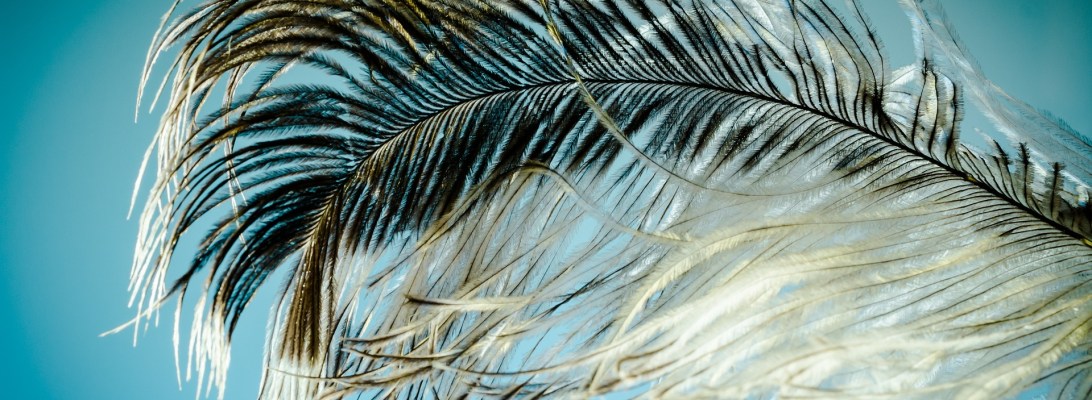
It’s about time that we have a short chat on feathers. They are very complex, beautiful structures, and you could probably write entire books about them, but we’ll just cover a couple of things I didn’t know about until I researched it (Pretty cool when something so ordinary becomes amazing, just by taking a closer look).
Feathers are keratinous (like our hair or fingernails) structures that grow from the skin, and there are many different forms that serve many different functions. Here’s a video where we can see the basic structure of a feather quite nicely. 🙂
These feathers are like the peacock feather. The shaft, or rachis, branches off into many barbules, but those barbules don’t have the little hooks that ziplock together. Since Emu’s don’t fly or swim much, there’s no need for the streamlined contour feathers flying birds have.
Emus have no problem with staying dry in the rain, because just like any other bird, they spend a good part of their day combing their beaks through their feathers and coating them with oil from a gland near the base of their tails.
Here’s another video, this one about how varied feather shapes can be, and what they can be useful for. It focuses on birds of paradise and their crazy display plumage, but try to think about what it means for other feathered, flightless animals (like feathered dinos), and how they might use feathers. 🙂
Next week, we’ll finally get to see the Art & Science of little Terry. Keeping this post in mind will help keep that one short, because flying reptiles like Terry are rumored to have a fluffy coat of feathers… 😉
Quick Question: What was your favorite out of the wacky feathers displayed by the birds of paradise? Do you think feathered dinosaurs could’ve had similarly weird and wonderful feathers? I’d love to hear your answer in the comments! 😀
A sneak-peak for this week’s critter of the week. I’m afraid I’ve had a bit of trouble wrangling Bella. She won’t leave her friends when they’re in the middle of choir practice.
Maybe it’s the squarish shape of her snout, her stout proportions, and that thick, kinda stumpy neck (for a longneck anyway)…but for some reason poor Bella is often quoted as the “ugliest of sauropods”.
Beauty is in the eye of the beholder, and Bella certainly doesn’t care about beauty contests. She’d much rather sing with the other hundred Camarasaurus in the herd.
Just imagine hearing a hundred of these first thing in the morning… XD
Just sit tight and listen to those busy longnecks gossip. I’m sorry to keep you waiting, but just like any animals, these dinos can be a bit of a handful to handle. I’ll have to see if Pete will help me with the tractor…I’ll be back with Bella as soon as I can!






 Pete's Paleo Petshop